
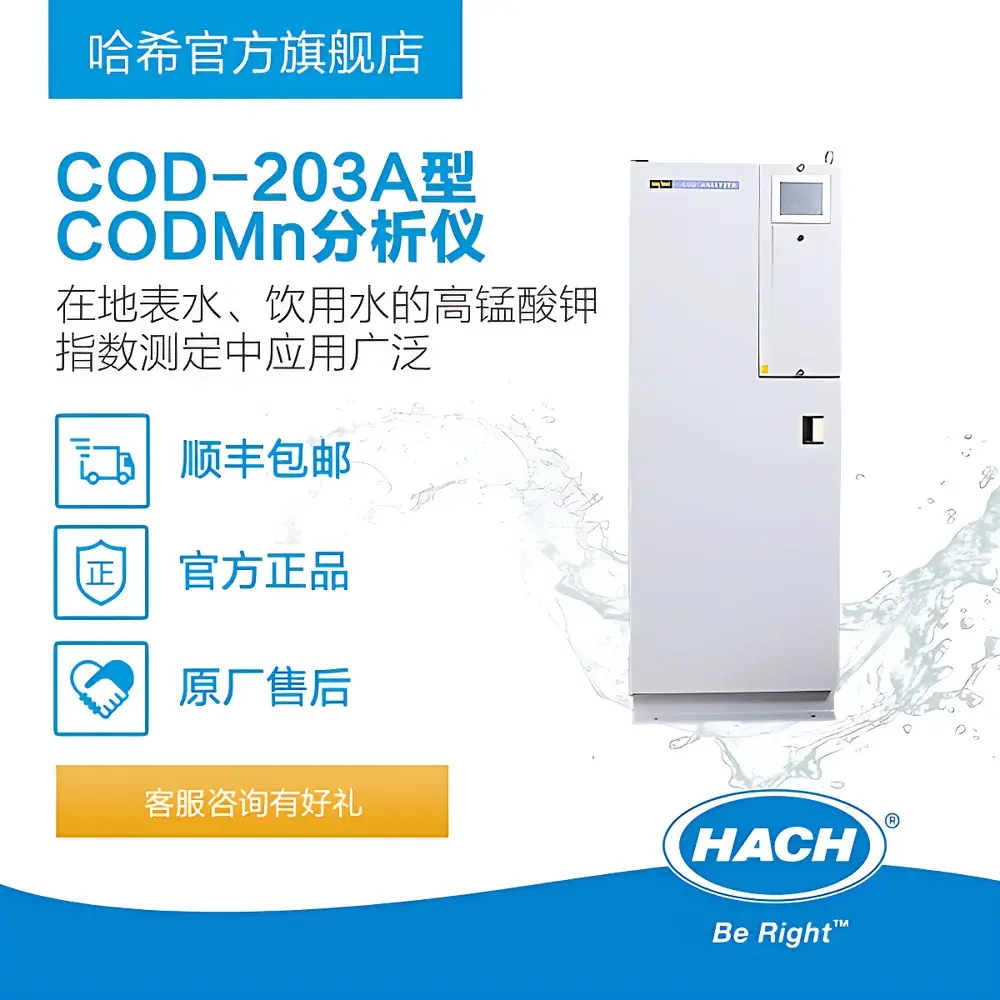
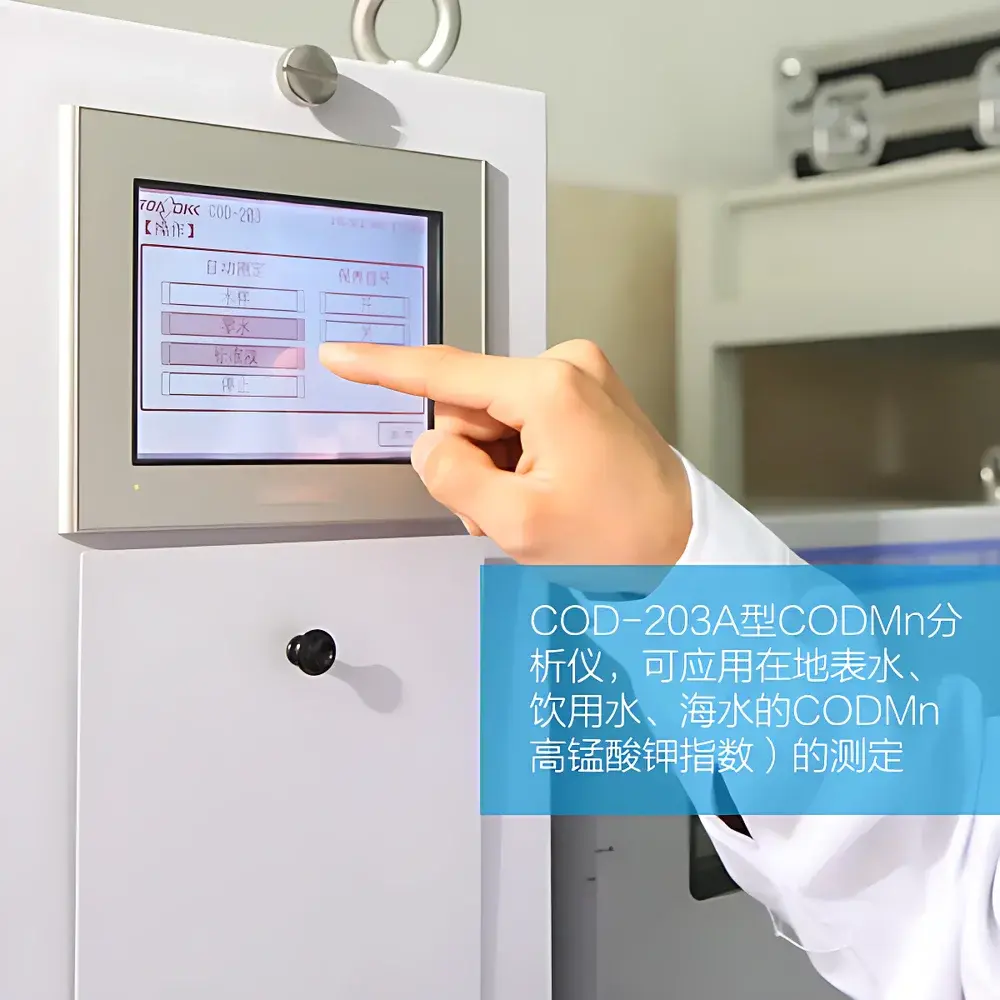
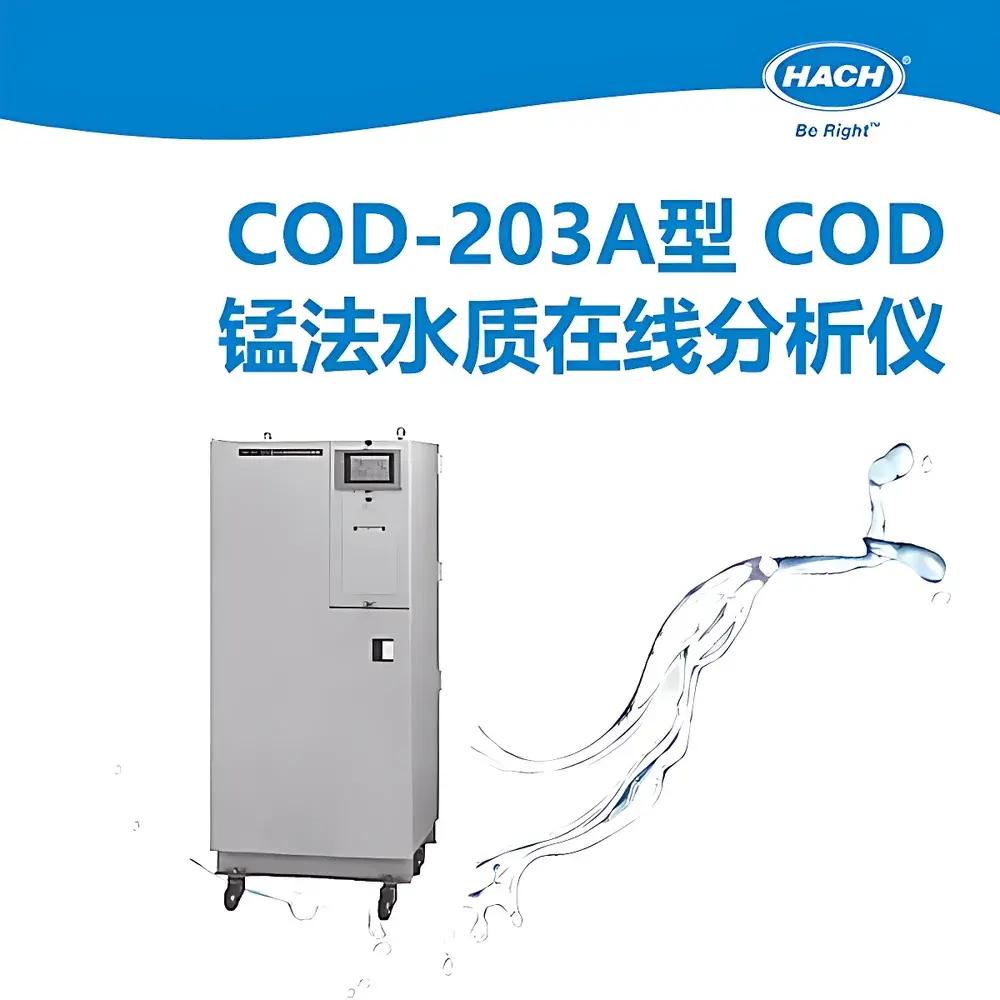
Hach COD-203A Permanganate Index (CODMn) Analyzer
| Brand | Hach |
|---|---|
| Origin | Imported |
| Manufacturer Type | Original Equipment Manufacturer (OEM) |
| Measurement Principle | Potassium Permanganate Oxidation with ORP Endpoint Detection |
| Range | 0–20 mg/L and 0–2000 mg/L |
| Repeatability | ±1% FS (0–20 mg/L), ±2% FS (20–200 mg/L), ±5% FS (>200 mg/L) |
| Resolution | 0.01 mg/L |
| Single-Test Duration | 60 minutes |
| Display | LCD |
| Stability | Zero Drift ±3% FS |
| Operating Environment | Indoor installation |
| Sample Temp. | 5–40°C, Ambient Pressure |
| Sample Volume per Test | 500 mL |
| Analog Output | 4–20 mA (max. load 600 Ω) |
| Power Supply | 220 VAC, 50/60 Hz |
| Power Consumption | Max. 550 VA, Avg. 200 VA |
| Dimensions | 600 × 600 × 1600 mm |
| Weight | 150 kg |
| Data Storage | 14-day onboard logging |
| Optional Accessories | Thermal printer interface |
| Maintenance Frequency | Low (automated line flushing, air-jet nozzle for titration tip) |
Overview
The Hach COD-203A Permanganate Index (CODMn) Analyzer is a fully automated, laboratory-grade online instrument engineered for precise, unattended determination of the permanganate index in surface water, raw drinking water, and low-organic-content aqueous matrices. It implements the standardized acidic or alkaline potassium permanganate oxidation method—per ISO 8467:2021 and APHA Standard Methods 5210 B—followed by potentiometric endpoint detection via oxidation-reduction potential (ORP) measurement. Unlike colorimetric or spectrophotometric alternatives, this system relies on electrochemical titration kinetics to deliver traceable, interference-resistant results across two dynamic ranges (0–20 mg/L and 0–2000 mg/L as O₂). Its design prioritizes long-term operational stability in municipal and regulatory monitoring environments where compliance with national and international water quality directives (e.g., EU Drinking Water Directive 2020/2184, China’s GB 3838–2002) requires auditable, GLP-aligned measurement protocols.
Key Features
- ORP-based endpoint detection ensures high specificity for permanganate-mediated oxidation, minimizing false positives from chloride, nitrite, or Fe²⁺ interferences common in conventional dichromate-based COD assays.
- Patented pneumatic line-flushing mechanism activates prior to each analysis cycle, eliminating sediment accumulation and preventing clogging without electromagnetic valves—enhancing system robustness and reducing mean time to failure (MTTF).
- Integrated air-jet nozzle at the titration tip prevents MnO₂ precipitate adhesion, maintaining consistent delivery accuracy over extended deployment periods (≥6 months between maintenance interventions).
- Configurable measurement intervals: programmable periodic sampling at user-defined intervals (1–6 hours), or on-demand triggered analysis via external command signal (e.g., PLC or SCADA handshake).
- Onboard data logger retains 14 days of timestamped results, including raw ORP curves, endpoint volume, calculated CODMn value, and system diagnostic flags—exportable via RS-232 or optional USB interface.
- Compliant analog output (4–20 mA) supports direct integration into existing DCS or LIMS infrastructure, with galvanic isolation and configurable scaling per range segment.
Sample Compatibility & Compliance
The COD-203A is validated for use with turbidity ≤10 NTU, suspended solids <50 mg/L, chloride <300 mg/L, and pH 4–9 samples—conditions typical of protected surface water intakes and pre-treatment stages in waterworks. It conforms to ISO/IEC 17025:2017 requirements for measurement uncertainty estimation and supports audit-ready documentation for regulatory submissions under EPA Method 410.4 (Permanganate Oxidizability) and ISO 8467. All calibration and validation procedures—including blank correction, standard addition, and spike recovery—are executable directly through the front-panel interface, with full traceability to NIST-traceable KMnO₄ reference standards.
Software & Data Management
The embedded firmware provides password-protected access levels (Operator, Technician, Administrator) and maintains an immutable audit trail compliant with FDA 21 CFR Part 11 requirements: all parameter changes, calibration events, and result modifications are time-stamped, user-identified, and non-erasable. Data export supports CSV format compatible with LIMS platforms (e.g., LabWare, STARLIMS) and statistical process control (SPC) tools. Optional Hach Insight™ cloud connectivity enables remote diagnostics, predictive maintenance alerts, and centralized fleet management across multi-site deployments.
Applications
- Real-time monitoring of source water quality at reservoirs and river intakes
- Performance verification of pre-oxidation and coagulation-flocculation units in drinking water treatment plants
- Long-term trend analysis for watershed health assessment programs
- Regulatory reporting for national water quality inventories (e.g., USGS NWIS, China’s National Surface Water Monitoring Network)
- Research applications requiring high-reproducibility CODMn data under controlled thermal conditions (100°C bath maintained within ±0.5°C)
FAQ
What sample pretreatment is required before analysis?
No filtration or centrifugation is needed if suspended solids remain below 50 mg/L. For higher turbidity, a 0.45-µm membrane filter is recommended—though excessive particulate load may require inline coarse filtration upstream of the analyzer.
Can the instrument switch between acidic and alkaline digestion modes automatically?
No—the digestion mode (acidic or alkaline) must be manually configured during setup and remains fixed per installation; method selection follows regional regulatory mandates (e.g., acidic for EU compliance, alkaline for certain Asian protocols).
Is the 0.01 mg/L resolution achievable across the full 0–2000 mg/L range?
Resolution is hardware-limited to 0.01 mg/L in the 0–20 mg/L range; above 20 mg/L, displayed values are rounded to 0.1 mg/L for metrological consistency with defined repeatability specifications.
How is reagent consumption managed and monitored?
Reagent volumes are metered via precision peristaltic pumps with integrated flow verification; low-reagent alerts trigger visual and relay outputs, and total dispensed volume is logged daily for inventory forecasting.
Does the system support third-party calibration verification standards?
Yes—certified reference materials (CRMs) from LGC, AccuStandard, or NIST can be loaded as validation standards; recovery calculations and bias reports are auto-generated per ISO Guide 35 and ILAC-G8.
Related Products







