
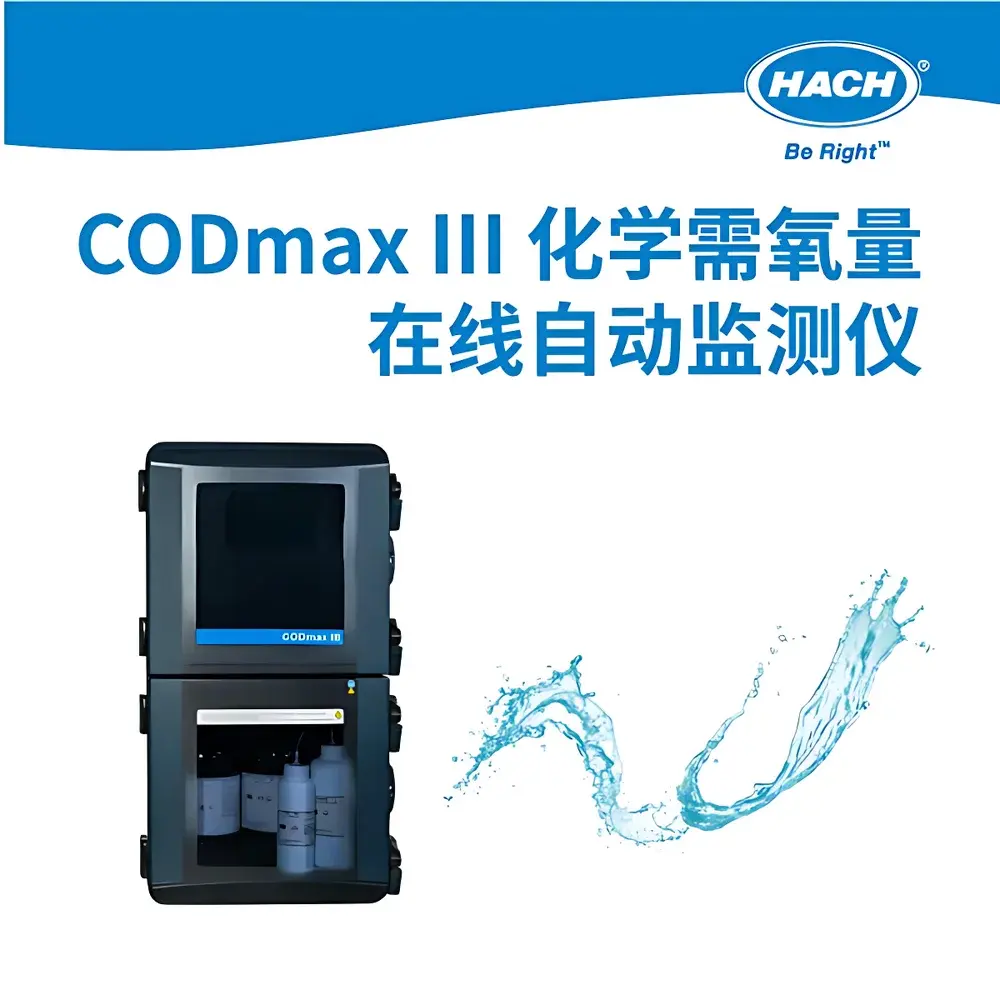

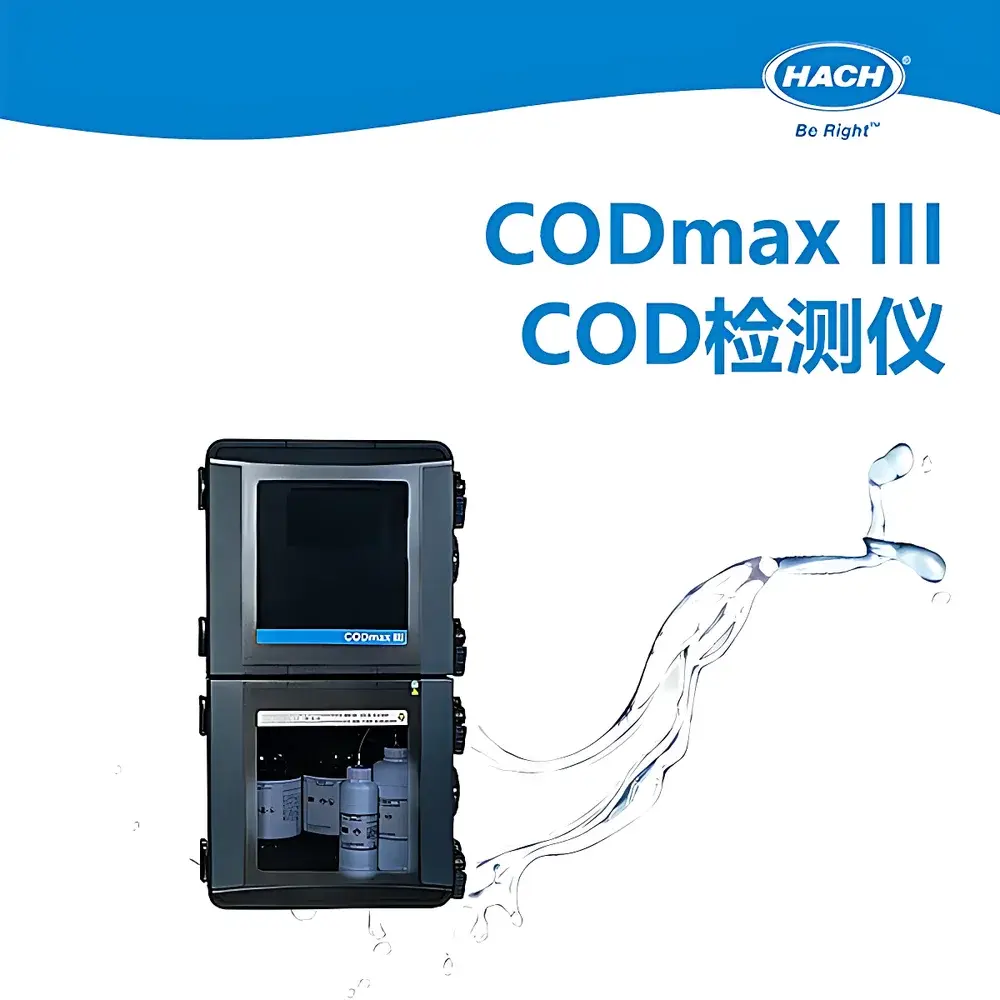
Hach CODmax III Online Chemical Oxygen Demand Analyzer
| Brand | Hach |
|---|---|
| Origin | Imported |
| Manufacturer Type | Manufacturer |
| Model | CODmax III |
| Instrument Type | Online Analyzer |
| Measurement Principle | Potassium Dichromate Digestion Method (High-Temperature Closed-System Digestion) |
| Detection Wavelength | LED at 620 nm |
| Measurement Range | 10.0–5,000 mg/L COD |
| Accuracy | ±10% (10.0–39.9 mg/L), ±6% (40.0–99.9 mg/L), ±3% (100.0–5,000.0 mg/L) |
| Optical Metrology | Multi-stage photometric dosing system |
| Sample Introduction | Precision piston pump with >12-month service life |
| Maintenance Interval | Extended via anti-fouling measurement cycle |
| Diagnostics | Integrated Prognosys predictive diagnostics and Diagnose self-diagnostic engine |
| Compliance | Fully aligned with HJ 377–2019, HJ 35X–2019, and method-equivalent to HJ 828–2017 |
Overview
The Hach CODmax III Online Chemical Oxygen Demand Analyzer is an industrial-grade, fully automated water quality monitoring system engineered for continuous, regulatory-compliant COD measurement in demanding effluent and surface water applications. It implements the standardized potassium dichromate digestion method under controlled high-temperature, closed-system conditions—mirroring the reference laboratory procedure defined in China’s HJ 828–2017 while meeting the operational and data integrity requirements of HJ 377–2019 (for online COD analyzers) and HJ 35X–2019 (for automatic wastewater monitoring systems). Unlike portable or benchtop variants, the CODmax III operates as a fixed-installation analyzer with integrated sample conditioning, reagent delivery, thermal digestion, photometric detection at 620 nm, and intelligent data handling—all housed within a robust, IP65-rated enclosure suitable for outdoor or wet-process environments. Its core architecture prioritizes long-term stability, minimal operator intervention, and metrological traceability to national standard methods.
Key Features
- Anti-fouling measurement protocol: Dynamically adjusts digestion duration, reagent dosage, and optical path cleaning frequency based on real-time sample turbidity and organic load—extending maintenance intervals for sampling probes, metering valves, and digestion cells by up to 3× compared to conventional online COD analyzers.
- Piston-pump fluid handling: High-precision ceramic-coated piston pump ensures consistent volumetric delivery over >12 months of continuous operation; designed to withstand abrasive suspended solids and variable viscosity without calibration drift.
- Multi-stage optical metrology: Combines dual-beam photometry with temperature-compensated LED source (620 nm) and solid-state detector array to minimize stray light interference and improve low-range precision (<50 mg/L COD) through dynamic signal averaging and baseline correction.
- Reagent flexibility: Supports both factory-prepared Hach-certified reagents (with QR-coded lot traceability) and user-formulated reagents compliant with HJ 828–2017 specifications—reducing preparation time by ≥40% versus legacy protocols.
- Prognosys predictive diagnostics: Continuously monitors 28+ internal parameters (e.g., digestion temperature ramp rate, reagent depletion rate, optical signal decay slope) and displays actionable maintenance forecasts as progress bars on the local HMI; also exports predictive alerts via Modbus TCP or 4–20 mA analog output.
- Diagnose self-test suite: Executes automated functional verification of all critical subsystems—including peristaltic pumps, heating elements, photodiode response, and valve actuation—upon power-up and at configurable intervals; logs diagnostic history with timestamps for GLP/GMP audit readiness.
Sample Compatibility & Compliance
The CODmax III is validated for use with municipal influent/effluent, industrial wastewater (including textile, food processing, chemical, and pharmaceutical discharges), and ambient surface water. It accommodates samples with TSS ≤ 200 mg/L and chloride concentrations up to 2,000 mg/L (with optional chloride compensation module). All measurement outputs comply with data formatting and reporting requirements of HJ 353–2019 (data transmission standards for pollution source monitoring) and support integration into national environmental monitoring platforms (e.g., China’s National Monitoring Network). Firmware includes built-in audit trails, electronic signatures, and data encryption—meeting foundational expectations for ISO/IEC 17025-aligned laboratories and supporting alignment with US EPA Method 410.4 and ISO 6060 principles where applicable.
Software & Data Management
Embedded firmware v4.2 provides local configuration via touchscreen HMI or remote access via secure HTTPS interface. Measurement data—including raw absorbance values, digestion temperature profiles, reagent consumption logs, and diagnostic event timestamps—are stored internally for ≥90 days and exportable via USB or FTP. The system supports OPC UA and Modbus TCP for seamless SCADA/DCS integration. Optional Hach DataSuite software enables trend analysis, alarm threshold customization, report generation (PDF/CSV), and comparison against lab reference data using statistical tools (e.g., Passing-Bablok regression, Bland-Altman plots). All data modifications are logged with user ID, timestamp, and reason code—ensuring compliance with ALCOA+ (Attributable, Legible, Contemporaneous, Original, Accurate, Complete, Consistent, Enduring, Available) data integrity principles.
Applications
- Continuous discharge monitoring at municipal wastewater treatment plant inflow and outfall points
- Real-time process control in industrial pretreatment units (e.g., electroplating rinse water, brewery spent wash, pulp & paper mill effluent)
- Regulatory compliance verification for enterprises subject to China’s “Total Discharge Control System”
- Trend-based early warning for biological treatment system upset (e.g., shock loading, toxicity events)
- Long-term water quality assessment in rivers, lakes, and reservoirs under national ecological monitoring programs
FAQ
Does the CODmax III meet international regulatory standards such as ISO or EPA methods?
It is method-validated against HJ 828–2017, which is technically equivalent to ISO 6060 and US EPA Method 410.4. While not certified to ISO/IEC 17025 itself, its performance characteristics and documentation support use in ISO-accredited labs.
Can the instrument operate reliably in high-chloride wastewater?
Yes—standard configuration handles chloride up to 2,000 mg/L; optional chloride compensation module extends range to 10,000 mg/L via silver nitrate precipitation and filtration.
Is remote firmware update supported?
Yes—secure over-the-air (OTA) updates are available via authenticated HTTPS connection; all updates include cryptographic signature verification and rollback capability.
What is the recommended calibration verification frequency?
Daily zero/span checks using certified KHP standards are advised; full multi-point calibration every 7 days or after reagent batch change, per HJ 377–2019 Annex C.
How does Prognosys differ from conventional fault alarms?
Prognosys identifies degradation trends (e.g., gradual heater efficiency loss) 72–120 hours before failure thresholds are breached—enabling scheduled maintenance instead of reactive downtime.
Related Products







