
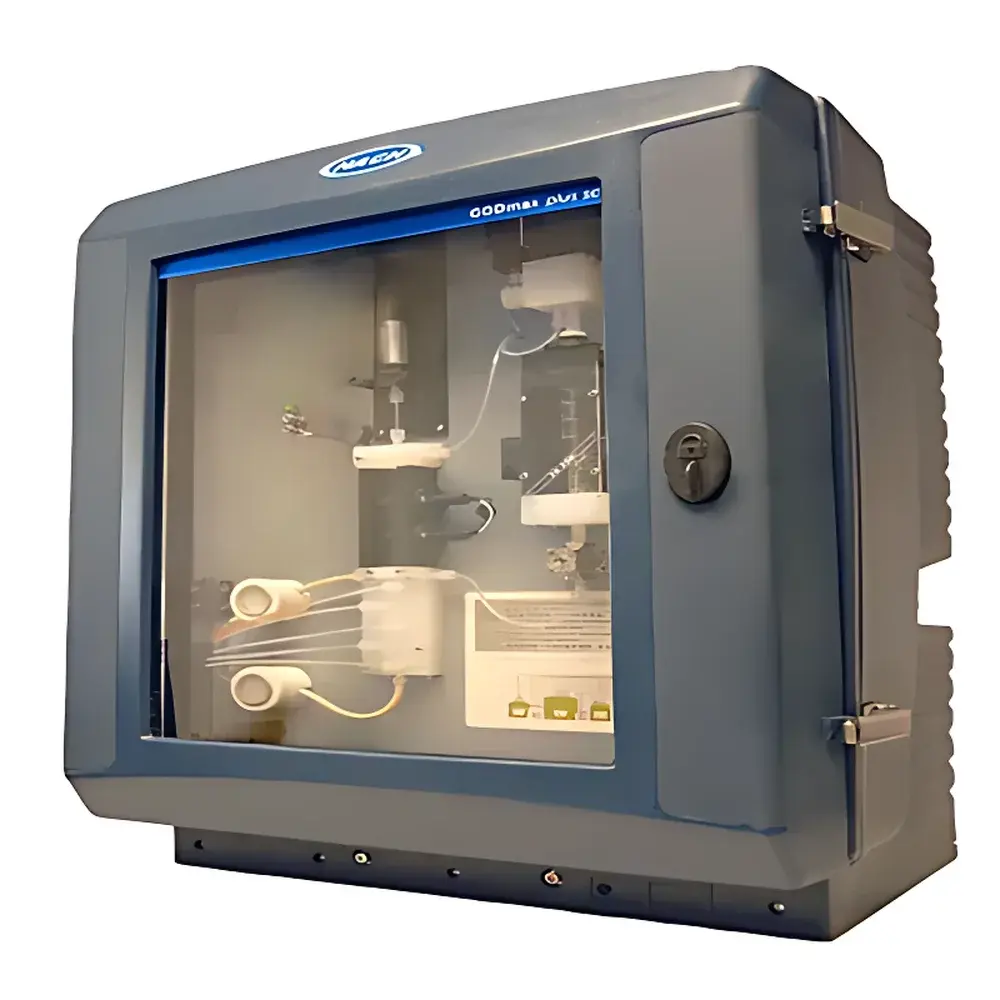
HACH CODmax plus sc Online Chemical Oxygen Demand Analyzer (Cr(VI) Method)
| Brand | HACH |
|---|---|
| Origin | Imported |
| Manufacturer Type | Manufacturer |
| Instrument Type | Online Analyzer |
| Measurement Principle | Potassium Dichromate Digestion Method (Online) |
| Wavelengths | 420 nm (Low Range), 610 nm (High Range) |
| Measurement Range | 10–5000 mg/L COD |
| Accuracy | ±8% of reading |
| Repeatability | ≤3% RSD |
| Detection Limit | 10 mg/L COD |
| Cycle Time | 20 min (standard digestion time |
| Operation Mode | Continuous measurement |
| Compliance | GB 11914–1989, ASTM D1252–2022 (Method B), ISO 6060:1989 |
Overview
The HACH CODmax plus sc is a fully automated, online chemical oxygen demand (COD) analyzer engineered for continuous, unattended monitoring of wastewater and industrial effluent streams. It implements the standardized open-reflux potassium dichromate digestion method—aligned with China’s national standard GB 11914–1989 and internationally recognized protocols including ASTM D1252–2022 (Method B) and ISO 6060:1989. Unlike spectrophotometric or electrochemical surrogates, this system delivers primary-reference-grade COD quantification by thermally oxidizing organic matter in acidic dichromate solution under controlled reflux conditions, followed by photometric determination of residual Cr(VI) at dual wavelengths (420 nm for low-range samples, 610 nm for high-range). The instrument is designed for integration into HACH’s sc200 or sc1000 universal controller platforms, enabling centralized configuration, data aggregation, and regulatory-compliant audit trails.
Key Features
- Configurable digestion duration (3–120 minutes) to accommodate variable matrix complexity and regulatory requirements
- Five-point user-defined calibration capability, supporting non-linear response modeling for improved accuracy across full 10–5000 mg/L range
- Chloride interference correction algorithm, compensating for up to 2000 mg/L Cl⁻ without manual dilution or mercury sulfate addition
- Automated system cleaning cycle integrated into each analysis sequence, minimizing carryover and fouling in high-solids applications
- Modular reagent delivery architecture with sealed, pre-filled reagent packs—designed for ≥30 days of continuous operation at 30-min digestion interval and daily calibration
- Embedded dual 4–20 mA analog outputs (500 Ω max load) and two programmable 24 VDC/1 A relays for direct PLC interfacing or alarm signaling
- Front-access service design reducing routine maintenance to ≤60 minutes per month—no tools required for tubing replacement or optical cell inspection
Sample Compatibility & Compliance
The CODmax plus sc accepts raw influent, secondary effluent, and industrial process water with suspended solids ≤150 mg/L and temperature stability within 5–40 °C ambient. It meets GLP-aligned operational traceability requirements when deployed with sc200/sc1000 controllers equipped with SD-card logging and time-stamped event records. Data integrity conforms to FDA 21 CFR Part 11 principles via electronic signature-capable controller firmware (v3.2+), supporting audit-ready export of calibration logs, maintenance history, and raw absorbance values. All wetted components comply with USP Class VI biocompatibility standards, and housing meets IP65 ingress protection rating for indoor cabinet or sheltered outdoor installation.
Software & Data Management
Control and diagnostics are managed exclusively through HACH’s sc platform firmware, accessible via local touchscreen or remote web interface (HTTPS-secured). The system supports scheduled or event-triggered measurements (e.g., flow-proportional sampling), automatic zero/span verification, and drift-compensated baseline correction. Historical measurement data—including absorbance at both wavelengths, digestion temperature profile, and reagent consumption counters—is stored on removable SD cards (formatted FAT32, ≥4 GB) with timestamped .CSV exports compatible with LIMS and SCADA systems. Modbus RTU/TCP and PROFIBUS DP-V1 protocols are natively supported for enterprise-level integration without third-party gateways.
Applications
This analyzer is deployed in municipal wastewater treatment plants for real-time compliance reporting against discharge permits (e.g., China’s GB 8978–1996, EU Urban Wastewater Treatment Directive 91/271/EEC). It serves pulp & paper mills requiring rapid detection of organic loading shifts during bleaching stage transitions, and pharmaceutical manufacturing facilities needing batch-release verification per ICH Q5C guidelines. In food processing plants, it monitors equalization tank dynamics prior to biological treatment—enabling adaptive aeration control. Its robustness in high-chloride brines (e.g., seafood processing outfalls) and resistance to sulfide-induced electrode poisoning differentiate it from UV-based or titrimetric alternatives.
FAQ
What digestion methods does the CODmax plus sc support?
It implements only the open-reflux potassium dichromate method per GB 11914–1989 and ASTM D1252–2022 Method B. No closed-vessel or microwave digestion options are available.
Can the instrument operate without an sc-series controller?
No. The CODmax plus sc requires either an sc200 or sc1000 controller for power management, timing synchronization, data logging, and user interface functionality.
Is method validation documentation provided?
Yes—HACH supplies a Factory Acceptance Test (FAT) report, including linearity verification across five certified reference materials (CRMs), repeatability testing per ISO 5725-2, and interference studies per EPA Method 410.1.
How often must reagents be replaced?
Under continuous operation at 30-minute digestion intervals and daily 5-point calibration, one reagent pack lasts ≥30 days. Reagent level monitoring is automated and reported via controller alarm status.
Does the system meet cybersecurity requirements for Industry 4.0 deployments?
When configured with sc1000 v4.1+ firmware and TLS 1.2 encryption enabled, it satisfies IEC 62443-3-3 SL2 requirements for secure remote access and firmware update authentication.
Related Products







