
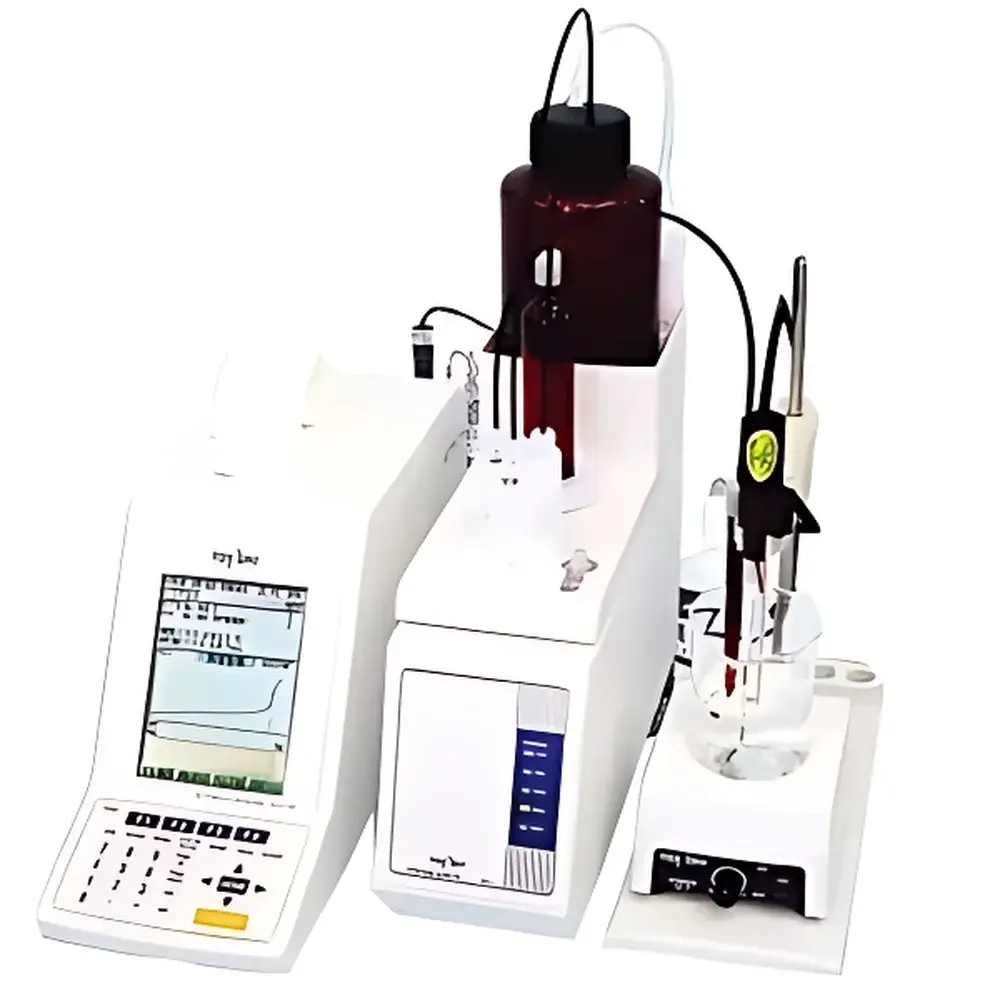
HACH DKK AUT-701 Automatic Potentiometric Titrator
| Brand | HACH |
|---|---|
| Origin | Japan |
| Manufacturer Type | Original Equipment Manufacturer (OEM) |
| Origin Category | Imported |
| Model | AUT-701 |
| Instrument Type | General-purpose Potentiometric Titrator |
| Application Scope | Universal |
| pH Measurement Range | 0–14 |
| Burette Reading Accuracy | ±0.01 mL |
| Burette Resolution | 0.00005 mL |
| Titration Precision | ±0.1% |
| Simultaneous Titration Channels | 2 |
| Electrode Inputs | Up to 4 (pH/mV standard |
| Maximum Burettes Supported | 10 |
| Data Storage Capacity | 100 methods per system (expandable to 200) |
| Connectivity | USB (hot-swappable), LAN (standard), RS-232 (optional) |
| Validation Support | Built-in electrode calibration logging, burette volume verification, optional temperature/humidity environmental monitoring |
Overview
The HACH DKK AUT-701 Automatic Potentiometric Titrator is an engineered platform for high-reproducibility, multi-parameter electrochemical titration in regulated laboratory environments. Based on the principle of potentiometric endpoint detection—measuring potential shifts across a reference/indicator electrode pair during controlled reagent addition—the AUT-701 delivers precise stoichiometric quantification of analytes including acids, bases, redox-active species, halides, and chelatable metals. Its dual-channel architecture enables concurrent, independent titrations—such as simultaneous pH and ORP titration—without cross-interference, significantly improving throughput in QC/QA, environmental testing, and pharmaceutical release laboratories. Designed and manufactured in Japan under strict ISO 9001-certified processes, the instrument complies with core analytical requirements outlined in ASTM E2087, ISO 8655-6 (burette performance), and USP for volumetric analysis.
Key Features
- Dual independent titration systems: Two fully isolated burette assemblies, each with dedicated electrode inputs, drive mechanisms, and real-time endpoint algorithms—enabling parallel pH and redox titrations or duplicate sample analysis under identical conditions.
- Modular electrode interface: Standard pH/mV inputs plus two configurable slots supporting optional photometric, polarographic, conductometric, or differential potentiometric cells—allowing method flexibility across acid-base, precipitation, complexometric, and redox titrations.
- Ultra-high-resolution dispensing: 0.00005 mL resolution combined with ±0.01 mL absolute reading accuracy and ±0.1% volumetric precision meets stringent traceability requirements for GLP/GMP workflows.
- Validation-ready architecture: Integrated logging of electrode calibration history (including slope, offset, response time), burette volume verification cycles, and optional environmental monitoring (via external temperature/humidity sensor) supports FDA 21 CFR Part 11-compliant audit trails when paired with validated software.
- Expandable automation ecosystem: Native support for HACH DKK accessories—including TTT-510 rotary autosampler (up to 50 positions), AST-3210 automatic sample handler, precision analytical balances, and LIMS integration via TCP/IP—enables end-to-end unattended operation.
- Intuitive human-machine interface: 7-inch full-color TFT-LCD display with touch navigation, context-sensitive soft keys, and real-time titration curve visualization simplifies method development and operator training.
Sample Compatibility & Compliance
The AUT-701 accommodates aqueous and non-aqueous samples across diverse matrices—including wastewater, pharmaceutical intermediates, food extracts, and industrial process streams—when paired with application-specific electrodes (e.g., micro-pH composite electrodes for low-volume samples, Ag/AgCl silver electrodes for halide titrations). All hardware and firmware adhere to IEC 61010-1 safety standards and electromagnetic compatibility (EMC) directives (EN 61326-1). For regulated environments, the system supports IQ/OQ documentation packages and is compatible with third-party validation services aligned with ISO/IEC 17025 and Annex 11 requirements.
Software & Data Management
Data acquisition and method management are handled via DKK’s proprietary TitraWin software (Windows-based, optional license), which provides electronic signature capability, role-based user access control, and encrypted database storage. Each titration event records raw mV/pH vs. volume data, derivative curves, equivalence point calculations (1st/2nd derivative, Gran plot, inflection), and metadata (operator ID, timestamp, ambient conditions if monitored). Export formats include CSV, PDF reports (with customizable templates), and XML for LIMS ingestion. Local storage retains 100 complete titration records per channel (expandable to 200 via SD card or network share), with automatic overwrite protection for flagged results.
Applications
- Environmental: Alkalinity and acidity titrations per EPA Method 310.1; chloride determination in drinking water (Mohr or potentiometric); COD back-titration.
- Pharmaceutical: Assay of active ingredients (e.g., ibuprofen, ascorbic acid) per USP monographs; residual titrant verification in cleaning validation.
- Food & Beverage: Total acidity (TA) in wines and juices; salt content in processed foods; preservative (sorbate/benzoate) quantification.
- Chemical Manufacturing: Concentration verification of NaOH/HCl stock solutions; catalyst residue analysis; quality control of surfactants and chelating agents.
FAQ
Does the AUT-701 support Good Laboratory Practice (GLP) compliance?
Yes—when configured with TitraWin software, optional environmental sensors, and appropriate SOPs, the system supports ALCOA+ data integrity principles, including attributable, legible, contemporaneous, original, and accurate recordkeeping.
Can the instrument perform thermometric or coulometric titrations?
No—the AUT-701 is designed exclusively for potentiometric, photometric, conductometric, polarographic, and amperometric endpoint detection. Thermometric and coulometric modes require dedicated instrumentation.
Is remote monitoring or control possible over LAN?
Yes—via standard TCP/IP protocols, authorized users can initiate methods, view real-time progress, and retrieve completed reports using a web browser or custom API integration.
What maintenance intervals are recommended for the burette system?
Burette piston seals should be inspected every 6 months or after 10,000 dispensing cycles; calibration verification is required before each analytical batch or daily in high-throughput labs.
Are firmware updates provided by HACH DKK?
Yes—HACH distributes validated firmware revisions through its global support portal, including security patches, regulatory alignment updates (e.g., enhanced 21 CFR Part 11 features), and minor functional enhancements.





