
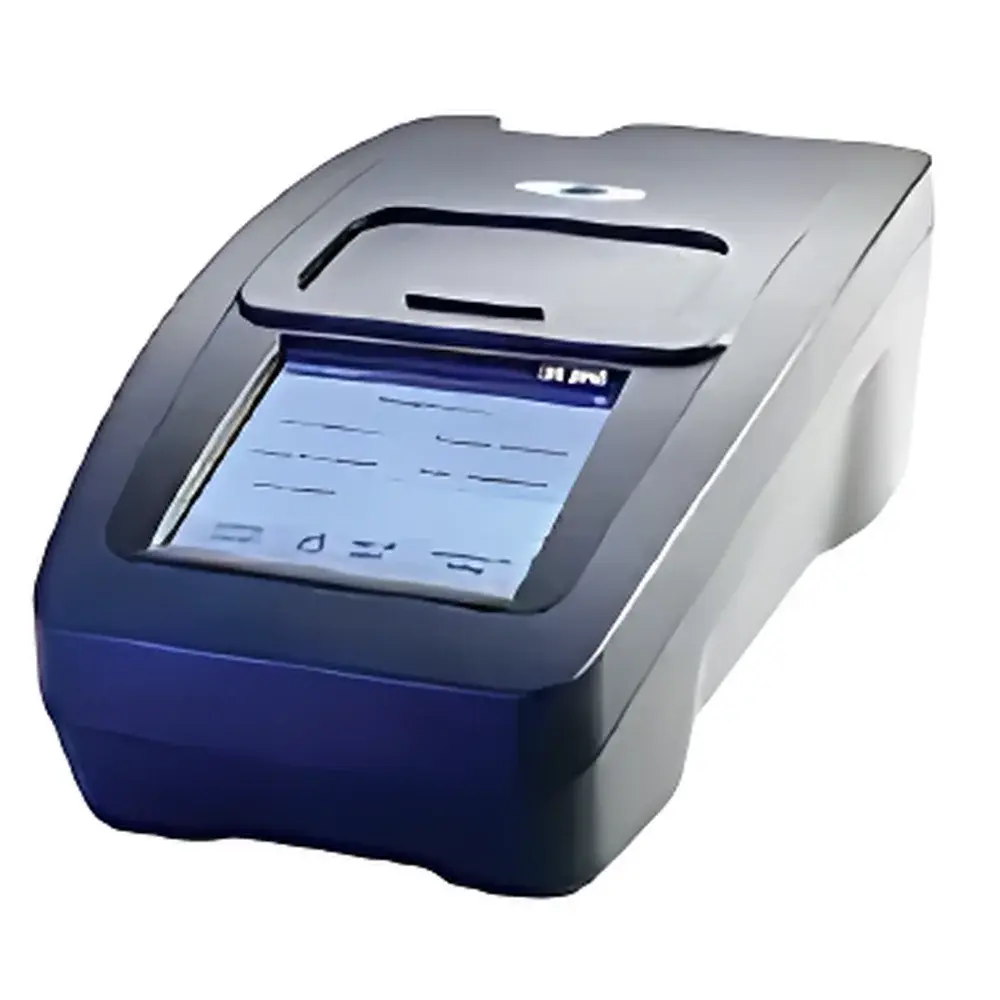
Hach DR/2800 Portable Spectrophotometer
| Brand | Hach |
|---|---|
| Origin | Imported |
| Manufacturer Status | Original Equipment Manufacturer (OEM) |
| Instrument Type | Portable/HANDHELD Water Quality Analyzer |
| Wavelength Range | 340–900 nm |
| Optical Bandwidth | 5 nm |
| Wavelength Selection | Method-Driven Automatic Selection |
| Wavelength Calibration | Fully Automatic |
| Readout Modes | Transmittance (%T), Absorbance (A), Concentration (mg/L, ppm, etc.) |
| Interface | USB 1.1 |
| Power Supply | AC Input (100–240 V, 47–63 Hz) or Rechargeable Lithium-ion Battery |
| Weight | 4.06 kg (instrument only), 4.38 kg (with battery) |
| Operating Environment | 10–40 °C, ≤90% RH (non-condensing) |
| Data Storage Capacity | 500 test records with timestamp, sample ID, operator code, and result metadata |
| Display | Touchscreen LCD with Chinese-language menu support |
| Sample Compatibility | Hach TNTplus™ pre-filled reagent vials with barcode recognition |
Overview
The Hach DR/2800 Portable Spectrophotometer is a laboratory-grade, field-deployable UV-Vis spectrophotometer engineered for quantitative colorimetric analysis of water and wastewater samples. Based on single-beam optical architecture with tungsten-halogen light source and grating monochromator, the instrument operates across a broad spectral range (340–900 nm) with 5 nm optical bandwidth—optimized for compliance with standard methods including EPA, ISO 7027, ASTM D1253, and APHA Standard Methods for the Examination of Water and Wastewater. Its optical design ensures high photometric stability (<0.002 A/h drift) and repeatability (RSD <1.0% at 0.5 A), critical for regulatory reporting and trend monitoring in municipal, industrial, and environmental applications. Unlike benchtop alternatives, the DR/2800 integrates ruggedized mechanical construction with embedded method logic—enabling traceable, operator-independent measurements under variable ambient conditions.
Key Features
- Integrated touchscreen interface with intuitive Chinese-language navigation—designed for rapid method selection and real-time result visualization without external software dependency.
- Automated barcode recognition system compatible exclusively with Hach TNTplus™ pre-filled reagent vials; eliminates manual method entry and reduces transcription errors during field deployment.
- Dual-power architecture: rechargeable lithium-ion battery (up to 8 hours continuous operation) and universal AC adapter (100–240 V, 47–63 Hz)—validated for use in global voltage environments per IEC 61000-4-3 EMC standards.
- Onboard method library containing 240+ pre-programmed analytical procedures—including COD, ammonia-N, nitrate, phosphate, chlorine species, iron, manganese, hardness, and total suspended solids—each aligned with published regulatory protocols.
- Automatic blank correction and wavelength calibration executed at power-on and prior to each measurement cycle—ensuring consistent baseline integrity without user intervention.
- Ruggedized transport case certified to MIL-STD-810G for shock, vibration, and ingress protection (IP54 rating), enabling reliable operation in outdoor, plant-floor, and mobile laboratory settings.
Sample Compatibility & Compliance
The DR/2800 is validated for use with Hach’s full line of TNTplus™ vials, which contain NIST-traceable reagents, calibrated reaction chemistry, and laser-etched barcodes compliant with GS1-128 symbology. Each vial batch undergoes lot-specific verification against certified reference materials (CRMs) per ISO/IEC 17025 requirements. The instrument supports GLP/GMP data integrity through mandatory operator login, audit-trail-enabled data logging (including date/time stamp, method ID, vial lot number, and raw absorbance values), and tamper-resistant USB export. All stored results comply with FDA 21 CFR Part 11 electronic record requirements when used with Hach’s compliant data management software (e.g., Hach LabStation or DataStream).
Software & Data Management
Data capture includes full metadata: sample ID, analyst code, location tag (manually entered), method version, calibration status, and raw photometric readings. Up to 500 test records are retained onboard with time-stamped entries. USB 1.1 interface enables direct transfer to Windows-based PCs using Hach-provided drivers; exported files follow CSV and XML formats compatible with LIMS integration. Firmware updates and new method packages are distributed via encrypted USB flash drives—requiring digital signature verification before installation to maintain configuration control. Optional cloud synchronization (via Hach Connect subscription) provides remote data backup, multi-user access control, and automated report generation aligned with ISO 17025 clause 7.7 documentation requirements.
Applications
The DR/2800 serves as a primary analytical tool in drinking water treatment plants for routine monitoring of disinfectant residuals (free/total chlorine, chloramine), turbidity (via formazin-equivalent calibration), and organic precursors (UV254). In wastewater facilities, it supports NPDES permit compliance testing for nutrient loading (nitrogen/phosphorus speciation), BOD/COD estimation, and effluent toxicity screening. Field researchers deploy it for watershed assessments, stormwater runoff characterization, and emergency response (e.g., post-flooding contamination surveys). Educational institutions utilize its method transparency and error-reduction features to teach fundamental spectrophotometric principles while maintaining alignment with APHA Standard Methods pedagogical frameworks.
FAQ
Does the DR/2800 require annual recalibration by an accredited service provider?
No—its self-calibrating optical path and factory-installed wavelength reference eliminate scheduled recalibration; however, performance verification using NIST-traceable neutral density filters is recommended quarterly per ISO/IEC 17025 clause 6.5.2.
Can third-party reagents be used with the DR/2800?
Only Hach TNTplus™ vials with valid GS1-compliant barcodes trigger automatic method activation; non-Hach reagents may be measured manually but forfeit automated calibration, blank subtraction, and regulatory method validation.
Is the instrument suitable for GLP-compliant laboratories?
Yes—when operated with enabled user authentication, full audit trail logging, and electronic signature workflows via Hach LabStation, it satisfies ALCOA+ data integrity principles required for GLP audits.
What is the minimum detectable concentration for orthophosphate using Method 8190?
Method 8190 (ascorbic acid reduction) achieves a practical quantitation limit of 0.02 mg/L PO₄-P with 10-mm pathlength cells, verified per EPA Method 365.1 validation criteria.
How is firmware update integrity ensured?
All firmware packages are cryptographically signed using SHA-256 hashing; the instrument validates signatures prior to installation, preventing unauthorized or corrupted code execution.
Related Products







