
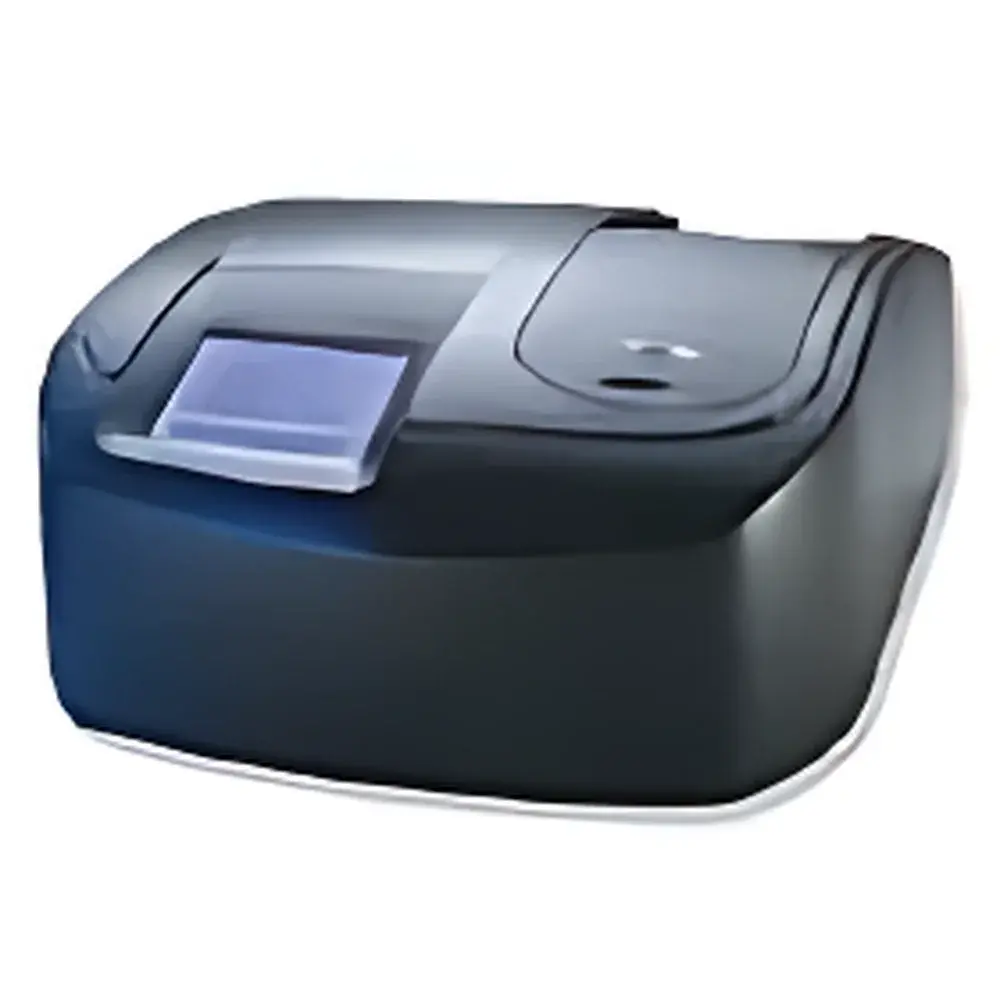
Hach DR/5000 UV-Vis Spectrophotometer
| Brand | Hach |
|---|---|
| Origin | Imported |
| Manufacturer Type | Manufacturer |
| Model | DR/5000 |
| Optical Design | Double-beam |
| Detector Type | Photodiode Array (PDA) |
| Wavelength Range | 190–1100 nm |
| Wavelength Accuracy | ±1 nm (200–900 nm) |
| Spectral Bandwidth | 2 nm |
| Wavelength Resolution | 0.1 nm |
| Stray Light | <0.05% T at 220 nm |
| Absorbance Range | ±3.0 ABS |
| Measurement Modes | Transmittance (%T), Absorbance (ABS), Concentration |
| Data Storage Capacity | 2000 data points with timestamp, sample ID, operator code, and result |
| Interface | USB 1.1 (to PC, printer, external keyboard) |
| Power Supply | 200–240 V, 50/60 Hz |
| Weight | 15.5 kg |
| Operating Environment | 10–40 °C, ≤90% RH (non-condensing) |
Overview
The Hach DR/5000 UV-Vis Spectrophotometer is a double-beam, photodiode array-based analytical instrument engineered for high-reproducibility quantitative analysis in the ultraviolet and visible spectral regions (190–1100 nm). Designed specifically for routine water and wastewater quality testing, it employs fixed-slit optics with a PDA detector to deliver rapid spectral acquisition without mechanical wavelength scanning—enabling simultaneous measurement across the full range with inherent wavelength stability. Its optical architecture minimizes drift and thermal sensitivity, supporting long-term calibration integrity required in regulated environmental laboratories. The instrument complies with fundamental performance criteria outlined in EPA Method 450.0 and ISO 7027 for turbidity-related absorbance measurements, and supports method validation under GLP and ISO/IEC 17025 frameworks when operated with traceable standards and documented procedures.
Key Features
- Double-beam optical design with real-time reference compensation for enhanced photometric stability during extended analyses
- Photodiode array detector enabling full-spectrum acquisition in <1 second—eliminating motorized grating movement and associated wear or misalignment risks
- Automated barcode recognition system for instant method recall and reagent lot tracking; compatible with Hach’s pre-packaged TNTplus vials, powder pillows, and ampoules
- Integrated auto-zero and reagent blank subtraction routines executed prior to each measurement cycle, reducing manual intervention and systematic error
- Five-position cuvette adapter (single-cell and rotary) plus optional flow cell and pipette modules for flexible sample handling—including low-volume, high-throughput, or continuous-flow configurations
- Onboard data logging of up to 2000 test records, each containing date/time stamp, sample ID, operator code, method name, measured value, and unit—supporting audit-ready documentation
Sample Compatibility & Compliance
The DR/5000 is validated for use with aqueous matrices across municipal, industrial, and regulatory laboratory settings. It accommodates standard 10-, 20-, 50-, and 100-mm pathlength cuvettes, as well as Hach-specific 13-mm round vials and rectangular flow cells. All preprogrammed methods—including over 240 EPA-accepted and ASTM-standardized water quality parameters (e.g., COD, nitrate, phosphate, silica, chlorine species, heavy metals)—are embedded in firmware and undergo periodic revision per Hach’s internal verification protocol. The instrument meets electrical safety requirements per IEC 61010-1 and electromagnetic compatibility per IEC 61326-1. While not inherently 21 CFR Part 11 compliant, its USB data export functionality enables integration into validated LIMS environments where electronic signatures and audit trails are managed externally.
Software & Data Management
Data transfer occurs exclusively via USB 1.1 interface to Windows-based PCs running Hach’s DR Utility software (v5.x or later), which provides CSV export, report generation, trend plotting, and method library updates. Raw absorbance spectra and processed results are stored in non-proprietary formats to ensure long-term accessibility. The onboard memory retains timestamps with millisecond resolution and enforces mandatory entry of operator ID and sample identifier—facilitating traceability in multi-user labs. Firmware supports user-defined method creation using built-in calibration curve editors (linear, quadratic, polynomial), with slope/intercept validation against NIST-traceable standards. No cloud connectivity or remote access capabilities are implemented, preserving data sovereignty in compliance-sensitive deployments.
Applications
- Regulatory compliance monitoring per EPA Methods 365.4 (phosphate), 4500-Cl G (chlorine), and 351.2 (COD)
- Process control in drinking water treatment plants (e.g., UV254 for organic load estimation, permanganate index surrogate)
- Effluent discharge verification for textile, pharmaceutical, and electroplating industries
- Calibration and verification of field-portable colorimeters and ion-selective electrodes
- Academic teaching labs requiring robust, method-locked instrumentation for standardized curriculum delivery
- Method development for emerging contaminants using custom absorbance ratio algorithms or derivative spectroscopy
FAQ
Does the DR/5000 support custom method development beyond the preloaded 240+ applications?
Yes—users may define new calibration curves, assign units, set acceptance limits, and associate them with unique method IDs using the DR Utility software. All custom methods are stored on the instrument and retain full data logging functionality.
Is wavelength calibration traceable to NIST standards?
The factory calibration uses holmium oxide and didymium filters certified to NIST SRM 2034 and SRM 2035. Field recalibration is performed automatically at startup using internal reference LEDs; optional annual verification with external standards is recommended for ISO/IEC 17025 accreditation.
Can the DR/5000 operate unattended for batch analysis?
No—while it supports sequential measurement of multiple samples via rotary adapter, it lacks robotic autosampler integration or scheduled run initiation. Operator presence is required for sample loading, barcode scanning, and result review.
What is the expected lifetime of the deuterium and tungsten lamps?
Typical lamp service life exceeds 1,000 hours under normal usage conditions. Lamp status is monitored continuously; the instrument displays remaining operational hours and prompts replacement when output falls below 85% of nominal intensity.
Are firmware updates provided free of charge?
Yes—Hach releases firmware revisions quarterly via its official support portal. Updates require manual download and installation using the DR Utility software and maintain backward compatibility with existing method libraries and data files.




