
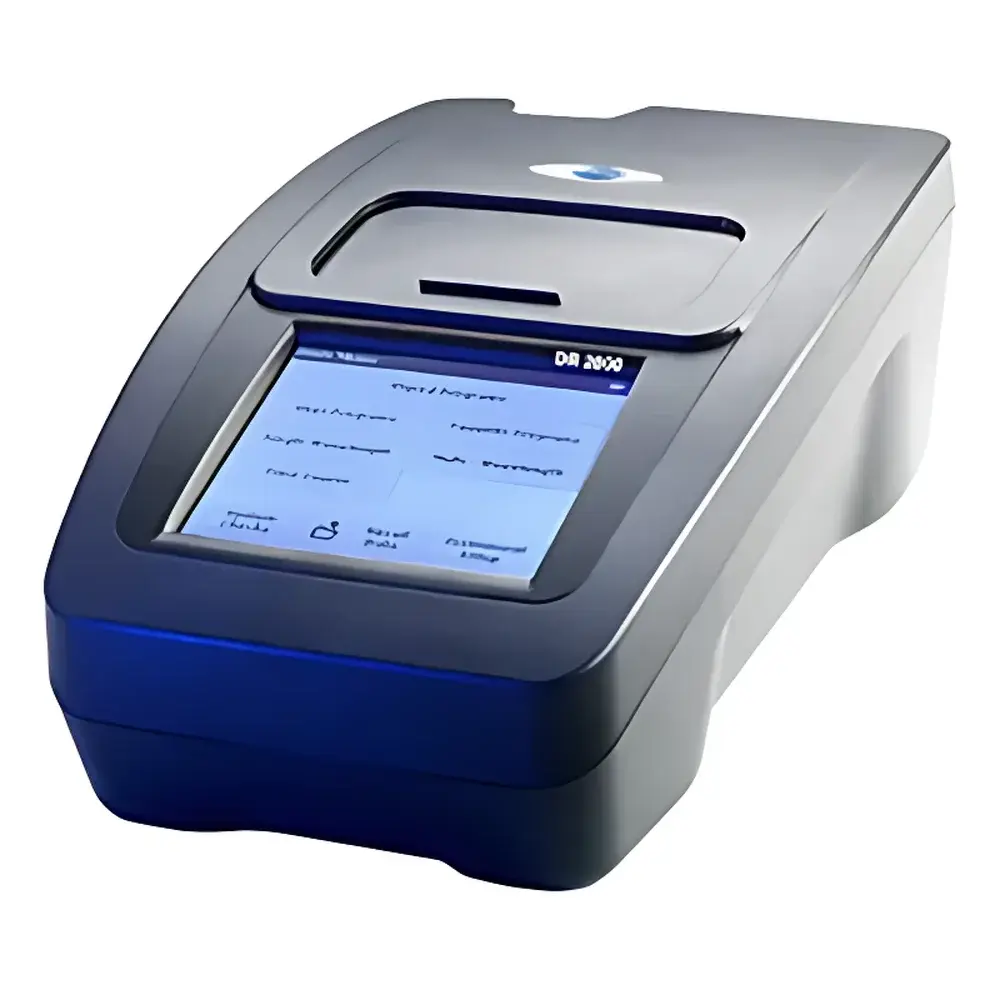
Hach DR2800 Portable Spectrophotometer
| Brand | Hach |
|---|---|
| Origin | Imported |
| Manufacturer Type | Manufacturer |
| Model | DR2800 |
| Price | Upon Request |
| Wavelength Range | 340–900 nm |
| Optical Bandwidth | 5 nm |
| Measurement Modes | Transmittance (%), Absorbance, Concentration |
| Data Storage Capacity | 500 test records |
| User-Defined Methods | Up to 50 |
| Preloaded Methods | 240+ |
| Power Supply | Rechargeable Li-ion battery or 100–240 V AC adapter |
| Weight | 4.06 kg (without battery), 4.38 kg (with battery) |
| Operating Environment | 10–40 °C, ≤90% RH (non-condensing) |
Overview
The Hach DR2800 Portable Spectrophotometer is a precision optical instrument engineered for quantitative analysis of aqueous samples using absorbance-based photometric measurement principles. It operates on a fixed-wavelength, dual-beam optical architecture—commonly referred to as a “pseudo-double-beam” design—to minimize drift and enhance baseline stability during field and laboratory measurements. The instrument employs a tungsten-halogen light source and a grating monochromator to deliver discrete wavelength selection across a broad spectral range (340–900 nm), enabling compliance with standard colorimetric and spectrophotometric methods defined in EPA, ISO, ASTM, and APHA guidelines. Its primary application domain centers on water quality analysis—including nutrients (e.g., nitrate, phosphate), metals (e.g., iron, copper), disinfectants (e.g., chlorine, chlorine dioxide), and organic indicators (e.g., COD, TOC surrogates)—where rapid, trace-level quantification is required under variable environmental conditions.
Key Features
- Pseudo-double-beam optical system with automatic wavelength calibration and real-time baseline correction for high reproducibility across temperature fluctuations and extended operation cycles.
- Integrated barcode reader for seamless recognition of Hach’s pre-packaged, factory-calibrated reagent vials—eliminating manual method selection and reducing operator-induced error.
- Automated multi-point reading: captures ten sequential absorbance values at defined intervals, statistically filters outliers using robust averaging algorithms, and displays final concentration within 10 seconds.
- Touchscreen interface with intuitive, icon-driven navigation; supports multilingual prompts (English default) and contextual help overlays for method-specific guidance.
- Dual-power architecture: rechargeable lithium-ion battery provides ≥8 hours of continuous operation in standalone mode; universal AC adapter (100–240 V, 47–63 Hz) ensures global compatibility.
- Ruggedized transport case rated IP54 for dust resistance and limited moisture protection; designed for repeated deployment in industrial plants, wastewater treatment facilities, and remote sampling sites.
- Onboard timer and password-protected user access control to support GLP-compliant workflows and audit-ready data integrity.
Sample Compatibility & Compliance
The DR2800 accommodates standard 13-mm round glass or plastic cuvettes, as well as Hach’s proprietary 16-mm square vials and flow-through cells for low-volume (<2 mL) or turbid sample analysis. Its optical path length is optimized for 10-mm and 50-mm cell configurations, ensuring adherence to Beer-Lambert law assumptions across typical environmental concentration ranges. All preloaded methods are validated against U.S. EPA Methods (e.g., 365.4 for phosphate, 334.0 for nitrate), ISO 7027 (turbidity), and ASTM D1253 (residual chlorine). The device meets IEC 61010-1 safety standards for laboratory equipment and complies with electromagnetic compatibility requirements per EN 61326-1. While not inherently 21 CFR Part 11 compliant, its audit-trail-capable firmware version (v3.2+) supports configurable electronic signatures and exportable CSV logs suitable for regulated QA/QC environments.
Software & Data Management
Data acquisition, storage, and transfer are managed through embedded firmware supporting up to 500 complete test records—including timestamp, operator ID, sample ID, method name, raw absorbance values, calculated concentration, and unit metadata. USB 1.1 interface enables direct connection to Windows-based PCs for firmware updates via USB flash drive and bulk export of datasets in comma-separated format. Optional Hach LabStation software (v5.0+) provides advanced features such as trend visualization, statistical process control charts, report generation with customizable templates, and integration with LIMS platforms via ODBC drivers. All user-defined methods are stored in non-volatile memory and persist across power cycles and firmware upgrades.
Applications
The DR2800 serves critical roles across municipal water utilities (source water screening, distribution system monitoring), industrial effluent compliance (metal plating, food processing, pharmaceutical manufacturing), environmental consulting (field-based watershed assessments), and academic teaching laboratories (analytical chemistry pedagogy, method validation exercises). Specific use cases include rapid detection of orthophosphate in stormwater runoff, total chlorine residual verification in drinking water distribution networks, ammonia-nitrogen quantification in aquaculture systems, and silica monitoring in boiler feedwater. Its portability and ruggedness make it particularly suited for time-sensitive applications where laboratory turnaround would delay decision-making—such as emergency response to chemical spills or seasonal algal bloom characterization.
FAQ
Does the DR2800 support custom calibration curves?
Yes—up to 50 user-defined methods can be programmed using linear, quadratic, or polynomial regression models based on absorbance-concentration relationships derived from laboratory standards.
Can the instrument operate while charging?
Yes—the device functions normally when connected to AC power, with simultaneous battery charging and uninterrupted measurement capability.
Is external calibration required before each use?
No—automatic zeroing and reference calibration are performed internally at startup and after method changes; however, periodic verification with certified reference standards is recommended per ISO/IEC 17025 quality assurance protocols.
What file formats are supported for data export?
CSV (comma-separated values) is the native export format; third-party tools may convert this into Excel (.xlsx), PDF reports, or database-compatible schemas.
How often should the optical components be serviced?
Under normal field-use conditions, no routine optical maintenance is required; Hach recommends annual inspection by authorized service centers to verify lamp output stability and detector linearity.






