
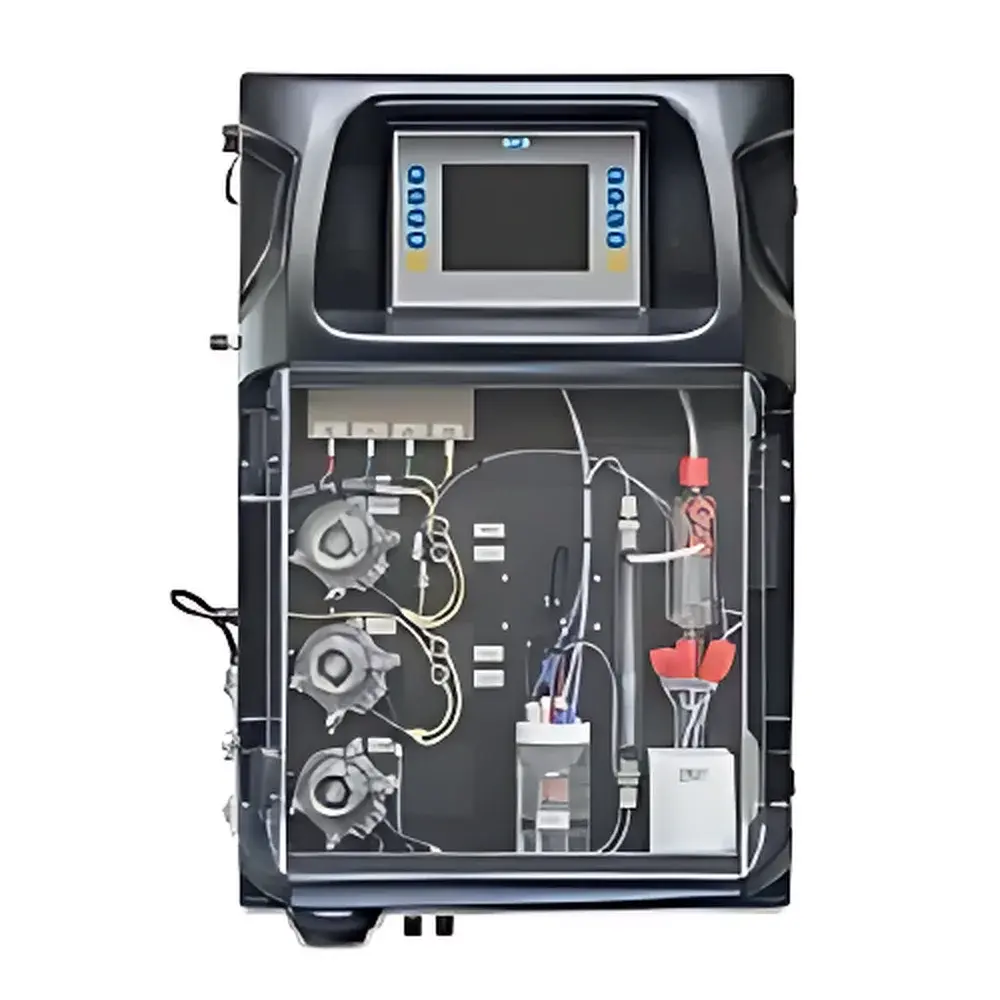
HACH EZ6000 Trace Metals Analyzer
| Brand | HACH |
|---|---|
| Origin | Imported |
| Manufacturer Type | Original Equipment Manufacturer (OEM) |
| Model | EZ6000 Trace Metals Analyzer |
| Instrument Type | Online Analyzer |
| Detection Principle | Anodic Stripping Voltammetry (ASV) |
| Target Analytes | Arsenic (As³⁺/Total As), and configurable for additional heavy metals (e.g., Cd, Pb, Cu, Zn) |
| Analysis Cycle Time | ≤ 40 minutes (including digestion, if integrated) |
| Accuracy/Precision | ±5% of full scale |
| Resolution | ≤ 1 µg/L |
Overview
The HACH EZ6000 Trace Metals Analyzer is an industrial-grade online electrochemical instrument engineered for continuous, unattended monitoring of trace-level heavy metal contaminants—primarily arsenic (As³⁺ and total arsenic)—in aqueous environmental matrices. It employs Anodic Stripping Voltammetry (ASV), a well-established, standardized electroanalytical technique recognized under ASTM D3559 and ISO 8692 for its high sensitivity and selectivity in low-concentration metal speciation. In ASV, target metal ions are first electrochemically preconcentrated (reduced and deposited) onto a mercury-film or bismuth-film working electrode during a controlled deposition step. Subsequently, a linear or staircase voltage scan oxidizes (strips) the deposited metals, generating characteristic current peaks whose magnitude correlates quantitatively with analyte concentration. This two-step process delivers sub-ppb detection capability without requiring complex sample pretreatment or expensive consumables such as ICP-MS torches or graphite furnace components.
Key Features
- Multi-channel architecture supporting up to eight independent analysis streams, enabling parallel monitoring across intake, distribution, and effluent points.
- Integrated digestion module (optional) compliant with EPA Method 200.8 protocols for total arsenic determination, ensuring oxidation of As³⁺ to As⁵⁺ prior to ASV analysis.
- Full automation including auto-calibration using certified multi-point standard solutions, scheduled electrode cleaning via ultrasonic or electrochemical regeneration, and fault-condition recovery routines.
- Physically segregated wet/dry zones: all fluidic components—including peristaltic pumps, solenoid valves, flow cells, and electrode modules—are housed in a dedicated, corrosion-resistant wet compartment; electronics, power supplies, and computing hardware reside in a sealed, ventilated dry enclosure—minimizing cross-contamination and simplifying service access.
- Low reagent consumption (≤ 1.2 mL per analysis cycle) and minimal sample volume requirement (≤ 25 mL), reducing operational cost and waste generation in long-term deployment.
Sample Compatibility & Compliance
The EZ6000 is validated for use with raw surface water, treated drinking water, bottled mineral water, and municipal wastewater discharge streams. It meets the functional requirements of U.S. EPA Safe Drinking Water Act (SDWA) arsenic compliance monitoring (MCL = 10 µg/L) and supports reporting under state-level Total Coliform Rule (TCR) and Unregulated Contaminant Monitoring Rule (UCMR) frameworks. All firmware and data handling routines comply with FDA 21 CFR Part 11 for electronic records and signatures, including audit-trail logging of calibration events, method changes, and user logins. Hardware design adheres to IEC 61326-1 (EMC for laboratory equipment) and IP65-rated enclosures for outdoor or semi-outdoor installation environments.
Software & Data Management
Control and data acquisition are managed through a ruggedized industrial PC running embedded Windows IoT Enterprise OS and HACH’s proprietary EZ6000 Control Suite. The interface provides real-time voltammogram visualization, peak identification algorithms with baseline correction, and automatic integration of stripping current areas. Data export formats include CSV, XML, and Modbus TCP for seamless integration into SCADA, LIMS, or cloud-based environmental dashboards (e.g., AWS IoT Core, Microsoft Azure IoT Hub). Historical trend storage supports ≥12 months of minute-resolution concentration data with metadata tagging (sample ID, QC flag, maintenance timestamp). Remote diagnostics and firmware updates are supported via secure TLS 1.2–encrypted HTTPS connections.
Applications
- Regulatory compliance monitoring at public water system entry points and distribution system endpoints per EPA 40 CFR Part 141.
- Early-warning detection of arsenic contamination events in groundwater-fed utilities, especially in geologically vulnerable regions (e.g., Bengal Basin, Andean aquifers).
- Effluent quality assurance at wastewater treatment plants discharging to sensitive receiving waters governed by EU Water Framework Directive (WFD) or China’s GB 3838–2002 Class III standards.
- Process control support in semiconductor fab ultrapure water loops where arsenic must be maintained below 0.1 µg/L to prevent wafer defect propagation.
- Research-grade longitudinal studies on arsenic speciation dynamics in constructed wetlands or iron-oxide filtration systems.
FAQ
What electrode chemistries are supported for arsenic detection?
The standard configuration uses a rotating mercury-film electrode (MFE) optimized for As³⁺; optional bismuth-film electrodes (BiFE) are available for mercury-free operation and improved stability in chloride-rich matrices.
Can the EZ6000 quantify arsenic species separately (e.g., As³⁺ vs. As⁵⁺)?
Yes—by coupling with a programmable pre-reduction or pre-oxidation module, the system can differentiate inorganic arsenic species in accordance with EPA Method 1632 and ISO/IEC 17025-accredited workflows.
Is routine maintenance required between analyses?
No scheduled intervention is needed; the automated electrode cleaning and calibration cycles occur autonomously every 2–24 hours depending on user-defined protocol, with status alerts issued only upon consumable depletion or sensor drift beyond ±7.5% tolerance.
Does the analyzer support remote validation and third-party audit readiness?
Yes—full electronic audit trail, digital signature logs, and version-controlled method files meet GLP/GMP and ISO/IEC 17025 documentation requirements for regulatory submission and external laboratory accreditation.
Related Products







