
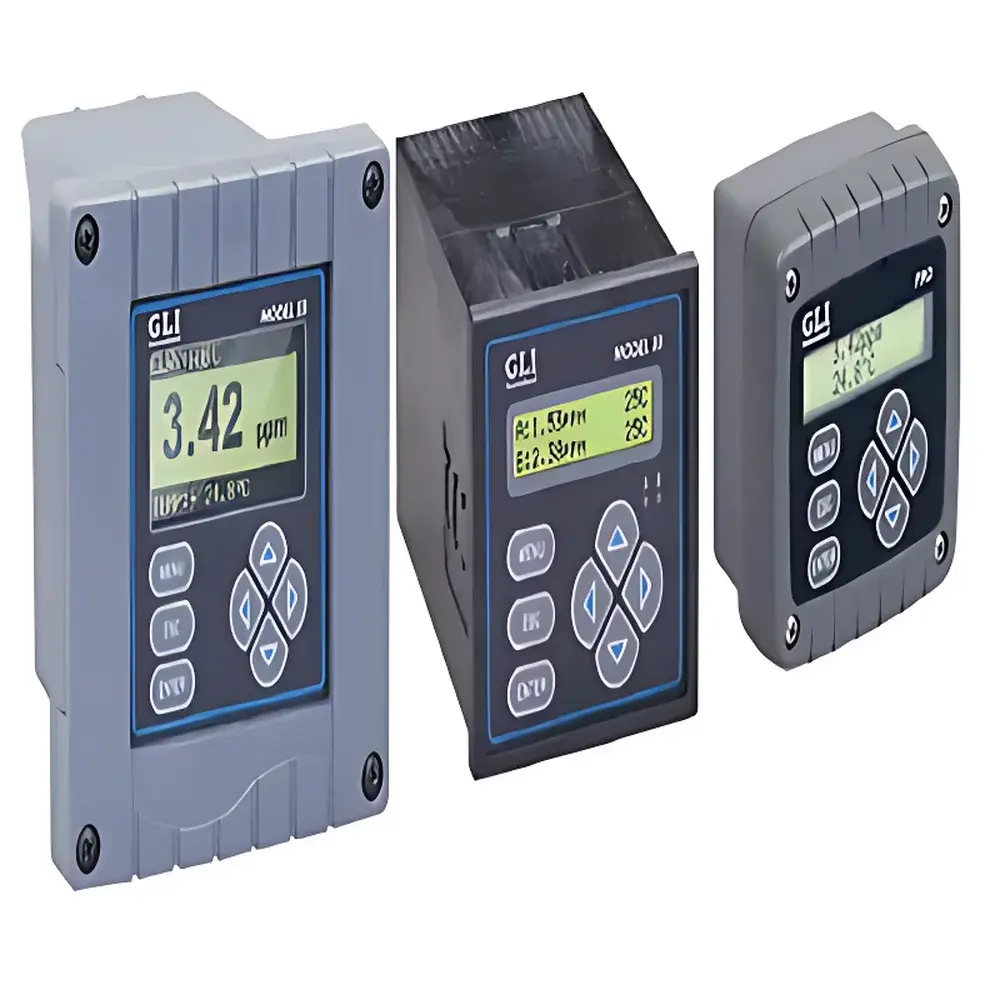
Hach GLI Polarographic Dissolved Oxygen Analyzer
| Brand | Hach |
|---|---|
| Model | GLI Series (D53/D33/PRO-D3) |
| Measurement Principle | Clark-type Polarographic Electrochemistry |
| DO Range | 0–99.99 ppm / mg/L |
| Saturation Range | 0–999.9 % |
| Temperature Range | 0.0–100.0 °C |
| Stability | ±0.05% of full scale |
| Repeatability | ±0.05% of full scale |
| Power Supply | 190–260 VAC (D53/D33), 16–30 VDC (PRO-D3) |
| Enclosure Rating | NEMA 4X (IP65) |
| Explosion Protection | PRO-D3 certified for Class I, Division II, Groups A, B, C, D, T5 |
| Calibration Methods | Air-saturation and sample comparison |
| Output Options | Up to two 4–20 mA analog outputs |
| Communication | RS-232 or HART® (D53/D33) |
| Display | Backlit LCD (D53/D33), LCD (PRO-D3) |
| Relay Outputs | 4 (D53), 2 (D33), None (PRO-D3) |
| Probe Support | Dual probe (D53/D33), Single probe (PRO-D3) |
| CE Certified | Yes |
| Temperature Compensation | Automatic |
| Diagnostic Functions | Built-in self-diagnostics |
| Mounting | Panel, wall, or pipe mount |
Overview
The Hach GLI Polarographic Dissolved Oxygen Analyzer is an industrial-grade electrochemical measurement system engineered for continuous, high-reliability dissolved oxygen (DO) monitoring in municipal and industrial wastewater treatment processes. It operates on the Clark-type polarographic principle—utilizing a three-electrode sensor (gold cathode, silver reference electrode, and stainless steel counter electrode) housed within a gas-permeable membrane. A constant polarization voltage applied to the silver reference electrode ensures stable redox potential, eliminating drift associated with conventional two-electrode configurations. This architecture delivers consistent, low-maintenance performance across dynamic process environments—from influent equalization basins and aerobic/anaerobic bioreactors to final effluent discharge points. Designed for integration into SCADA and PLC-based control systems, the analyzer supports real-time optimization of aeration energy consumption while maintaining compliance with biological treatment requirements under regulatory frameworks such as EPA Clean Water Act guidelines and ISO 5814:2012 (water quality — determination of dissolved oxygen — electrochemical probe method).
Key Features
- Three-electrode polarographic sensor (GLI5500) with gold cathode and polarized silver reference electrode for enhanced long-term stability and reduced zero drift.
- Multiple controller options: D53 (dual-channel, 4 relays, dual 4–20 mA outputs), D33 (dual-channel, 2 relays, dual 4–20 mA outputs), and PRO-D3 (single-channel, intrinsically safe for Class I, Division II hazardous locations).
- Automatic temperature compensation using integrated Pt100 RTD sensor; supports operation from 0.0 to 100.0 °C.
- Backlit LCD display (D53/D33) or compact monochrome LCD (PRO-D3) with simultaneous readouts in ppm, mg/L, and % saturation.
- NEMA 4X (IP65)-rated enclosures suitable for outdoor or washdown environments; panel, wall, or pipe-mount configurations available.
- Built-in diagnostic routines—including membrane integrity check, electrolyte level detection, and electrode response verification—to support predictive maintenance and reduce unplanned downtime.
- Compliance-ready features: CE marking, traceable calibration protocols, and audit-log-capable firmware (on D53/D33 models with optional data logging).
Sample Compatibility & Compliance
The GLI analyzer demonstrates robust performance across diverse aqueous matrices, including raw sewage, activated sludge, tertiary effluent, surface water, brackish water, and saline discharges. Its Clark-cell design tolerates moderate levels of sulfide, chlorine residuals, and suspended solids without requiring frequent cleaning or recalibration—provided routine membrane replacement and electrolyte replenishment are performed per Hach’s recommended intervals (typically every 3–6 months depending on fouling conditions). The system conforms to ASTM D888-20 (Standard Test Methods for Dissolved Oxygen in Water), ISO 5814:2012, and EN 25814 for electrochemical DO measurement. For regulated facilities operating under US EPA NPDES permits or EU Urban Wastewater Treatment Directive (91/271/EEC), the analyzer supports documentation of calibration records, operator interventions, and sensor validation events—enabling alignment with GLP and GMP-aligned quality management systems.
Software & Data Management
While the D53 and D33 controllers support direct serial communication via RS-232 or HART® protocol for integration with distributed control systems (DCS) or asset management platforms, they do not include embedded PC software. Instead, configuration and diagnostics are performed locally via intuitive menu navigation or remotely through compatible HART communicators (e.g., AMS Device Manager). Optional analog output scaling allows seamless interfacing with PLCs for closed-loop aeration control. All models store calibration timestamps and user-initiated diagnostic logs internally; however, external data acquisition systems are required for long-term trend analysis or electronic record retention. For facilities subject to FDA 21 CFR Part 11 requirements, third-party historian solutions with electronic signature and audit trail capabilities may be deployed upstream of the analyzer’s analog or digital outputs.
Applications
- Real-time DO profiling in activated sludge aeration tanks to maintain optimal redox conditions for nitrification and denitrification.
- Monitoring dissolved oxygen gradients across oxidation ditches, sequencing batch reactors (SBRs), and membrane bioreactors (MBRs).
- Effluent compliance verification prior to discharge—particularly where permit limits specify minimum DO thresholds (e.g., ≥5.0 mg/L).
- Process troubleshooting in anaerobic digesters and denitrification zones where sub-ppm DO detection sensitivity supports strict anoxic condition enforcement.
- Calibration reference and field verification against laboratory-grade Winkler titration or optical DO sensors during QA/QC audits.
FAQ
What distinguishes the GLI5500 sensor from conventional galvanic DO probes?
The GLI5500 employs a polarographic three-electrode cell with active voltage polarization of the silver reference electrode, resulting in superior baseline stability, lower temperature coefficient error, and extended service life compared to self-powered galvanic cells.
Can the D53 controller manage two independent DO measurement points simultaneously?
Yes—the D53 supports dual probe inputs with independent scaling, alarm setpoints, and analog outputs, enabling comparative monitoring of DO at different process stages (e.g., inlet vs. outlet of an aeration basin).
Is the PRO-D3 model certified for use in Zone 1 hazardous areas?
No—the PRO-D3 is rated for Class I, Division II only, which corresponds to non-incendive equipment suitable for locations where ignitable concentrations of flammable gases are unlikely under normal operation; it is not approved for Zone 1 (IEC 60079-0) or ATEX Category 2G environments.
How often should the membrane and electrolyte be replaced?
Hach recommends membrane and electrolyte replacement every 3–6 months depending on operational conditions; more frequent changes may be necessary in high-fouling applications such as primary clarifier effluent or grease-laden industrial streams.
Does the analyzer support automatic pressure compensation?
No—barometric pressure compensation must be applied manually during calibration or externally via DCS logic when high-altitude installations or variable atmospheric conditions significantly affect saturation calculations.







