
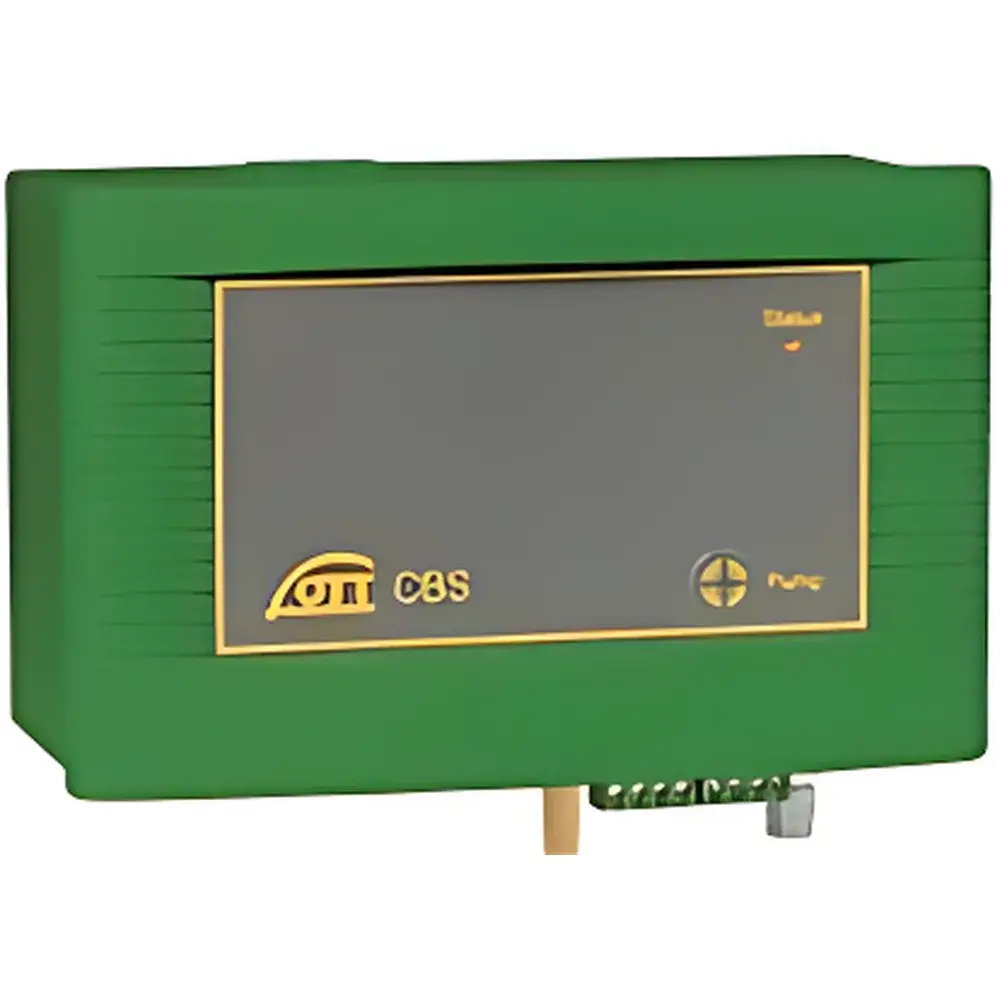
HACH OTT CBS Bubbler Water Level Sensor
| Brand | OTT Hydromet |
|---|---|
| Origin | Imported |
| Model | OTT CBS |
| Measurement Range | 0–15 m / 0–30 m (selectable) |
| Accuracy | ±5 mm (standard), ±1.5 mm (USGS-compliant, within first 3 m of 15 m range) |
| Resolution | 1 mm / 0.1 mbar |
| Output | SDI-12, 4–20 mA (0.1% accuracy, 15-bit) |
| Power Supply | 10–30 V DC (typically 12 V or 24 V) |
| Power Consumption | 320 mAh/day (1-min interval), 25 mAh/day (15-min interval) |
| Operating Temperature | –20 to +60 °C |
| Storage Temperature | –40 to +85 °C |
| Enclosure | IP43-rated CBS engineering plastic |
| Dimensions | 165 × 205 × 115 mm |
| Weight | 1500 g |
| EMC Compliance | IEC 61326 / EN 61326 |
Overview
The HACH OTT CBS Bubbler Water Level Sensor is a precision-engineered, maintenance-optimized hydrostatic level measurement instrument designed for long-term deployment in demanding surface water, groundwater, and tidal monitoring applications. It operates on the proven differential pressure (bubbler) principle: an internal piston pump delivers compressed air through a calibrated capillary tube into a submerged bubble chamber positioned at the measurement depth. As air escapes steadily as discrete bubbles, the backpressure required to overcome the hydrostatic head of the water column above the chamber is measured by a high-stability pressure transducer. This pressure—linearly proportional to liquid height assuming constant fluid density—is converted to water level with traceable metrological integrity. The integrated bubble chamber design actively dampens wave-induced pressure fluctuations, eliminates false readings from surface turbulence, and prevents water ingress or tubing blockage—critical advantages in silt-laden, saline, or biofouling-prone environments.
Key Features
- Self-regulating intelligent air pump: Measures ambient tube pressure prior to each cycle; initiates compression only when pressure deviation exceeds threshold—reducing actuation cycles by >80% versus conventional bubblers and extending pump service life up to 5×.
- No external gas cylinders, desiccants, or consumables required: Fully self-contained operation ensures uninterrupted field performance across seasonal temperature shifts and extended unattended deployments.
- Dual-output interface: Native SDI-12 protocol for direct integration with Campbell Scientific, Onset HOBO, and other industry-standard dataloggers; simultaneously provides isolated 4–20 mA analog output (15-bit resolution, 0.1% full-scale accuracy) for SCADA or PLC connectivity.
- Robust environmental hardening: IP43-rated enclosure fabricated from UV-stabilized CBS engineering plastic; no electronics submerged—eliminating corrosion risk in seawater, brackish estuaries, or chemically aggressive aquifers.
- Configurable pneumatic tubing: Supports Ø2 mm, Ø4 mm, and 1/8″ OD tubing; maximum air line length up to 150 meters without calibration drift or response lag.
- Field-serviceable hardware switch: Dedicated mechanical toggle enables safe commissioning, zero calibration, and diagnostic mode activation without software access or power interruption.
Sample Compatibility & Compliance
The OTT CBS sensor maintains stable, drift-free performance across heterogeneous hydraulic environments—including turbid rivers, saline lagoons, frozen-ground piezometers, and sediment-choked monitoring wells. Its bubble chamber geometry and pressure compensation algorithm inherently correct for minor density variations in natural waters (e.g., temperature- or salinity-driven ρ changes), ensuring consistent accuracy per USGS NWIS protocols. The device complies with IEC 61326-1 for electromagnetic compatibility in industrial and outdoor measurement settings and meets Class A emission limits per EN 61326. While not intrinsically rated for hazardous areas, its passive pneumatic sensing architecture and absence of submerged electronics make it suitable for Class I, Division 2 locations under NEC Article 500 when installed per manufacturer guidelines.
Software & Data Management
Data acquisition is fully compatible with standard hydrologic telemetry stacks: SDI-12 commands support asynchronous polling, burst-mode sampling, and error-checking via CRC validation. The 4–20 mA output conforms to NAMUR NE43 standards for fault signaling (e.g., 3.6 mA = under-range, 20.5 mA = over-range). No proprietary software is required; configuration and diagnostics are performed via ASCII command sets transmitted over RS-232 or TTL-level serial interfaces. Raw pressure-to-level conversion follows the hydrostatic equation P = ρ·g·h, with user-selectable density presets (freshwater, seawater, brine) or custom ρ input. All operational parameters—including measurement interval (1 min to 24 h), pump timeout, and output scaling—are stored non-volatile memory and survive power loss. Audit trails for configuration changes are maintained in firmware for GLP-aligned data governance.
Applications
- River and reservoir stage monitoring for flood forecasting and dam safety compliance
- Groundwater level tracking in multi-depth piezometer nests for aquifer characterization
- Tidal and coastal wetland elevation studies under high-salinity, biofouling conditions
- Infrastructure health monitoring: bridge pier scour detection, levee seepage assessment, and spillway gate position verification
- Short-term hydrological campaigns requiring rapid deployment and minimal site preparation (e.g., post-storm event monitoring)
- Regulatory reporting under EPA Method 1604, ASTM D4044, and ISO 4064-1 for open-channel flow estimation
FAQ
Does the OTT CBS require periodic recalibration?
No—its pressure transducer is factory-calibrated with NIST-traceable standards and exhibits <0.02% FS/year long-term stability. Field verification against a certified reference gauge is recommended annually for regulatory reporting, but adjustment is rarely necessary.
Can the sensor operate in freezing conditions?
Yes—the air delivery system prevents ice formation in the bubble chamber, and the electronics housing remains functional down to –20°C. For sustained sub-zero deployment, insulated tubing and heat-traced conduit are advised to prevent condensation-induced pressure lag.
What is the maximum allowable air tube length for 0–30 m range operation?
Up to 150 meters using Ø4 mm polyethylene tubing with ≤0.5 bar total friction loss at 150 mL/min flow rate. Longer runs require verification of dynamic pressure response time per ISO 9001 calibration procedures.
Is the 4–20 mA output intrinsically safe?
The output is non-isolated by default but can be made intrinsically safe via external Zener barrier (e.g., Pepperl+Fuchs KFD2-ST2-Ex2) compliant with IEC 60079-11 for Zone 1 installations.
How does the CBS handle air tube blockages?
The intelligent pump continuously monitors line pressure; if obstruction is detected (no pressure decay after purge), it triggers a diagnostic alarm via SDI-12 status flag and holds last valid reading until cleared—preventing erroneous “dry well” interpretations.
Related Products







