
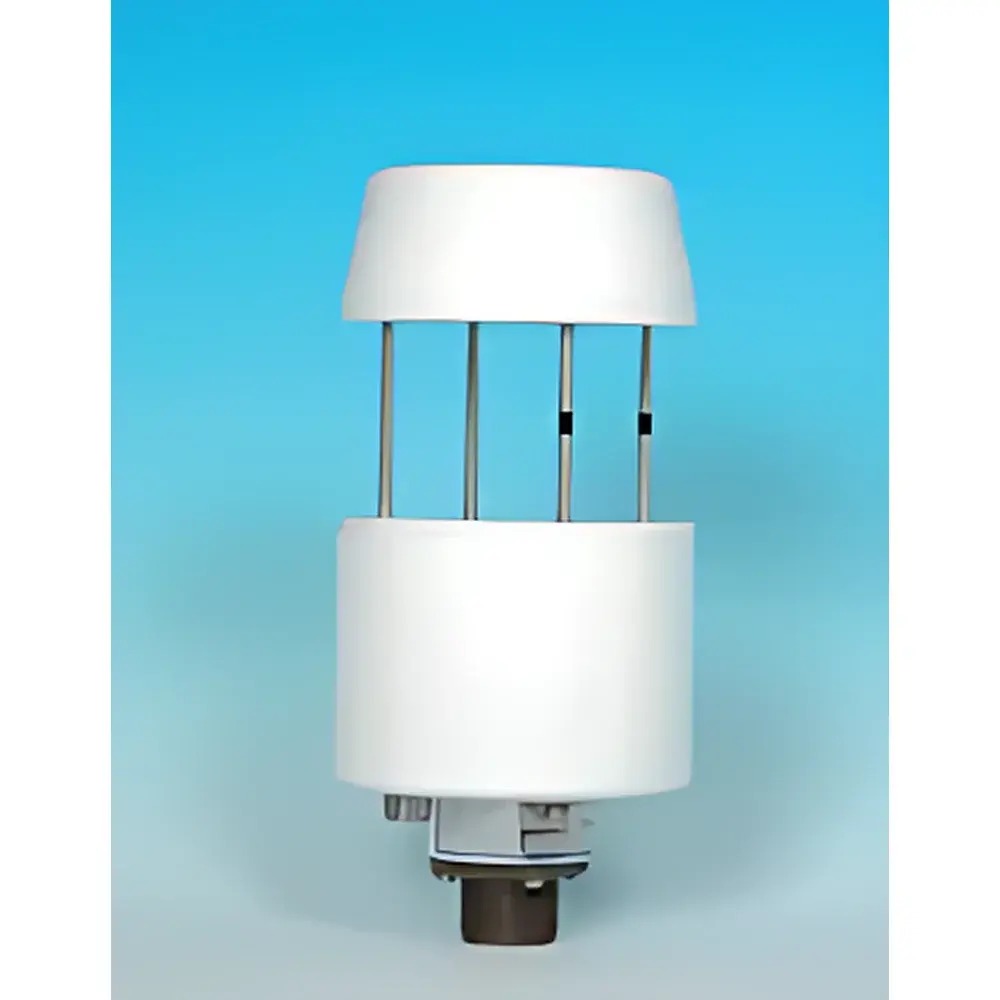
HACH OTT SWS Ultrasonic Anemometer
| Brand | OTT Hydromet |
|---|---|
| Origin | Imported |
| Model | OTT SWS |
| Wind Speed Range | 0–65 m/s |
| Wind Speed Accuracy | ±0.5 m/s or ±5% |
| Wind Speed Resolution | 0.1 m/s |
| Wind Speed Repeatability | ±0.2 m/s or ±5% |
| Wind Direction Range | 0°–360° |
| Wind Direction Accuracy | ±5° |
| Wind Direction Resolution | ±1° |
| Measurement Principle | Ultrasonic time-of-flight (orthogonal X/Y axes) |
| Output Interfaces | RS-232C, RS-485, SDI-12 |
| Sensor Power Supply | 9–36 VDC |
| Heater Power Supply | 24 VDC |
| Power Consumption | <0.5 W |
| Operating Temperature | −40 °C to +60 °C |
| Relative Humidity | 0–100% RH (non-condensing) |
| MTBF | 80,000 hours |
| Dimensions (H × D) | 203.2 mm × 101.6 mm |
| Weight | 1.0 kg |
| Mounting | 3/4″ IPS vertical pipe (26 mm ID) |
| Optional Features | Automatic north alignment, integrated de-icing heater, field-configurable via serial interface |
Overview
The HACH OTT SWS Ultrasonic Anemometer is a solid-state, maintenance-free wind sensing instrument engineered for long-term, high-reliability deployment in unattended environmental monitoring applications. Unlike traditional cup-and-vane or propeller-based mechanical anemometers, the OTT SWS employs ultrasonic time-of-flight measurement across two orthogonal acoustic paths (X and Y axes) to compute true 2D wind vector components—wind speed and direction—without moving parts. This principle eliminates mechanical wear, bearing drift, and inertia-related lag, enabling accurate capture of rapid gusts and low-wind dynamics down to 0 m/s. The sensor’s compact, aerodynamically shaped housing (203.2 mm height × 101.6 mm diameter) minimizes flow distortion while positioning transducers externally to reduce contamination from rain, snow, dust, and particulate buildup—critical for sustained accuracy in remote or harsh-climate installations.
Key Features
- Zero-maintenance solid-state design with no rotating or friction-prone components
- Low-power operation (<0.5 W typical), optimized for solar- or battery-powered stations
- Integrated de-icing heater (24 VDC) available as factory option for sub-zero environments
- Automatic magnetic north alignment (optional firmware-enabled compass module)
- Field-programmable via standard serial interface (RS-232C/RS-485/SDI-12) without disassembly
- Robust aluminum housing rated IP66 for outdoor exposure; operational from −40 °C to +60 °C
- High sampling rate of 2 Hz per axis at 40 kHz ultrasonic carrier frequency, supporting turbulence analysis
Sample Compatibility & Compliance
The OTT SWS is designed for continuous, unattended atmospheric boundary layer monitoring in compliance with international meteorological standards including WMO Guide to Instruments and Observing Methods (WMO-No. 8) and ISO 17123-5 for field performance of wind sensors. Its measurement uncertainty profile meets requirements for Class II automated weather stations under ICAO Annex 3 and supports data traceability for regulatory-grade environmental reporting. While not certified to FDA 21 CFR Part 11, its digital output protocols (SDI-12, Modbus over RS-485) are compatible with SCADA and telemetry systems used in GLP/GMP-aligned air quality networks. No sample preparation or calibration gas is required—the device performs self-diagnostic checks on transducer integrity and signal-to-noise ratio during power-up and at configurable intervals.
Software & Data Management
Data output is delivered in ASCII-formatted strings compliant with standard meteorological data logging conventions. Each measurement packet includes timestamped wind speed (m/s), wind direction (degrees), internal temperature (°C), and diagnostic flags (e.g., heater status, signal quality index). The sensor supports configurable averaging intervals (1–3600 s) and burst-mode sampling for eddy-covariance studies. Integration with Campbell Scientific CR-series dataloggers, Onset HOBO RX3000, or third-party IoT platforms is achieved via native protocol support. Firmware updates are performed over serial connection using OTT’s proprietary configuration utility, which logs all parameter changes with UTC timestamps—enabling audit-ready change control in regulated deployments.
Applications
- Automated weather stations (AWS) for hydrological and agricultural monitoring networks
- Wind resource assessment for small-scale renewable energy feasibility studies
- Urban air quality and dispersion modeling requiring high-temporal-resolution wind vectors
- Environmental impact assessments (EIA) and stack emission monitoring per EPA Method 9 and ISO 9096
- Research-grade micrometeorology in flux towers, eddy covariance systems, and boundary-layer studies
- Aviation safety systems at general aviation airports and helipads where mechanical reliability is critical
FAQ
Does the OTT SWS require periodic recalibration?
No—ultrasonic time-of-flight measurement is inherently stable and does not drift with time. Field verification against NIST-traceable reference anemometers is recommended every 24 months for QA/QC in regulatory applications.
Can the sensor operate without the optional heater in freezing conditions?
Yes, but ice accumulation on transducer faces may cause temporary signal attenuation or dropout. The heater is strongly advised for continuous operation below −10 °C or in high-humidity freezing environments.
Is the north-alignment option dependent on GPS or external magnetometers?
No—the automatic north alignment uses an integrated 3-axis magnetometer calibrated during manufacturing; no GPS signal or external reference is needed.
What is the maximum cable length supported for RS-485 communication?
Up to 1,200 meters with proper twisted-pair shielded cable (AWG 22–24) and termination resistors, per EIA/TIA-485-A specification.
How is mounting stability ensured on tall masts or vibrating structures?
The 3/4″ IPS threaded base allows rigid coupling to standard anemometer booms or vibration-damped mounting arms; dynamic response is unaffected by mast resonance up to 25 Hz.







