
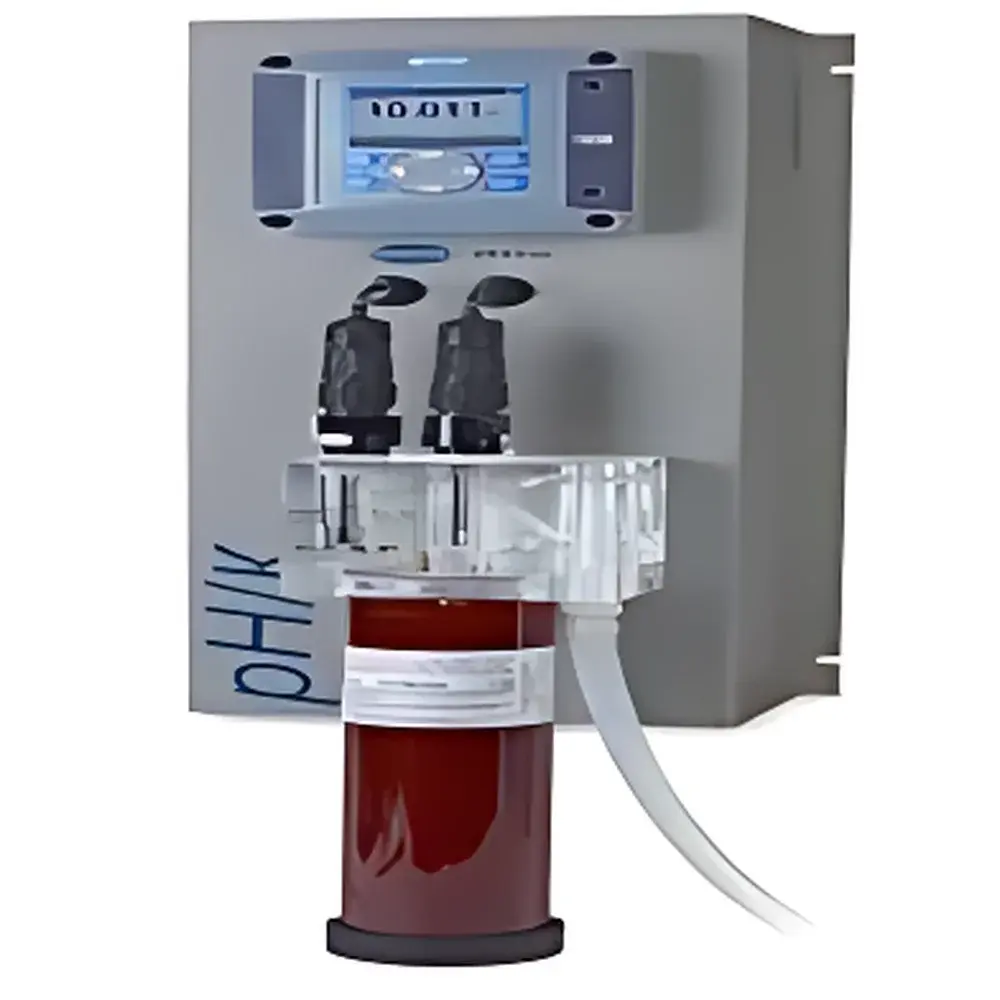
HACH POLYMETRON 9523 Cationic Conductivity Analyzer
| Brand | HACH |
|---|---|
| Origin | Imported |
| Manufacturer Type | Manufacturer |
| Model | POLYMETRON 9523 |
| Instrument Type | Multi-Ion Analyzer |
| Compliance | ISO 7888, ASTM D1125 |
Overview
The HACH POLYMETRON 9523 Cationic Conductivity Analyzer is a high-precision, on-line analytical instrument engineered for continuous monitoring of cationic conductivity in ultra-pure water systems—particularly in power generation applications such as boiler feedwater, condensate, and steam cycle chemistry control. Unlike conventional specific-ion measurement techniques, the 9523 employs a flow-through cation exchange column to convert neutral salts (e.g., NaCl, NH₄Cl, CaSO₄) into their corresponding strong acids (e.g., HCl, H₂SO₄), thereby amplifying the measurable conductance signal by approximately 3× relative to the original sample. This principle enables highly sensitive detection of trace ionic contamination—even at sub-ppb levels—where standard conductivity or pH measurements lack resolution and stability due to electrode drift, liquid junction potential instability, and membrane aging. The analyzer operates on the fundamental relationship between ionic concentration and electrical conductance in aqueous solutions, delivering robust, low-maintenance performance under stringent ISO 7888 and ASTM D1125 compliance requirements.
Key Features
- Integrated cation exchange module with long-life, regenerable resin—visual end-of-life indicator reduces unplanned downtime
- Single-platform architecture shared across HACH’s POLYMETRON family, enabling hardware/software interoperability and consistent engineering workflows
- Standardized HMI interface with intuitive navigation, context-sensitive help, and guided calibration/maintenance wizards
- Modular design with field-replaceable components—including conductivity cell, cation column, and reagent-free flow path—minimizing spares inventory and service time
- Auto-compensation for temperature (0–50 °C) using integrated Pt1000 sensor; conductivity range: 0.001–20.0 µS/cm (full-scale)
- Robust 19-inch rack-mount enclosure rated IP65; suitable for installation in turbine halls, chemical metering rooms, and central control areas
Sample Compatibility & Compliance
The POLYMETRON 9523 is validated for use with deionized, demineralized, and condensate water streams having total dissolved solids (TDS) < 1 ppb and silica < 5 ppb. It is not intended for raw surface water, wastewater, or seawater applications. All wetted materials—including EPDM gaskets, PFA tubing, and 316L stainless steel fittings—meet USP Class VI and FDA-compliant material specifications. System validation documentation supports GLP and GMP environments, with full audit trail capability for calibration events, maintenance logs, and configuration changes per FDA 21 CFR Part 11 requirements when paired with HACH SCADA-compatible software.
Software & Data Management
The analyzer communicates via Modbus RTU/ASCII over RS-485 or optional Ethernet/IP, enabling seamless integration into DCS, PLC, or centralized asset management platforms. HACH’s INTELLIGENT CONFIGURATOR software provides remote setup, real-time diagnostics, trend visualization, and automated report generation (PDF/CSV). All measurement data are timestamped and stored locally (≥30 days internal memory) with configurable alarm thresholds (high/low, rate-of-change, deviation from reference). Firmware updates are performed securely via signed binary packages, ensuring traceability and version control in regulated operations.
Applications
- Steam cycle purity monitoring in fossil-fuel and nuclear power plants
- Condensate polishing system performance verification
- Feedwater quality assurance prior to high-pressure boilers
- Validation of mixed-bed ion exchange resin exhaustion
- Corrosion product ingress detection in closed-loop cooling systems
- Supporting chemistry guidelines per EPRI TR-102328, IAPWS RP-7, and VGB S-007
FAQ
What is the difference between specific conductivity and cationic conductivity?
Cationic conductivity measures the conductance of a water sample after passing through a cation-exchange resin in H⁺ form—converting all cations to H⁺ and their anions to strong acids. Specific (or “true”) conductivity measures the raw sample without pretreatment and is less sensitive to low-level ionic contamination.
Does the POLYMETRON 9523 require chemical reagents or acid addition?
No. The system is reagent-free and relies solely on solid-phase cation exchange resin. No acid dosing pumps, storage tanks, or hazardous chemical handling are required.
How often does the cation exchange column need replacement?
Typical service life exceeds 12 months under continuous operation at ≤1 ppb chloride; visual resin color change (amber → brown) indicates exhaustion and triggers maintenance alert.
Can the analyzer be used in non-power applications?
While optimized for power plant chemistry, it may be deployed in semiconductor ultrapure water (UPW) recirculation loops or pharmaceutical purified water (PW) systems where cationic conductivity trending is specified per USP or ISO 14644-1 Annex B.
Is field calibration supported without lab-grade standards?
Yes—calibration uses certified KCl standard solutions (e.g., 0.01 mol/kg) traceable to NIST; built-in two-point calibration routine includes zero and span checks with auto-temperature compensation.







