
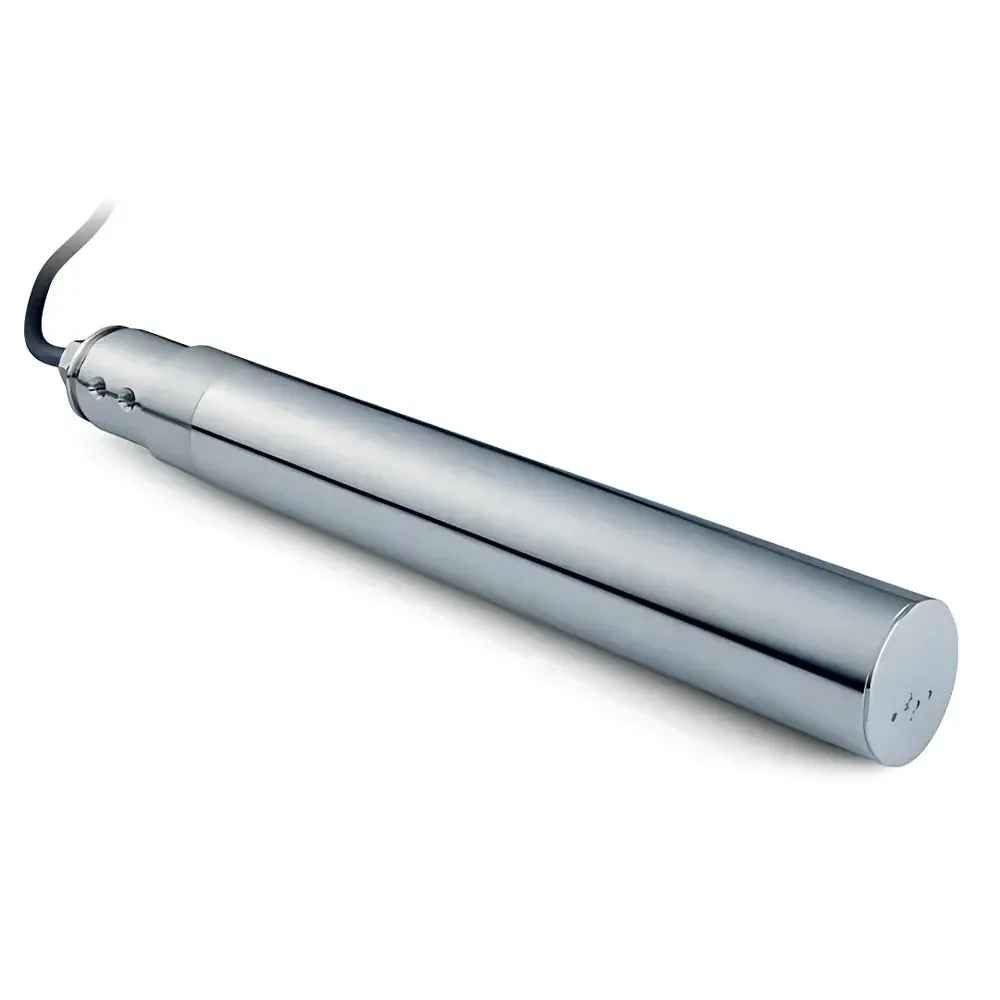
Hach TSS sc Portable Turbidity and Suspended Solids Analyzer
| Brand | Hach |
|---|---|
| Origin | Imported |
| Manufacturer Type | Manufacturer |
| Instrument Type | Portable |
| Model | TSS sc |
| Measurement Principle | Dual-source, 8-beam infrared (860 nm) nephelometric and multi-angle absorption method |
| Turbidity Range | 0.001–4000 FNU/NTU |
| SS Range | 0.001–500 g/L |
| Turbidity Accuracy | ±5% of reading or ±0.01 FNU/NTU |
| Turbidity Repeatability | <3% |
| SS Repeatability | <4% |
| Response Time | 1 s |
| Max Pressure | up to 16 bar (model-dependent) |
| Temp Range | –10°C to +90°C (model-dependent) |
| Compliance | DIN EN 27027 / ISO 7027 (turbidity), software-based bubble compensation |
| Probe Materials | Sapphire window, optional titanium alloy (TITANIUM2/TITANIUM7), sanitary-grade stainless steel, explosion-proof (EX1), high-temp (HT), variable-pressure (VARI), extended-range (XL) |
Overview
The Hach TSS sc is a field-deployable, dual-parameter optical analyzer engineered for simultaneous, real-time measurement of turbidity and suspended solids (SS) concentration in liquid streams. It employs a patented dual-infrared-source, eight-beam optical architecture operating at 860 nm — a wavelength selected to minimize interference from natural water coloration while maximizing sensitivity to particulate scattering and absorption. Turbidity quantification follows the standardized 90° dual-channel nephelometric principle per DIN EN 27027 and ISO 7027, with independent validation via eight-angle scattered-light analysis. For suspended solids, the instrument applies a modified multi-angle absorption algorithm—calibrated against gravimetric SS reference methods—to convert optical attenuation into mass concentration (g/L). Unlike single-wavelength or single-angle instruments, the TSS sc’s parallel beam geometry and real-time software compensation for air bubbles, window fouling, and thermal drift ensure metrological robustness across dynamic process environments.
Key Features
- Patented dual-IR-source, eight-beam optical system for concurrent turbidity and SS measurement using a single probe
- Sapphire measurement window offering exceptional scratch resistance and anti-fouling performance; optional automatic cleaning brush available
- Modular probe variants engineered for application-specific demands: high-temperature (up to 90°C), explosion-proof (Zone 1 ATEX/IECEx certified), sanitary (3-A compliant), corrosion-resistant (titanium alloy body), and high-pressure (up to 16 bar)
- Real-time, software-driven compensation for entrained air bubbles and gradual optical surface contamination
- Sub-second response time (≤1 s) enabling closed-loop process control integration
- Calibration traceability supported by NIST-traceable standards and documented calibration procedures compliant with ISO/IEC 17025 laboratory requirements
Sample Compatibility & Compliance
The TSS sc is validated for use across heterogeneous aqueous matrices including raw and treated wastewater, surface water, potable water, industrial process liquors (e.g., pulp & paper effluents, pharmaceutical rinse waters, beverage production streams), and high-salinity or chemically aggressive solutions (with titanium probe variants). Its optical design inherently corrects for chromatic interference, making it suitable for colored wastewaters where traditional 400–600 nm turbidimeters exhibit bias. Regulatory alignment includes full compliance with ISO 7027 for turbidity reporting, supporting data integrity requirements under EPA Method 180.1, ASTM D6695, and EU Drinking Water Directive (98/83/EC). When deployed in GMP or GLP-regulated facilities, the instrument supports audit-ready electronic records when paired with Hach’s compliant data management software (see below).
Software & Data Management
The TSS sc interfaces seamlessly with Hach’s SC Series controllers and the unified Hach Insight platform—a secure, browser-based application supporting configuration, diagnostics, trend visualization, and automated report generation. All measurement data include embedded metadata (timestamp, probe ID, temperature, pressure, diagnostic flags), satisfying FDA 21 CFR Part 11 requirements for electronic signatures and audit trails when configured with user role-based access controls and system-generated log files. Firmware updates are delivered via encrypted OTA (over-the-air) protocols, and calibration history—including operator ID, standard lot numbers, and deviation logs—is permanently archived. Optional Modbus TCP/RTU and HART 7 outputs enable integration into DCS, SCADA, and MES systems without proprietary gateways.
Applications
- Municipal wastewater treatment: real-time monitoring of primary clarifier effluent, activated sludge return lines, and final disinfection basins
- Industrial pretreatment compliance: continuous verification of discharge limits per local NPDES or EU IED permits
- Pharmaceutical water systems: USP purified water and WFI loop surveillance, with sanitary probe variants meeting ASME BPE surface finish specifications
- F&B production: inline monitoring of CIP rinse clarity, beer filtration stability, and juice clarification efficiency
- Power generation: condensate polishing and cooling tower blowdown control to prevent heat exchanger fouling
- Chemical manufacturing: reaction mixture homogeneity tracking and catalyst suspension quantification in batch reactors
FAQ
Does the TSS sc require separate calibration for turbidity and suspended solids?
No — the instrument uses a unified optical path and shared calibration protocol. A single turbidity standard (e.g., Formazin or AMCO AEPA) establishes the baseline; SS calibration is performed empirically using representative process samples analyzed gravimetrically per ISO 11923.
Can the TSS sc operate reliably in aerated or foaming streams?
Yes — its embedded bubble compensation algorithm analyzes signal variance across all eight beams and dynamically adjusts the output, minimizing false-high readings common in aerated biological reactors or dissolved air flotation units.
Is the sapphire window susceptible to scaling in hard-water applications?
Sapphire exhibits negligible reactivity with CaCO₃ or silica scale; however, in extreme scaling conditions (e.g., >500 mg/L Ca²⁺, pH >9), the optional self-cleaning brush accessory is recommended to maintain long-term optical fidelity.
What documentation is provided for regulatory audits?
Each unit ships with a Factory Calibration Certificate (traceable to NIST), Declaration of Conformity (CE, UKCA, ATEX), and IQ/OQ templates aligned with GAMP 5. Full validation support packages—including risk assessments and test scripts—are available upon request.
How does temperature variation affect measurement stability?
Internal thermistor-corrected algorithms compensate for refractive index shifts across the full operational range (–10°C to +90°C); no manual temperature correction is required. Probe-specific thermal drift coefficients are factory-characterized and applied in firmware.







