
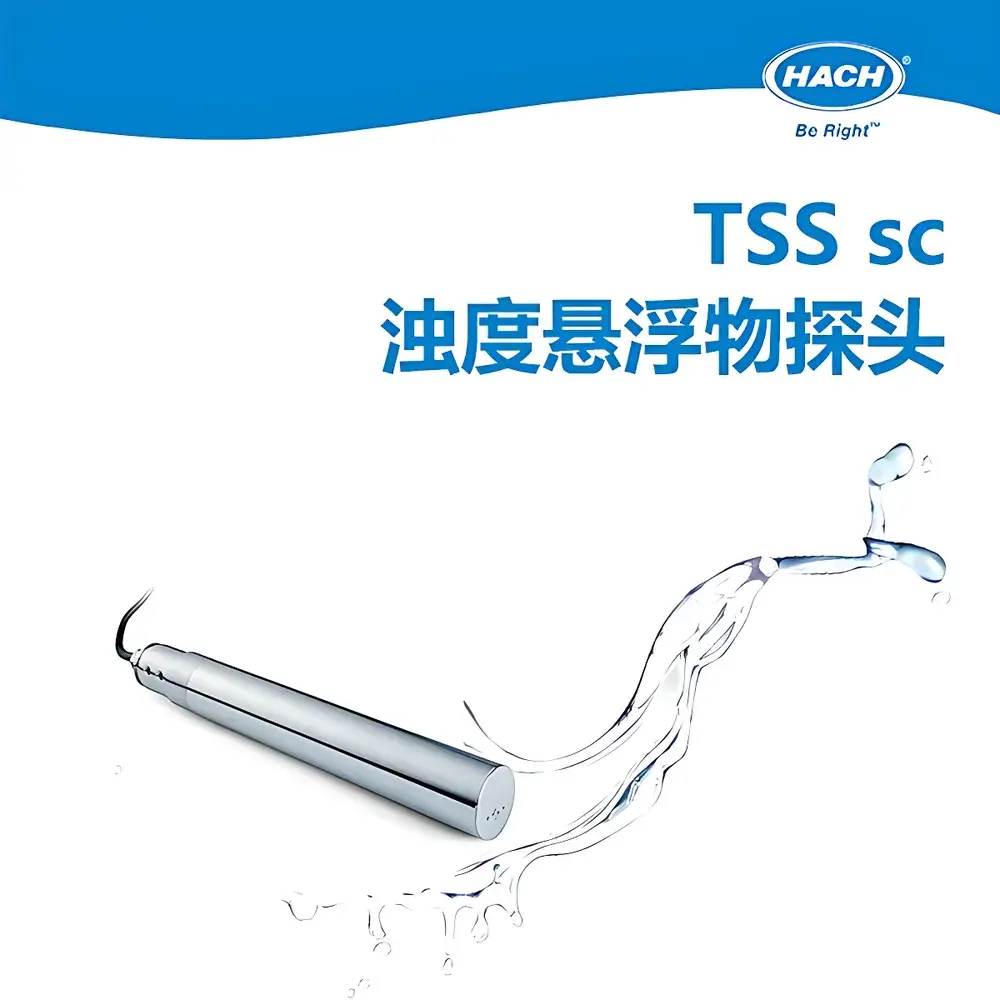
HACH TSS sc Turbidity & Suspended Solids Sensor
| Brand | HACH |
|---|---|
| Origin | Imported |
| Manufacturer Type | Manufacturer |
| Model | TSS sc Probe |
| Instrument Type | Online |
| Measurement Principle | Dual-source, 8-beam infrared (860 nm) optical system |
| Compliance | DIN EN 27027 / ISO 7027 (turbidity), multi-angle scattering for suspended solids |
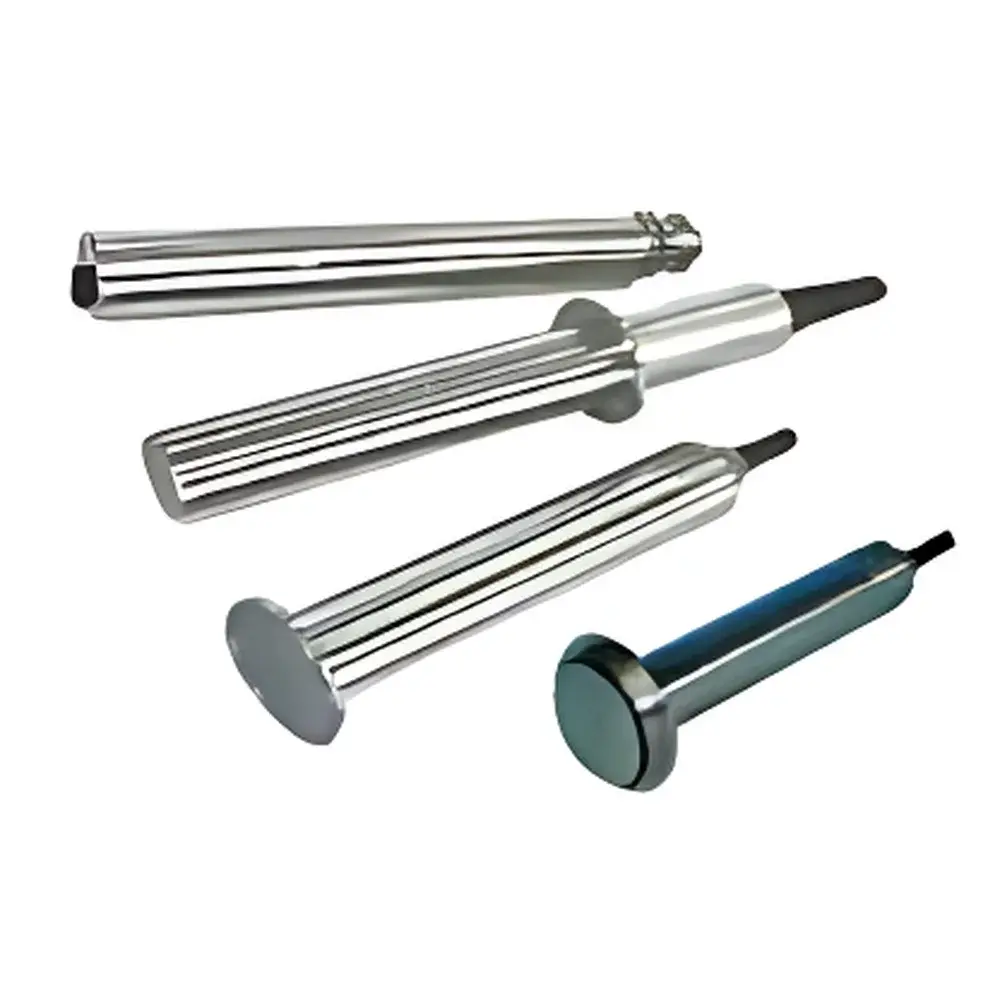
| Material Options | Sapphire measuring window, titanium alloy body (corrosive media), hygienic 3-A compliant design, high-temperature version (up to 90 °C), ATEX-certified explosion-proof variant (Zone 1) |
| Cleaning Option | Optional automatic brush cleaner |
| Sample Compatibility | Municipal wastewater, industrial effluents, surface water, drinking water, process streams in pulp & paper, power generation, pharmaceuticals, food & beverage, chemical, and aluminum production |
Overview
The HACH TSS sc sensor is an online, submersible optical probe engineered for simultaneous, real-time measurement of turbidity and suspended solids (TSS) concentration in liquid process streams. It operates on a dual-source, eight-beam infrared optical architecture centered at 860 nm — a wavelength selected to minimize interference from natural water coloration and organic chromophores while maintaining high sensitivity to particulate scattering. Unlike single-angle or single-wavelength turbidimeters, the TSS sc employs two synchronized pulsed infrared emitters and an array of eight discrete photodetectors arranged across multiple scattering angles. This configuration enables concurrent acquisition of 90° side-scatter (for turbidity per DIN EN 27027 / ISO 7027) and multi-angle forward/backscatter signals (for robust TSS quantification), delivering inherent compensation for fouling, temperature drift, and optical path obstruction.
Key Features
- Dual-source, eight-beam infrared optical system with 860 nm pulsed LEDs ensures stable signal integrity under variable lighting, flow, and ambient thermal conditions.
- Sapphire optical window provides exceptional scratch resistance, chemical inertness, and long-term surface clarity—critical for extended deployment in abrasive or scaling-prone environments.
- Modular mechanical design supports application-specific variants: high-temperature model rated to 90 °C, ATEX/IECEx-certified explosion-proof version for Zone 1 hazardous areas, and 3-A-sanitary-compliant probe with polished Ra ≤ 0.8 µm stainless steel housing for FDA-regulated food, beverage, and pharmaceutical applications.
- Titanium alloy probe body option available for sustained operation in highly corrosive matrices—including chloride-rich brines, acidic leachates, and caustic process liquors—where standard 316L stainless steel would suffer pitting or crevice corrosion.
- Optional integrated mechanical brush cleaner enables autonomous maintenance cycles without manual intervention or process shutdown, reducing calibration drift and extending service intervals.
Sample Compatibility & Compliance
The TSS sc probe is validated for continuous immersion in municipal wastewater influent/effluent, activated sludge basins, tertiary filtration channels, raw surface water intakes, potable water distribution networks, and aggressive industrial effluents. Its optical architecture meets DIN EN 27027 and ISO 7027 requirements for turbidity measurement using nephelometric principles. For suspended solids quantification, the multi-angle scattering algorithm correlates empirically to gravimetric TSS (ASTM D5907, ISO 11923) across defined matrix ranges—enabling traceable, repeatable estimation without sample filtration or drying. The probe complies with electromagnetic compatibility (EMC) per IEC 61326-1 and carries CE marking for use in the European Economic Area. Explosion-proof models are certified to ATEX Directive 2014/34/EU (II 1G Ex ia IIC T6 Ga) and IECEx SAA 20.0001.
Software & Data Management
The TSS sc integrates natively with HACH SC1000, SC200, or SC400 universal controllers, supporting Modbus RTU/ASCII, HART 7, and Ethernet/IP protocols. All measurement data—including raw scatter intensities, compensated turbidity (FNU), estimated TSS (mg/L), temperature, signal quality index, and cleaning event logs—are timestamped and stored locally with non-volatile memory. Firmware supports audit-trail-enabled operation compliant with FDA 21 CFR Part 11 when paired with HACH’s LogRite™ or Asset Insight™ platforms, enabling electronic signatures, user access control, and change history tracking for GLP/GMP-aligned laboratories and treatment facilities.
Applications
- Municipal wastewater: Real-time monitoring of primary clarifier performance, biological reactor loading, and final effluent compliance (e.g., EPA NPDES permit limits).
- Industrial pretreatment: Detection of process upsets in electroplating rinse waters, pulp & paper whitewater loops, and cooling tower blowdown.
- Power generation: Feedwater clarity assurance in nuclear and fossil-fuel steam cycles; condensate polishing system feedback control.
- Pharmaceutical manufacturing: Monitoring of purified water (PW) and water-for-injection (WFI) distribution loops per USP and EU GMP Annex 1.
- Food & beverage: In-line verification of CIP rinse effectiveness, filler feed consistency, and post-pasteurization clarity in beer, soft drinks, and dairy processing.
FAQ
Does the TSS sc require periodic calibration with formazin standards?
No—while formazin-based verification is recommended quarterly for metrological traceability, the probe’s dual-source architecture and internal reference channels enable drift-compensated operation between calibrations. Field validation against grab-sample gravimetric TSS remains the primary method for method correlation.
Can the probe be installed in pressurized pipelines?
Yes—when mounted in a properly designed flow cell (e.g., HACH Flow Cell FC100), the TSS sc operates reliably at line pressures up to 10 bar (145 psi) with NPT or Tri-Clamp sanitary connections.
Is temperature compensation automatic?
Yes—the integrated Pt1000 RTD provides real-time thermal correction of both optical signal gain and scattering coefficient, eliminating need for external temperature transmitters.
What maintenance intervals are recommended for the optional brush cleaner?
Brush cycle frequency is programmable (default: every 6 hours); wear life exceeds 2 years under typical municipal wastewater conditions. Visual inspection of sapphire window clarity is advised every 3 months.
How does the probe handle air bubbles or foam in the sample stream?
The 860 nm wavelength and multi-angle detection strategy inherently suppress bubble-induced noise; firmware includes adaptive signal averaging and bubble rejection algorithms that discard transient spikes without interrupting continuous output.
Related Products







