
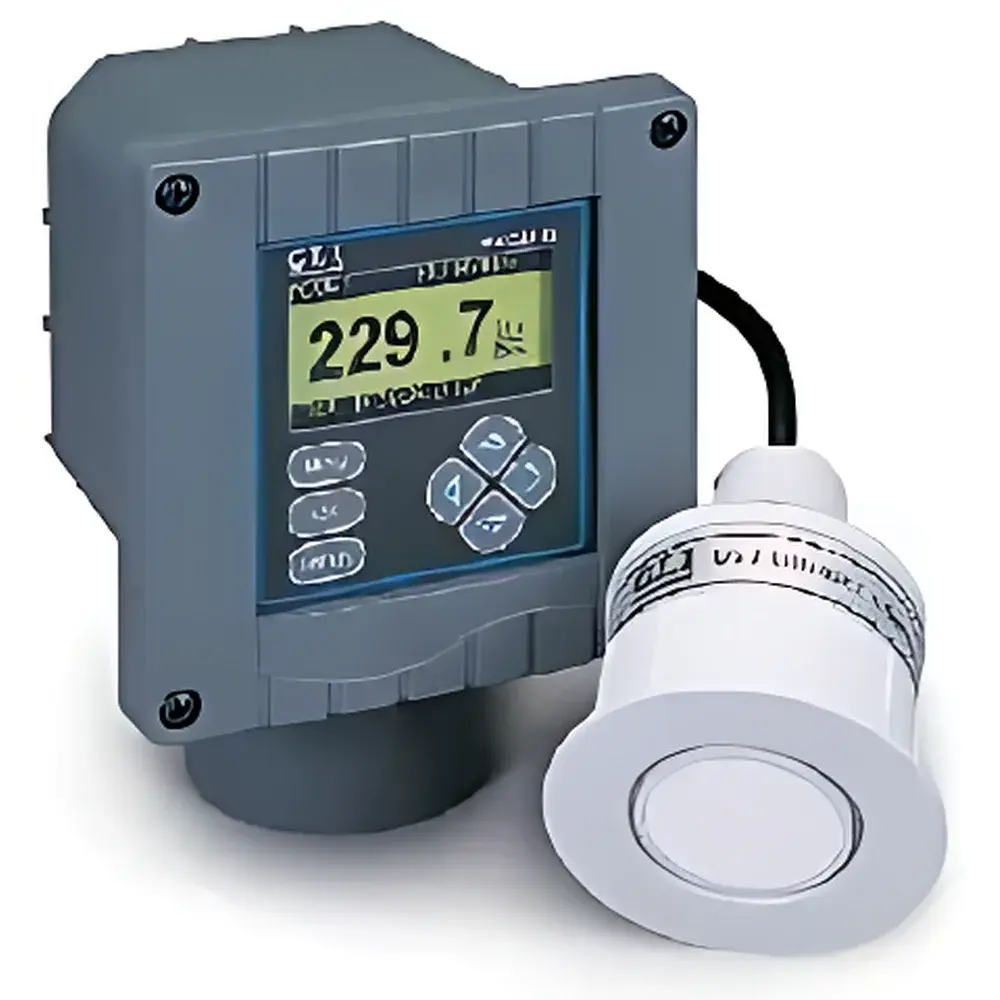
HACH U53 Ultrasonic Open-Channel Flow Meter
| Brand | HACH |
|---|---|
| Origin | Imported |
| Manufacturer | HACH Company |
| Model | U53 |
| Measurement Principle | Ultrasonic Time-of-Flight (Pulse-Echo) |
| Range | 0.25–6.0 m |
| Depth Resolution | ±1 mm |
| Accuracy | ±0.5% of full scale |
| Repeatability | ±0.1% of full scale |
| Sensitivity | ±0.1% of full scale |
| Temperature Compensation Range | –40 to +80 °C |
| Operating Ambient Temperature | –20 to +60 °C |
| Output | Two independent 4–20 mA or 0–20 mA analog outputs |
| Relays | Four SPDT relays |
| Enclosure Rating | NEMA 4X (IP65) |
| Mounting Options | Panel, surface, and pipe mounting |
| Sensor Weight | 1.6 kg |
| Sensor Cable Length | 3.05 m (10 ft) |
| Instrument Weight | 0.5 kg |
| Flow Units | L/s, m³/s, gal/min, ft³/s, ML/d, Mgal/d |
| Depth Units | mm, m, in, ft |
Overview
The HACH U53 Ultrasonic Open-Channel Flow Meter is an industrial-grade, non-contact flow measurement instrument engineered for continuous, reliable monitoring of liquid flow in open-channel applications. It operates on the principle of ultrasonic time-of-flight (pulse-echo) technology: a transducer emits high-frequency sound pulses toward the liquid surface, measures the return echo time, and calculates distance to the surface with high temporal resolution. Using pre-programmed hydraulic equations—such as those defined in ISO 1438, ASTM D5390, and USGS Water-Supply Paper 2175—the U53 converts measured depth into volumetric flow rate in real time. Designed for deployment in municipal water supply systems, stormwater networks, wastewater treatment plants, and activated sludge basins, the U53 delivers stable performance under variable hydraulic conditions, including turbulent flow, suspended solids, foam, and surface scum.
Key Features
- Integrated database of standardized hydraulic structures—including V-notch weirs, rectangular weirs, Palmer-Bowlus flumes, Parshall flumes, Palmer-Bowlus channels, and trapezoidal flumes—enabling immediate configuration without external calibration tables.
- User-definable custom flow curves for non-standard channel geometries, supporting field-specific hydraulic modeling and regulatory compliance reporting.
- Automatic temperature compensation across –40 °C to +80 °C, ensuring consistent acoustic velocity correction regardless of ambient or process temperature drift.
- Robust NEMA 4X (IP65)-rated enclosure suitable for outdoor, wet, and corrosive environments; compatible with panel, surface, and pipe-mount installations.
- Two independently configurable 4–20 mA analog outputs for simultaneous transmission of depth and flow data to SCADA, DCS, or PLC systems.
- Four SPDT relays for local alarm activation, pump control, or event-triggered sampling—fully programmable via front-panel interface or HACH DataStream software.
- No moving parts or submerged components; zero mechanical wear, no routine cleaning, and minimal long-term drift—reducing lifecycle maintenance costs and downtime.
Sample Compatibility & Compliance
The U53 is validated for use with clean water, raw sewage, stormwater runoff, and aerated biological treatment effluents. Its non-contact sensing eliminates fouling-related inaccuracies common in submersible sensors. The device complies with key international standards governing open-channel flow measurement, including ISO 1438-1:2003 (Measurement of liquid flow in open channels using weirs and flumes), ASTM D5390-19 (Standard Practice for Measuring Open-Channel Flow with Flumes), and EPA Method 160.1 (for wastewater discharge monitoring). When integrated into regulated facilities, the U53 supports GLP/GMP-aligned data integrity through optional audit-trail-enabled firmware versions compliant with FDA 21 CFR Part 11 requirements when paired with HACH’s certified data acquisition platforms.
Software & Data Management
HACH DataStream™ software provides intuitive commissioning, configuration, diagnostics, and historical trend analysis. Users can remotely adjust flow equations, calibrate zero offset, set relay thresholds, and export timestamped CSV reports containing depth, flow rate, temperature, and status flags. All configuration changes are logged with user ID and timestamp, satisfying traceability requirements for environmental audits. Optional Modbus RTU/ASCII and Modbus TCP protocols enable seamless integration into existing plant-wide communication architectures. Firmware updates are delivered via secure USB or Ethernet connection, with version-controlled rollback capability.
Applications
- Municipal drinking water distribution: real-time flow verification at intake and booster stations.
- Stormwater management: overflow detection, CSO event quantification, and flood forecasting support.
- Wastewater treatment: influent/effluent flow monitoring, equalization basin control, and sludge blanket level estimation in clarifiers.
- Industrial pretreatment: compliance reporting for NPDES permits and facility-specific discharge limits.
- Research and education: hydraulics laboratory instrumentation for open-channel flow studies and weir/flume coefficient validation.
FAQ
What hydraulic structures does the U53 support out of the box?
The U53 includes built-in coefficients and geometry definitions for over 15 standard weirs and flumes, including Parshall, Palmer-Bowlus, Palmer-Bowlus trapezoidal, V-notch, and rectangular configurations.
Can the U53 measure flow in channels without a primary device (e.g., no weir or flume)?
Yes—users may input custom stage-discharge relationships (Q = f(H)) as polynomial or tabular functions, enabling accurate flow calculation in natural or irregular channels.
Is the U53 suitable for high-solids or foaming wastewater?
Yes—the ultrasonic pulse-echo method is unaffected by turbidity, suspended solids, or surface foam, provided the acoustic path remains unobstructed and the liquid surface reflects sufficiently.
Does the U53 require periodic recalibration?
No—factory-calibrated transducers and digital signal processing eliminate routine recalibration; only initial installation verification and annual functional checks are recommended per ISO/IEC 17025 guidelines.
How is electrical isolation maintained between analog outputs and the main unit?
Both 4–20 mA outputs are galvanically isolated from internal circuitry and each other, preventing ground-loop interference in multi-point monitoring systems.







