
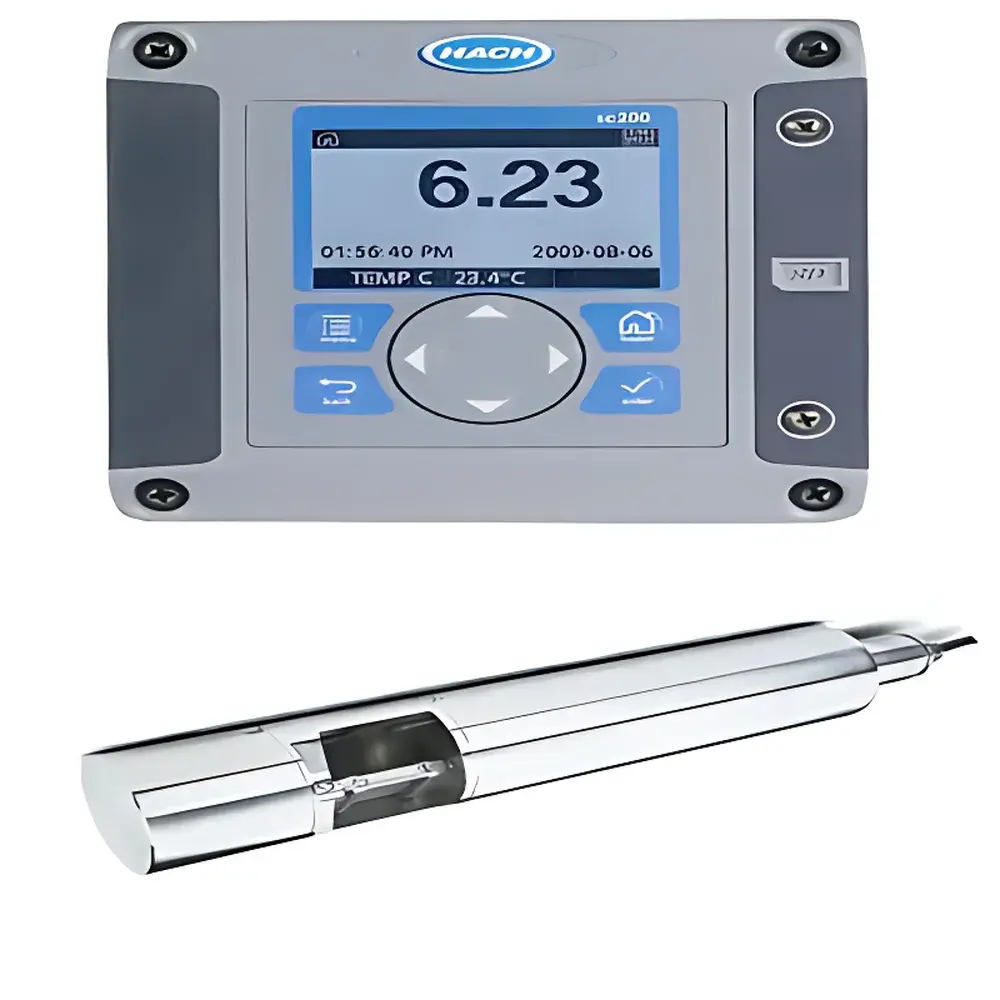
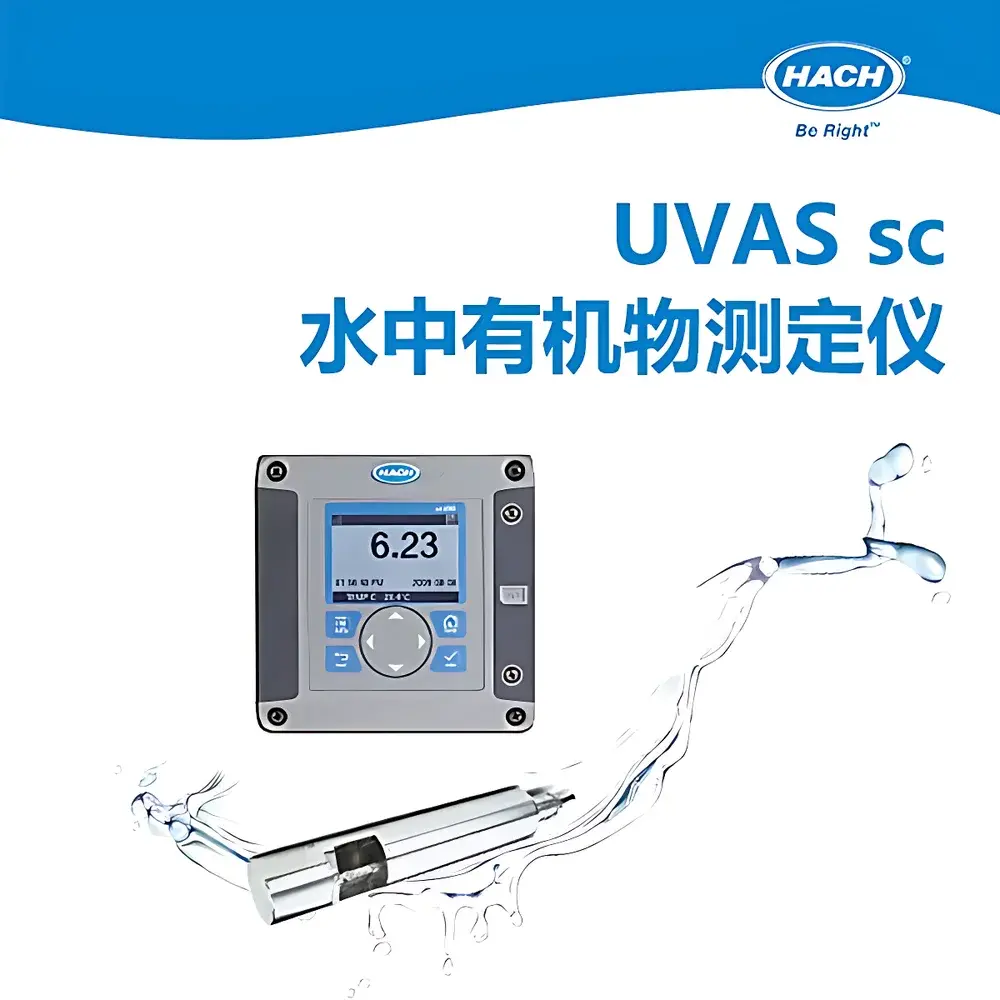
HACH UVASsc Online Organic Matter Analyzer
| Brand | HACH |
|---|---|
| Model | UVASsc |
| Measurement Principle | UV Absorption at 254 nm |
| Optical Path Length Options | 1 mm, 2 mm, 5 mm, 50 mm |
| Measuring Range Options | 0.01–60 m⁻¹, 0.1–600 m⁻¹, 0–1500 m⁻¹, 2–3000 m⁻¹ |
| Measurement Cycle | 1 minute |
| Response Time | >1 min (adjustable) |
| Turbidity Compensation | Dual-beam optical system |
| Analog Outputs | Two isolated 0/4–20 mA outputs (max. load 500 Ω) |
| Communication Protocols | MODBUS RTU or PROFIBUS DP (configurable) |
| Enclosure Rating | IP65 |
| Operating Temperature | +2 °C to +40 °C |
| Probe Pressure Rating | Max. 0.5 bar (suitable for submersion up to 2 m depth) |
| Power Supply | 230 VAC ±10%, 50 Hz, 15 VA OR 24 VDC/AC ±25%, 800 mA |
| Probe Dimensions | Ø70 × 333 mm |
| Probe Weight | ~3.6 kg |
| Installation Options | Immersion or flow-through cell |
| Self-cleaning Mechanism | Mechanical wiper integrated |
Overview
The HACH UVASsc Online Organic Matter Analyzer is an industrial-grade, in-situ ultraviolet absorbance sensor engineered for continuous, reagent-free quantification of dissolved organic carbon (DOC)-correlated organic load in water matrices. It operates on the well-established principle of UV absorption spectroscopy at 254 nm — a wavelength strongly absorbed by aromatic compounds, conjugated double bonds, and polycyclic aromatic hydrocarbons (PAHs) commonly present in natural and anthropogenic organic pollutants. Unlike wet-chemistry methods such as TOC combustion or permanganate oxidation, the UVASsc delivers real-time surrogate measurements of organic content without sample extraction, digestion, or chemical addition. Its dual-beam optical architecture actively compensates for light scattering caused by suspended solids, enabling robust performance in turbid wastewater, surface water, and industrial recirculation streams where particulate interference would otherwise compromise accuracy.
Key Features
- Reagent-free, maintenance-minimized operation: Eliminates consumables, calibration drift from reagent degradation, and associated operational overhead.
- Dual-beam photometric design: Compensates for turbidity-induced signal attenuation in real time, ensuring stable absorbance readings across variable suspended solids concentrations.
- Configurable optical path lengths (1 mm, 2 mm, 5 mm, 50 mm): Enables optimal sensitivity selection based on expected absorbance range — critical for applications spanning low-DOC source water to high-absorbance wastewater effluents.
- Integrated mechanical wiper: Prevents biofilm and sediment accumulation on the quartz optical window during long-term immersion, sustaining measurement fidelity without manual intervention.
- Flexible deployment: Supports both direct immersion (up to 2 m depth) and pressurized flow-cell integration, accommodating diverse site infrastructure and hydraulic constraints.
- Industrial communication readiness: Field-configurable MODBUS RTU (RS-485) or PROFIBUS DP interface ensures seamless integration into SCADA, DCS, or PLC-based monitoring networks compliant with IEC 61158 and IEC 61784 standards.
Sample Compatibility & Compliance
The UVASsc is validated for use in municipal wastewater influent/effluent, raw surface water, drinking water intake sources, cooling tower circuits, and industrial process waters containing humic substances, fulvic acids, phenolic compounds, and other UV-absorbing organics. It meets the functional requirements of ISO 7027 for turbidity compensation methodology and aligns with ASTM D5540 guidance for UV absorbance as a proxy parameter for organic loading. While not a direct replacement for certified TOC analyzers per USP or EPA Method 415.3, its output (expressed in inverse meter, m⁻¹) correlates strongly with SUVA (Specific UV Absorbance) and serves as a validated surrogate in regulatory trend monitoring programs. The device’s IP65-rated electronics housing and stainless-steel probe body comply with EN 60529 for outdoor enclosure protection, and its electrical design conforms to EN 61000-6-2 (immunity) and EN 61000-6-4 (emissions).
Software & Data Management
Data acquisition and configuration are managed via HACH’s IntelliCAL™ software suite or compatible third-party platforms supporting MODBUS/PROFIBUS register mapping. The analyzer supports time-stamped analog output with configurable damping and scaling, facilitating direct connection to legacy analog chart recorders or modern data historians. Audit trails for configuration changes, zero/span events, and diagnostic logs are retained onboard for GLP-aligned traceability. When deployed within validated systems, the UVASsc supports 21 CFR Part 11-compliant data integrity workflows when paired with HACH’s DataStream™ or equivalent secure logging infrastructure — including electronic signatures, user access control, and immutable event records.
Applications
- Early warning detection of organic contamination events in drinking water intakes (e.g., algal blooms, accidental spills).
- Process optimization in wastewater treatment plants: monitoring influent shock loads, evaluating biological treatment efficiency, and optimizing coagulant dosing in advanced oxidation units.
- Performance verification of membrane filtration systems (MF/UF/RO) through feed–permeate UV absorbance differentials.
- Regulatory compliance tracking under EU Water Framework Directive (WFD) Annex V parameters and China’s HJ/T 377–2007 standard for UV₂₅₄-based organic load assessment.
- Industrial water reuse loop surveillance, particularly in pharmaceutical, food & beverage, and semiconductor manufacturing where organic carryover impacts rinse quality.
FAQ
Does the UVASsc require periodic calibration with standard solutions?
No — it is factory-calibrated using NIST-traceable reference cells and designed for zero-point verification only; span calibration is not required under normal operation.
Can the UVASsc distinguish between different types of organic compounds?
No — it provides a bulk absorbance value at 254 nm, which correlates with total aromaticity and unsaturation but does not speciate individual compounds.
Is the probe suitable for seawater or high-salinity applications?
Yes, provided the installation avoids abrasive sand loading; however, extended exposure to chlorinated seawater may accelerate wiper wear and requires inspection per maintenance schedule.
How is fouling mitigated during long-term immersion?
The integrated mechanical wiper cycles automatically every 6–24 hours (user-configurable), removing biofilm and particulate deposits from the optical surface without interrupting measurement continuity.
What validation documentation is supplied with the instrument?
Each unit ships with a Factory Calibration Certificate, EC Declaration of Conformity (CE), RoHS compliance statement, and ISO 9001-manufactured quality record — all traceable to serial number.







