
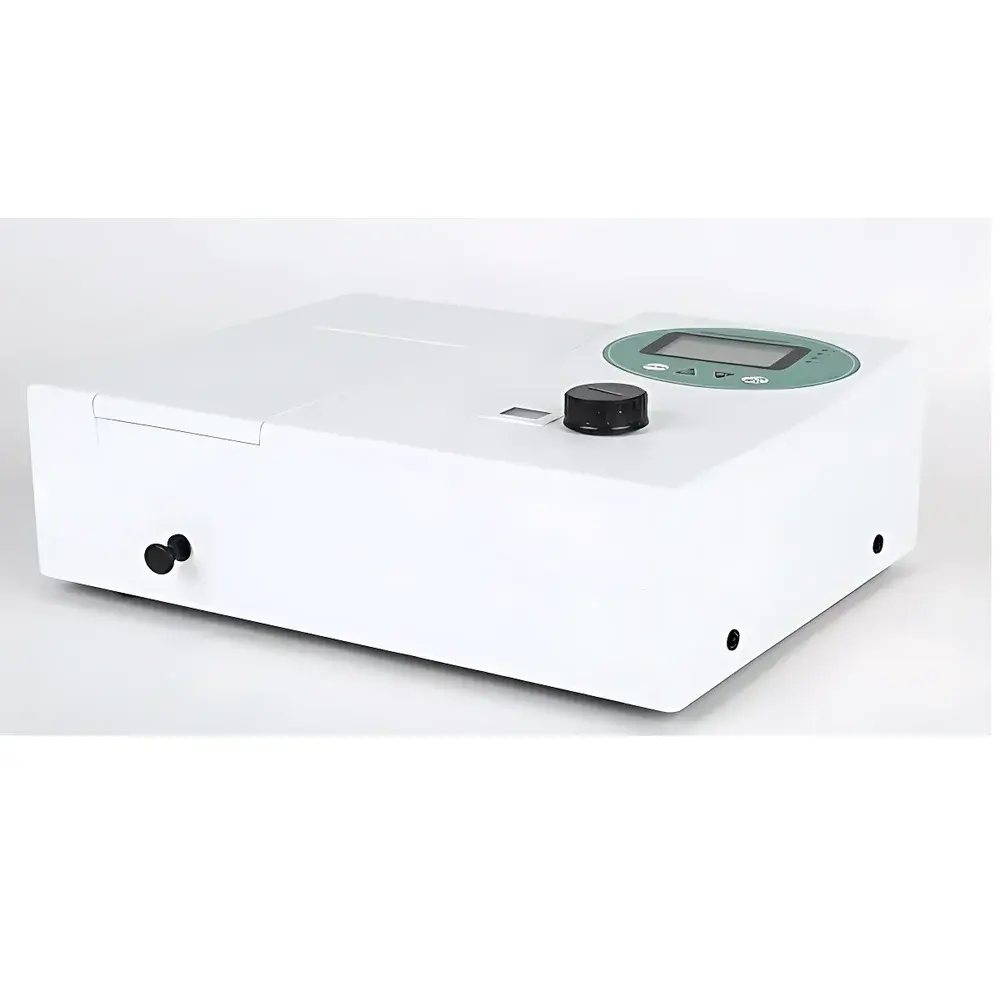
Hailong UV-Vis Spectrophotometer Series 722 / 72S / 722N / X2
| Brand | Hailong |
|---|---|
| Origin | Shanghai, China |
| Model | 722 / 72S / 722N / X2 |
| Price Range | USD 0–799 |
| Optical Design | Dual-wavelength |
| Detector Type | Photomultiplier Tube (PMT) |
| Wavelength Range | 325–1000 nm |
| Wavelength Scanning | Motorized automatic wavelength selection |
| Spectral Bandwidth | 4–5 nm |
| Wavelength Accuracy | ±2 nm |
| Stray Light | ≤0.2% T at 360 nm |
| Photometric Accuracy | ±0.5% T |
| Photometric Repeatability | ≤0.2% T |
| Baseline Stability | ±0.002 A/h at 500 nm |
| Light Source | Imported tungsten-halogen lamp |
| Monochromator | Czerny-Turner self-collimating design |
| Sample Compartment | Accommodates cuvettes from 5 mm to 50 mm pathlength |
| Interface | USB 2.0 |
| Operating Modes | Transmittance (T), Absorbance (A), Concentration (C), Factor (F) |
| Zero Adjustment | Fully automated OA and 100% T calibration |
| Dimensions | 400 × 310 × 160 mm |
| Weight | 6 kg |
Overview
The Hailong UV-Vis Spectrophotometer Series (Models 722, 72S, 722N, and X2) is a benchtop single-beam spectrophotometric system engineered for routine quantitative and qualitative analysis in academic teaching laboratories, QC/QA environments, and industrial process support applications. Operating on the principle of Beer-Lambert law-based absorption spectroscopy, these instruments measure the attenuation of monochromatic light as it passes through a sample solution within the visible and near-ultraviolet spectral region (325–1000 nm). Designed with a Czerny-Turner self-collimating monochromator and a high-efficiency 1200-line/mm diffraction grating, the series delivers consistent spectral resolution and photometric linearity across its operational range. The inclusion of an imported tungsten-halogen lamp ensures stable radiant output over extended operation cycles, while the photomultiplier tube (PMT) detector provides high signal-to-noise ratio and rapid response—critical for reproducible absorbance measurements in time-sensitive protocols.
Key Features
- Motorized automatic wavelength scanning with ±2 nm accuracy and ≤1 nm repeatability—enabling precise spectral positioning without manual adjustment.
- Dual-wavelength optical architecture supports comparative analysis (e.g., differential absorbance, background correction) and simultaneous monitoring at two discrete wavelengths.
- Automated zeroing and 100% transmittance calibration routines reduce operator dependency and minimize systematic drift between measurement sessions.
- USB 2.0 interface enables direct connectivity to Windows-based PCs; compatible with optional XP Professional Analysis Software for advanced data acquisition, kinetic profiling, and multi-point calibration workflows.
- Wide sample compartment accommodates standard rectangular cuvettes (5 mm to 50 mm pathlength), facilitating flexibility in sample volume and concentration optimization.
- Compact footprint (400 × 310 × 160 mm) and lightweight construction (6 kg) support portability between labs or integration into space-constrained analytical workstations.
- Spectral bandwidth of 4–5 nm balances resolution and signal intensity—optimized for compliance with common pharmacopeial and industrial method requirements where narrow bandwidths are not mandated.
Sample Compatibility & Compliance
These spectrophotometers accept liquid samples in quartz, glass, or plastic cuvettes compatible with standard 12.5 mm or 16 mm external dimensions. The system supports aqueous, organic, and mildly acidic/basic solutions typical in dye analysis, enzyme kinetics, water quality testing (e.g., nitrate, phosphate), and pharmaceutical excipient verification. While not certified for GMP-regulated production environments, the instrument’s photometric accuracy (±0.5% T), stray light performance (≤0.2% T at 360 nm), and baseline stability (±0.002 A/h at 500 nm) meet the minimum performance thresholds outlined in ASTM E275, ISO 6059, and USP for non-GxP educational and research-grade instrumentation. Automated calibration routines and digital logging (via optional software) support GLP-aligned documentation practices when used in regulated academic or contract research settings.
Software & Data Management
The optional XP Professional Analysis Software provides a Windows-native graphical interface supporting T/A/C/F mode switching, multi-point calibration curve generation (linear, polynomial), kinetic time-scan acquisition, and wavelength scanning with peak identification. All raw absorbance and transmittance data are exportable in CSV format for downstream statistical analysis in Excel, R, or Python-based platforms. The software implements audit-trail-capable session logging—including operator ID, timestamp, wavelength setting, and calibration status—facilitating traceability in teaching labs and preliminary method development studies. USB communication ensures deterministic data transfer without reliance on proprietary drivers or legacy serial adapters.
Applications
- Quantitative determination of analyte concentration using single-point or multi-point calibration (C = kA + b).
- Verification of reagent purity and standard solution preparation in chemistry and biochemistry teaching labs.
- Monitoring of enzymatic reaction rates via time-resolved absorbance changes at characteristic wavelengths (e.g., NADH at 340 nm).
- Colorimetric assays for environmental parameters including COD, iron, copper, and total phosphorus in wastewater samples.
- Quality control of dyes, pigments, and food colorants across visible spectral bands (400–700 nm).
- Validation of filter performance and optical material transmission characteristics.
FAQ
What wavelength range does this instrument cover?
It operates from 325 nm to 1000 nm, covering the near-UV, visible, and near-infrared regions—suitable for most routine absorbance measurements in chemistry and life sciences.
Is the instrument compliant with FDA 21 CFR Part 11?
No. It lacks electronic signature capability, role-based access control, and permanent audit trail storage required for Part 11 compliance. However, optional software provides basic session logging suitable for GLP documentation.
Can I use plastic cuvettes?
Yes—standard polystyrene or acrylic cuvettes are acceptable for visible-range measurements (≥350 nm); quartz cuvettes are recommended for UV measurements below 350 nm.
Does the system support kinetic measurements?
Yes, when used with XP Professional Analysis Software, it enables time-scan mode with user-defined interval and duration settings.
What maintenance is required?
Routine cleaning of the sample compartment and optical window; annual verification of wavelength and photometric accuracy using NIST-traceable filters or holmium oxide reference standards is recommended.




