
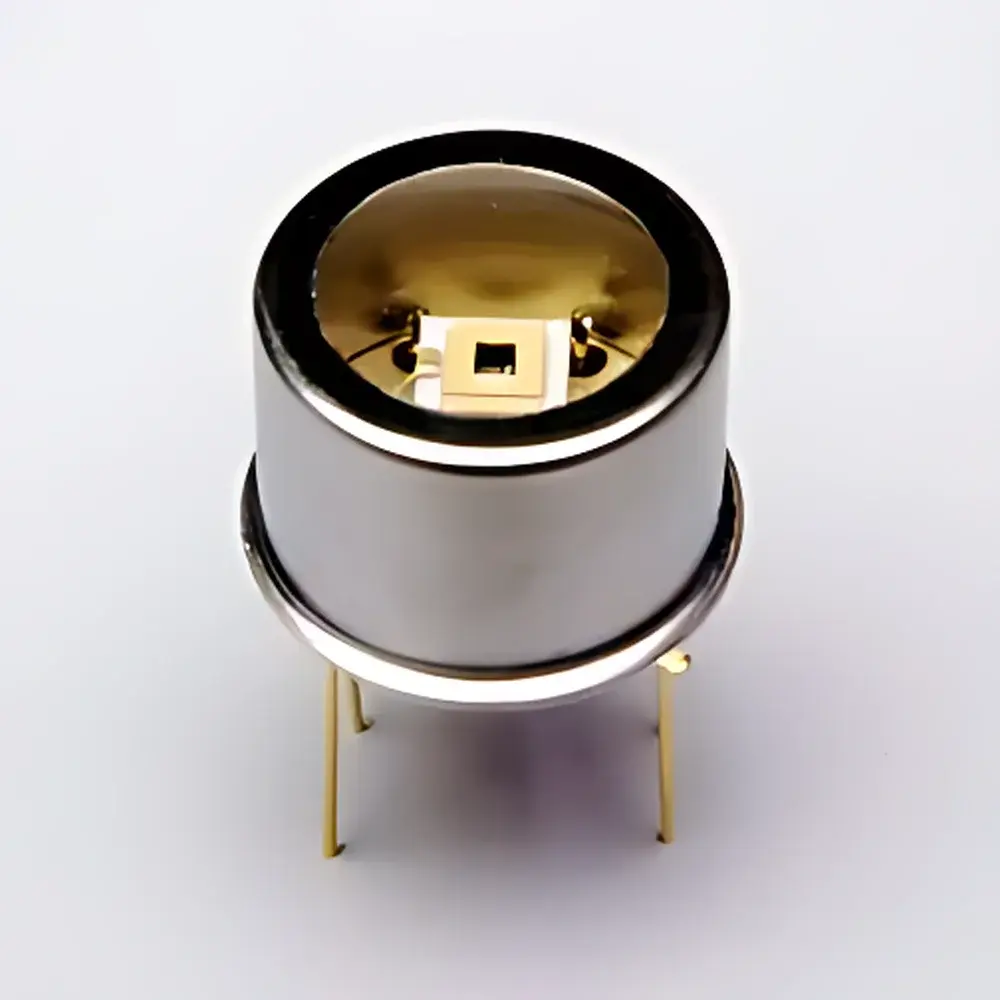
Hamamatsu InAsSb Photovoltaic IR Detector P11120-201
| Brand | Hamamatsu |
|---|---|
| Origin | Japan |
| Manufacturer Type | Original Equipment Manufacturer (OEM) |
| Product Origin | Imported |
| Model | P11120-201 |
| Cooling | Two-stage thermoelectric (TE) cooled |
| Package | TO-8 metal can |
| Photosensitive Area | Ø1 mm |
| Spectral Cutoff Wavelength (typ.) | 5.9 µm |
| Peak Responsivity Wavelength (typ.) | 4.9 µm |
| Responsivity (typ.) | 1.6 A/W |
| Detectivity D* (typ.) | 5.0 × 10⁹ cm·Hz¹ᐟ²/W |
| Rise Time (typ.) | 0.4 µs |
| Operating Temperature | −30 °C (detector element) |
| Material | InAsSb (Indium Arsenide Antimonide) |
| Environmental Compliance | RoHS-compliant, Pb-free packaging |
Overview
The Hamamatsu P11120-201 is a high-performance, two-stage thermoelectrically cooled photovoltaic infrared detector engineered for precision mid-infrared gas analysis in industrial and environmental monitoring applications. Based on lattice-matched InAsSb (indium arsenide antimonide) epitaxial material grown via Hamamatsu’s proprietary crystal growth process, this detector delivers exceptional quantum efficiency and signal-to-noise ratio in the critical 4–5.5 µm spectral window—encompassing fundamental vibrational absorption bands of key greenhouse and pollutant gases including CO₂ (4.26 µm), CO (4.67 µm), NO (5.33 µm), NO₂ (6.2 µm, with tail sensitivity), SO₂ (7.3 µm, via extended response shoulder), and CH₄ (3.3 µm, with second harmonic overlap). Unlike cryogenic liquid nitrogen-cooled alternatives, the P11120-201 integrates a compact, hermetically sealed TO-8 metal package with integrated two-stage TE cooling, enabling stable operation at −30 °C without external cryogens or vacuum infrastructure. Its photovoltaic (PV) structure—featuring a monolithic InAsSb p–n junction—eliminates bias current noise and ensures intrinsic DC-coupled response, making it ideal for lock-in amplification, wavelength-modulated spectroscopy (WMS), and pulsed quantum cascade laser (QCL) detection schemes.
Key Features
- High responsivity of 1.6 A/W at λp = 4.9 µm under −30 °C operating conditions
- Specific detectivity D* ≥ 5.0 × 10⁹ cm·Hz¹ᐟ²/W (measured at λ = λp, fc = 1.2 kHz, Δf = 1 Hz)
- Sub-microsecond temporal response: 0.4 µs rise time enables MHz-rate modulation compatibility
- Compact, robust TO-8 metal-can package with integrated two-stage thermoelectric cooler and temperature sensor
- RoHS-compliant, lead-free construction with InAsSb active layer—no HgCdTe toxicity or regulatory restrictions
- Hermetic sealing ensures long-term stability in humid or particulate-rich ambient environments typical of stack monitoring and ambient air quality stations
Sample Compatibility & Compliance
The P11120-201 is designed for integration into extractive and open-path gas analyzers compliant with international emission monitoring standards, including EPA Method 320, EN 15267-3 (QAL1-certifiable systems), and ISO 12039 (CO/NO/SO₂ continuous emission monitoring). Its linear photoresponse across input irradiance from 10⁻⁸ to 10⁻³ W/cm² supports both low-concentration ambient air measurements and high-dynamic-range industrial flue gas analysis. The detector meets IEC 61000-6-2 (immunity) and IEC 61000-6-3 (emissions) requirements when mounted within properly shielded optical modules. No special disposal protocols are required—InAsSb composition avoids restricted substances listed under EU Directive 2011/65/EU Annex II.
Software & Data Management
While the P11120-201 is a component-level detector—not a standalone instrument—it is fully compatible with industry-standard data acquisition platforms supporting analog voltage/current output interfaces (e.g., National Instruments PXIe-6368, Keysight 34972A). When embedded in OEM gas analyzer systems, its output integrates seamlessly with firmware implementing ASTM D6348-10–compliant calibration routines, real-time zero/span drift correction, and audit-trail logging per FDA 21 CFR Part 11 requirements where applicable. Hamamatsu provides comprehensive SPICE models and thermal transient simulation parameters for system-level noise budgeting and TE controller design.
Applications
- Continuous Emission Monitoring Systems (CEMS) for combustion exhaust streams (coal, biomass, waste incineration)
- Portable and fixed-site ambient air quality analyzers targeting urban NOx/SOx hotspots
- Industrial process control in petrochemical cracking units and ammonia synthesis plants
- Calibration transfer standards for FTIR and QCL-based multi-gas analyzers
- Research-grade tunable diode laser absorption spectroscopy (TDLAS) platforms requiring high-speed, low-noise detection at 4.5–5.2 µm
FAQ
Is the P11120-201 suitable for use with pulsed QCL sources?
Yes—the 0.4 µs rise time and photovoltaic architecture support direct coupling to nanosecond-pulsed QCLs without external bias or bandwidth-limiting amplification.
Does this detector require vacuum evacuation or getter maintenance?
No—hermetic TO-8 metal packaging eliminates the need for vacuum reconditioning or reactive getters common in dewar-based detectors.
Can the P11120-201 be operated at temperatures warmer than −30 °C?
Performance degrades predictably above −30 °C; D* falls by ~15% per +5 °C ambient increase. Stable operation is guaranteed only within the specified TE-controlled range.
What optical interface options are available?
Standard configuration includes plano-plano AR-coated (4–6 µm) sapphire window; custom wedged windows or fiber-pigtailed variants are available under OEM agreement.
Is NIST-traceable calibration data provided?
Hamamatsu supplies factory-measured spectral responsivity curves and D* vs. temperature datasets; full NIST-traceable calibration requires third-party lab services per ISO/IEC 17025.
Related Products







