
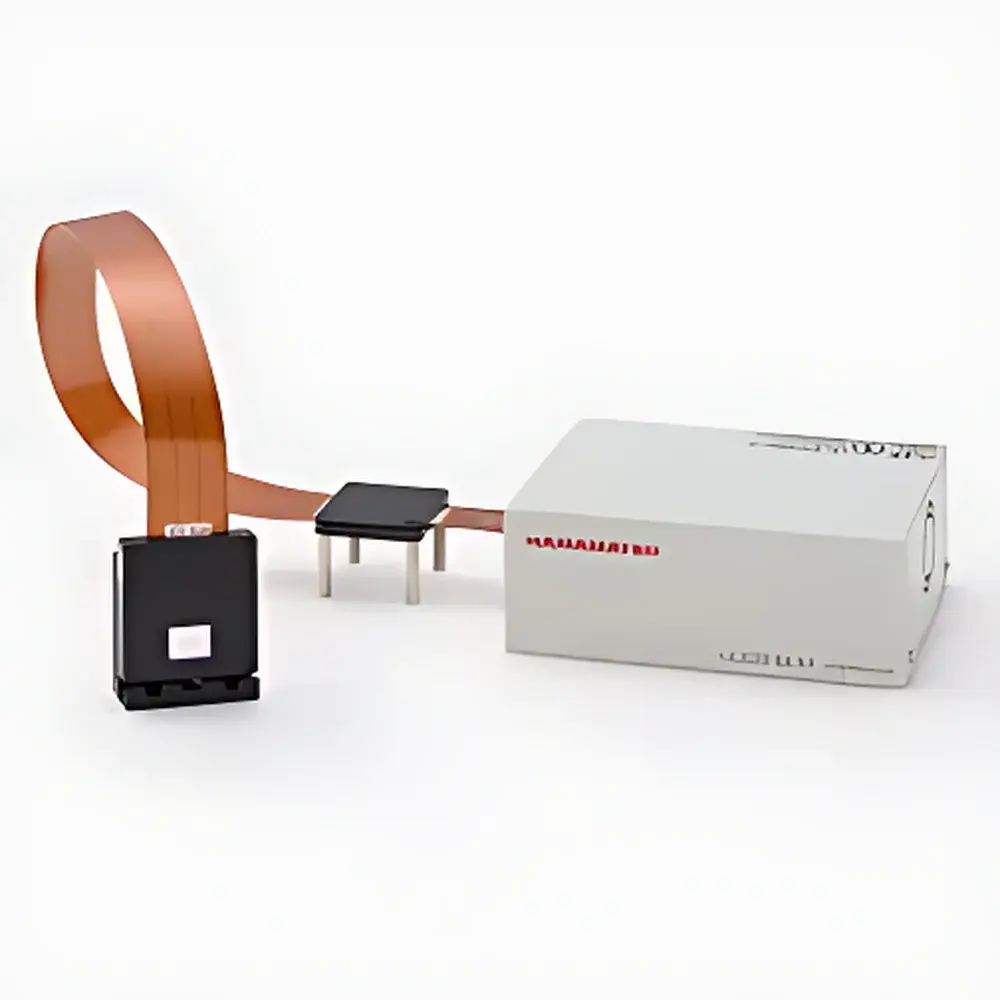
Hamamatsu LCOS-SLM (Spatial Light Modulator) X15213-19
| Brand | Hamamatsu |
|---|---|
| Origin | Japan |
| Manufacturer | Hamamatsu Photonics K.K. |
| Type | Reflective Pure-Phase LCOS Spatial Light Modulator |
| Model | X15213-19 |
| Wavelength Range | 1850–2050 nm |
| Pixel Count | 1272 × 1024 |
| Pixel Pitch | 12.5 µm |
| Active Area | 15.9 × 12.8 mm |
| Fill Factor | 96% |
| DVI Input | SXGA (1280 × 1024), 60 Hz, 8-bit (256 levels) |
| Interface | DVI-D + USB-B (USB 2.0 High-Speed) |
| Rise Time | 30 ms |
| Fall Time | 155 ms |
| Optical Efficiency | 97% (measured at λ = 1064 nm) |
| Maximum Spatial Resolution | 40 lp/mm |
| Operating Mode | Reflective, Voltage-Driven Phase Modulation |
Overview
The Hamamatsu LCOS-SLM X15213-19 is a high-performance reflective pure-phase spatial light modulator engineered for precision wavefront control in mid-infrared and near-infrared optical systems. Based on silicon-backplane liquid crystal on silicon (LCOS) technology, this device enables pixel-level voltage-controlled phase modulation of incident light without amplitude distortion—making it ideal for adaptive optics, holographic beam shaping, quantum optics experiments, and coherent laser pulse shaping. Unlike transmissive SLMs, the reflective architecture minimizes thermal load and supports higher average optical power handling, particularly critical in applications involving amplified femtosecond or CW laser sources operating between 1850 nm and 2050 nm. The device integrates a monolithic LCOS microdisplay with integrated driver electronics optimized for low-latency, high-fidelity phase mapping. Its 12.5 µm pixel pitch and 96% fill factor collectively ensure minimal diffraction-induced noise and maximized first-order diffraction efficiency—key parameters for high-contrast interferometry and closed-loop wavefront correction.
Key Features
- Pure-phase modulation mode with negligible amplitude coupling—enabling high-fidelity complex field synthesis
- 97% optical utilization efficiency at 1064 nm (representative benchmark wavelength), validated under collimated illumination and calibrated detection conditions
- Reflective configuration supporting high-power operation; compatible with laser sources up to several watts average power when properly heat-sinked and aligned
- SXGA-native resolution (1272 × 1024 active pixels) with 8-bit grayscale input (256 discrete phase levels), enabling fine-grained wavefront discretization
- DVI-D interface standard compliance—eliminates need for proprietary frame grabbers or FPGA-based controllers; fully compatible with commercial Windows/Linux PCs equipped with DVI output
- Integrated USB-B (USB 2.0 High-Speed) port for firmware updates, calibration data loading, and real-time phase map synchronization
- Factory-calibrated nonlinearity compensation tables stored onboard—correcting for LC birefringence hysteresis and voltage-to-phase response deviations across temperature and drive history
Sample Compatibility & Compliance
The X15213-19 is designed for integration into ISO-standard optical benches and vacuum-compatible optomechanical enclosures (with optional mounting flange kits). It complies with IEC 61000-6-3 (EMC emission limits) and IEC 61000-6-2 (immunity requirements) for laboratory instrumentation. While not certified for medical or aerospace deployment out-of-box, its phase stability (< ±0.02π RMS over 1 hour at 23°C ambient) and repeatability meet typical requirements for GLP-aligned optical metrology workflows. No hazardous substances are used per RoHS Directive 2011/65/EU. Device operation requires no consumables and exhibits no measurable outgassing in UHV environments when mounted with stainless-steel hardware.
Software & Data Management
Hamamatsu provides the SLM Control Studio software suite (Windows 10/11, 64-bit), which supports real-time phase pattern generation—including Zernike decomposition, Gerchberg-Saxton algorithm iteration, and user-defined LUT import. All phase maps are timestamped and logged with system metadata (temperature, frame count, DVI sync status) in HDF5 format for traceability. Audit trails comply with FDA 21 CFR Part 11 principles when deployed with network-authenticated user accounts and write-protected storage volumes. Third-party integration is supported via DLL APIs (C/C++, Python ctypes) and MATLAB Instrument Control Toolbox drivers. Raw DVI frame buffers can be captured and analyzed using industry-standard tools such as Thorlabs’ Kinesis or Newport’s Interactive LabVIEW modules.
Applications
- Adaptive optics in astronomical telescopes: dynamic correction of atmospheric turbulence-induced aberrations using Shack-Hartmann sensor feedback loops
- Quantum information processing: generation and manipulation of orbital angular momentum (OAM) states for high-dimensional entanglement encoding
- Mid-IR free-space optical communications: programmable beam steering and mode multiplexing in 2-µm telecom bands
- Ultrafast laser pulse shaping: spectral phase control in 4f-zero-dispersion compressors for chirped pulse amplification systems
- Optical trapping and micromanipulation: creation of reconfigurable multi-spot or vortex trap arrays in biological specimen handling
- Industrial metrology: calibration of interferometric sensors and structured-light 3D profilometers requiring stable, repeatable reference wavefronts
FAQ
What is the maximum safe incident power density for continuous-wave operation at 1950 nm?
For collimated illumination with uniform intensity distribution and active thermal management (e.g., Peltier-cooled mount), the recommended maximum power density is 500 W/cm². Exceeding this threshold may induce localized LC alignment drift or long-term birefringence degradation.
Can the X15213-19 be synchronized with external TTL triggers for pulsed laser applications?
Yes—via the optional SYNC-IN BNC port (available on custom-configured units), enabling sub-microsecond jitter lock to Q-switched or mode-locked laser pulses. Standard units require USB-triggered frame advancement with ~2 ms latency.
Is phase calibration data transferable between individual X15213-19 units?
No—calibration is unit-specific due to LC cell thickness variation and backplane voltage nonuniformity. Each device ships with a unique factory-generated .cal file that must be loaded prior to quantitative phase measurements.
Does the device support grayscale inversion or gamma correction in real time?
Yes—SLM Control Studio includes real-time gamma lookup table adjustment (0.1–3.0 range) and polarity inversion toggle, both applied pre-DVI transmission to preserve bit-depth fidelity.
What is the minimum resolvable phase step under closed-loop operation?
With full 8-bit input and factory linearization, the effective phase resolution is ≤ 0.008π radians (≈ 1.4°) across the central 80% of the active area, verified via Mach-Zehnder interferometry with HeNe reference.



