
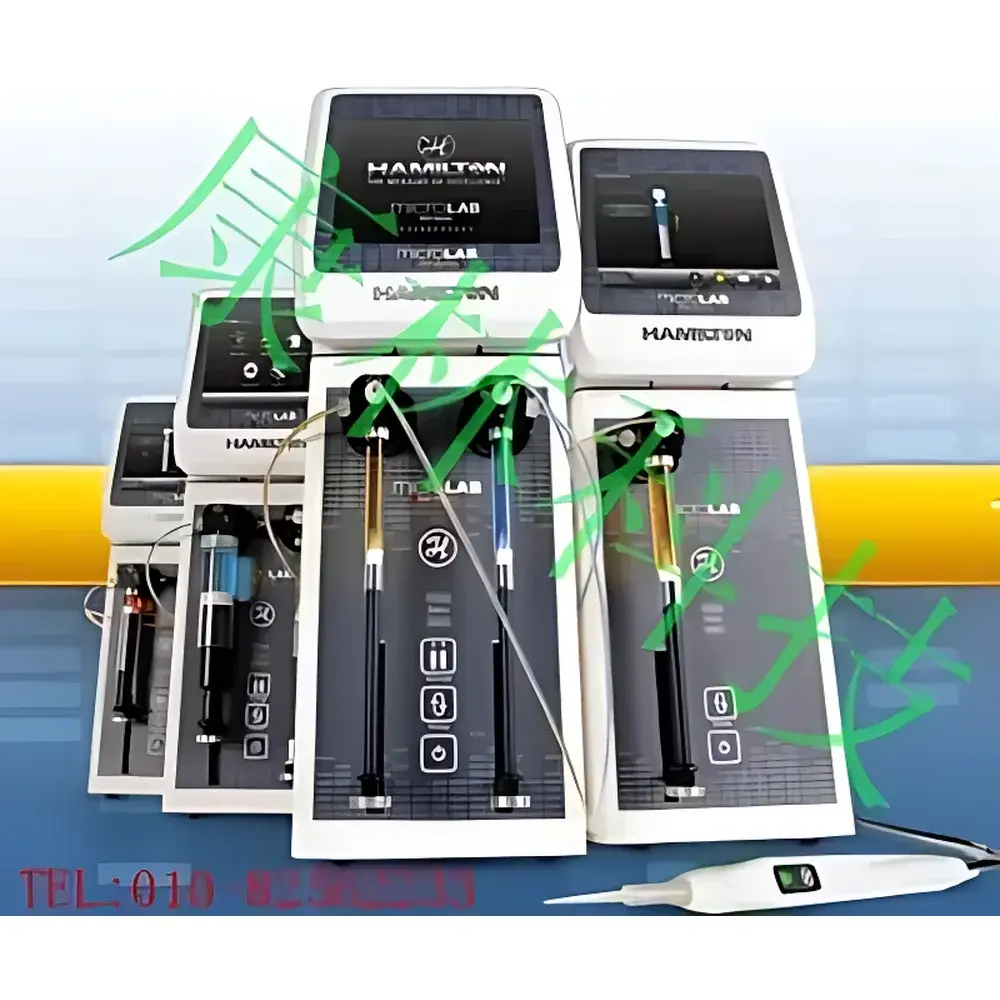
Hamilton MicroLab 600 Dual-Channel Precision Dilution and Dispensing System
| Brand | HAMILTON |
|---|---|
| Origin | USA |
| Model | MicroLab 600 |
| Instrument Type | Dual-Channel Motorized Liquid Handler |
| Channels | 2 |
| Maximum Syringe Volume | 100 mL |
| Minimum Dispense Volume | 100 nL |
| Accuracy | ±0.1% |
| Operating Principle | Positive-Displacement Syringe Pump Technology |
| Fluid Compatibility | Broad chemical resistance (including concentrated acids, bases, and organic solvents) |
| Residual Volume | <1 µL per cycle |
| Compliance | Designed for GLP/GMP environments with audit-trail-ready operation |
Overview
The Hamilton MicroLab 600 is a dual-channel, motorized precision liquid handling system engineered for reproducible dilution, proportional dispensing, titration, and serial preparation of aqueous and non-aqueous solutions in regulated laboratory environments. Unlike air-displacement pipettes or peristaltic pumps, the MicroLab 600 employs positive-displacement syringe pump technology—where fluid movement is directly coupled to plunger displacement within chemically inert glass or PTFE-lined syringes. This architecture eliminates compressibility errors, vapor pressure interference, and viscosity-dependent variability, enabling consistent volumetric delivery across a wide dynamic range—from 100 nanoliters to 50 milliliters per dispense. Its closed-loop motion control system ensures traceable, repeatable positioning and flow rate modulation, making it suitable for applications demanding metrological rigor and process documentation.
Key Features
- Dual independent syringe channels with synchronized or asynchronous operation, supporting parallel workflows such as master mix preparation and sample dilution.
- High-fidelity syringe drive mechanism delivering ±0.1% volumetric accuracy and <0.5% coefficient of variation (CV) across full volume range, validated per ISO 8655-5 and ASTM E2758 standards.
- Chemically resistant fluid path constructed from borosilicate glass, sapphire, PTFE, and ETFE—compatible with 98% sulfuric acid, 50% sodium hydroxide, acetonitrile, DMSO, and other aggressive solvents without degradation or carryover.
- Ultra-low residual volume design: <1 µL per aspiration/dispense cycle, minimizing cross-contamination and reagent waste in high-value assays.
- Intuitive graphical user interface (GUI) with real-time status visualization—including plunger position, flow direction, current volume, and error diagnostics—enabling rapid method setup without programming expertise.
- Modular hardware architecture supporting optional accessories: barcode readers for sample tracking, temperature-controlled deck modules, and integration-ready RS-232/USB/Ethernet interfaces.
Sample Compatibility & Compliance
The MicroLab 600 accommodates diverse sample matrices including viscous biological fluids (e.g., serum, synovial fluid), volatile organic solvents (e.g., chloroform, ether), and corrosive inorganic reagents. Its syringe-based architecture inherently mitigates aerosol generation and evaporation artifacts common in open-air dispensing systems. The instrument is designed to support compliance with international quality frameworks: its operational logs—including timestamped dispense events, syringe calibration records, and user authentication entries—meet ALCOA+ data integrity principles. While not FDA 21 CFR Part 11–certified out-of-the-box, the system supports electronic signature implementation and audit trail export when deployed with validated LIMS or ELN platforms under controlled SOPs.
Software & Data Management
The embedded firmware provides method storage for up to 100 preconfigured protocols, each defining aspiration/dispense sequences, dwell times, mixing cycles, and rinse steps. All operations generate immutable event logs containing operator ID, date/time stamp, syringe ID, volume setpoints, actual delivered volumes, and system status flags. Raw log files export in CSV format for downstream analysis or regulatory submission. Optional Hamilton VENUS software extends functionality with drag-and-drop workflow builder, multi-instrument coordination, and electronic batch record (EBR) generation aligned with GAMP 5 guidelines. Data security adheres to IEC 62443-3-3 requirements for industrial control systems.
Applications
- Chromatography sample preparation: Accurate dilution of stock standards for HPLC/UHPLC calibration curves and QC reference materials.
- Environmental testing: Reproducible spiking of certified reference materials into soil extracts or wastewater samples per EPA Method 8082 and ISO 17294-2.
- Geochemical analysis: Precise dosing of internal standards (e.g., indium, rhodium) during ICP-MS sample introduction.
- Clinical diagnostics: Automated preparation of hemolysate dilutions and calibrator series for CBC analyzers.
- Forensic toxicology: Controlled dispensing of methanol/acetonitrile extraction solvents and internal standard solutions in GC-MS workflows.
- Method development labs: Rapid iteration of formulation ratios for buffer optimization, stability studies, and excipient screening.
FAQ
What types of syringes are supported?
Standard configurations include 10 µL, 100 µL, 1 mL, 10 mL, and 100 mL glass or PTFE-sleeved syringes; custom syringe adapters are available for third-party components.
Can the MicroLab 600 be integrated into automated lab platforms?
Yes—it features industry-standard communication protocols (RS-232, USB CDC, Modbus TCP) and exposes a command-line interface (CLI) for seamless orchestration via robotic middleware or scheduling engines.
Is calibration traceable to NIST standards?
Syringe calibration certificates are provided with each unit, referencing gravimetric verification against NIST-traceable weights and certified water density tables per ISO/IEC 17025-accredited procedures.
How is maintenance performed on the fluid path?
The entire wetted path disassembles without tools; syringes, valves, and tubing are consumables with documented replacement intervals and wear-life specifications in the service manual.
Does the system support multi-step dilution protocols with intermediate mixing?
Yes—each method step can include defined agitation cycles (reciprocating plunger motion), pause durations, and rinse sequences using dedicated wash solvent ports.



