
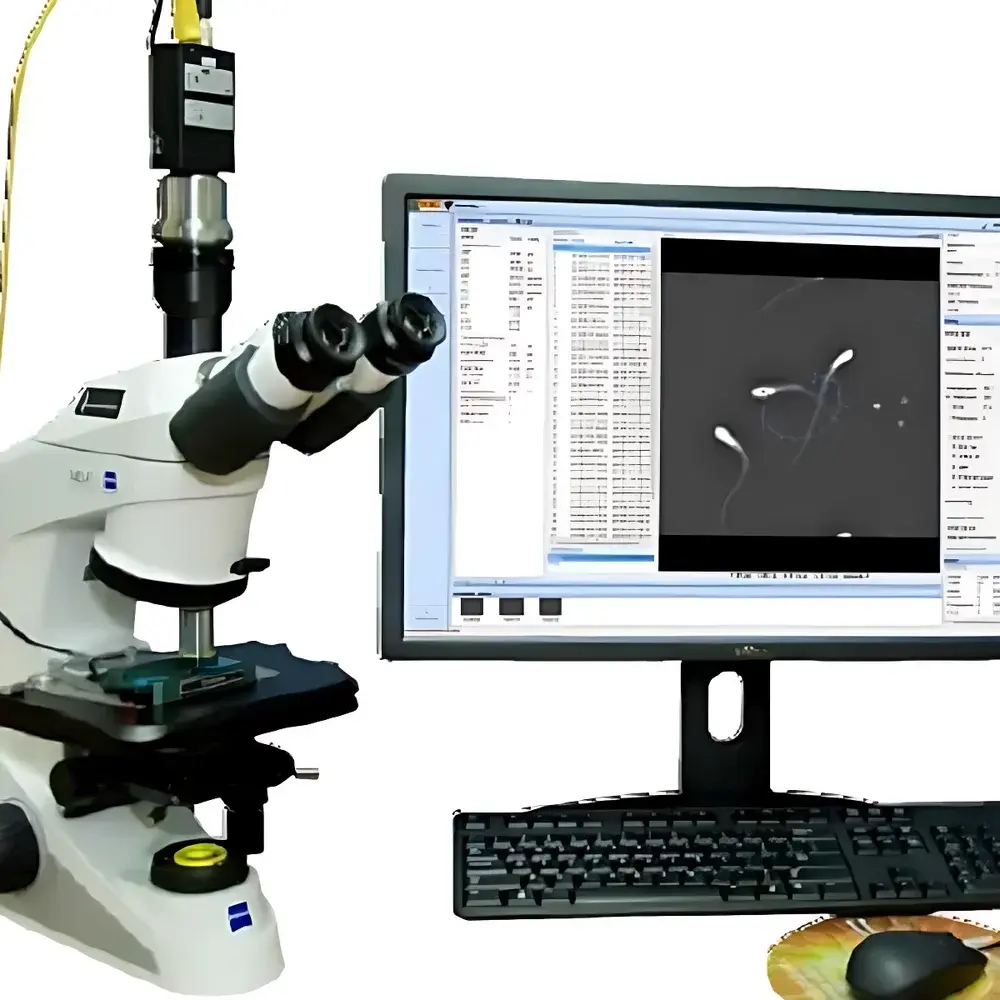
Hamilton Thorne CEROS II Sperm Analysis System
| Brand | Hamilton Thorne |
|---|---|
| Origin | USA |
| Model | CEROS II |
| Microscope Compatibility | Olympus CX41 or Zeiss Axio Lab.A1 with 10× phase contrast objective |
| Camera | Monochrome digital, 60 fps at full resolution (782 × 582 pixels) |
| Software | Animal Breeder II |
| Optional Accessories | MiniTherm heated stage (37 °C calibrated), temperature verification plate, Leja 4/8-chamber slides or standard glass slides |
| Compliance | Designed for GLP-compliant semen analysis workflows |
Overview
The Hamilton Thorne CEROS II Sperm Analysis System is a computer-assisted semen analysis (CASA) platform engineered for precision, reproducibility, and regulatory readiness in veterinary, agricultural, and translational research laboratories. It employs high-speed digital imaging coupled with proprietary motion-tracking algorithms to quantify sperm motility, concentration, and morphometric parameters in accordance with standardized CASA methodology. Based on phase-contrast microscopy and real-time centroid-based trajectory reconstruction, the system captures and analyzes individual sperm kinematics—including progressive velocity, lateral head displacement, and beat-cross frequency—while maintaining full traceability of raw video, calibration metadata, and user-defined analysis settings. Its architecture supports routine use in bovine, equine, porcine, ovine, and avian semen evaluation, as well as specialized applications in transgenic animal model development and conservation biology.
Key Features
- Color-coded illumination interface: Dynamically adjusts LED spectrum to render sperm heads in blue and tails in red—eliminating subjective lighting optimization and ensuring inter-operator consistency across daily QC checks.
- Real-time kinetic feedback: All motion parameters (VAP, VSL, VCL, ALH, STR, LIN, BCF, WOB, DSL, DCL, OAP) update continuously during acquisition, enabling immediate protocol adjustment without post-hoc reprocessing.
- Fully collapsible UI layout: Modular panels allow simultaneous access to live imaging, trajectory visualization, morphology measurement tools, and summary statistics—optimized for dual-monitor workstation deployment.
- High-fidelity imaging hardware: Integrated monochrome camera delivers 60 fps at 782 × 582 pixel resolution, capturing subtle flagellar undulations critical for distinguishing hyperactivated vs. linear motility patterns.
- Thermal control integration: Optional MiniTherm heated stage maintains sample temperature at 37 °C ± 0.3 °C via PID-regulated feedback; includes NIST-traceable temperature verification plate with visual color-change indicator.
Sample Compatibility & Compliance
The CEROS II accommodates both disposable Leja chambers (4- and 8-well formats) and conventional glass slides, with mechanical clamping options supporting rapid throughput in high-volume breeding operations. All analysis protocols adhere to ISO 20665:2017 (Animal reproduction — Semen analysis — General requirements) and align with FAO guidelines for livestock AI program quality assurance. When deployed with validated SOPs and electronic signature-enabled reporting modules, the system meets foundational requirements for GLP documentation and supports 21 CFR Part 11 compliance through configurable audit trails, user access controls, and immutable data archiving.
Software & Data Management
Animal Breeder II software provides native support for multi-field batch analysis, customizable dose calculations (e.g., total motile sperm per ejaculate, adjusted volume/concentration), and automated morphology segmentation using adaptive thresholding and elliptical Fourier descriptors. Morphometric outputs include head length, width, perimeter, area, tail length, distal/proximal droplet identification (annotated in orange overlay during playback), and structural anomaly counters (bent/coiled tail, DMR index). Reporting is managed via a drag-and-drop Report Designer module—enabling inclusion of non-analytical metadata (e.g., operator ID, facility stamp, client reference codes) alongside quantitative results. Export formats include CSV, PDF, and XML for LIMS integration.
Applications
- Commercial livestock AI centers: Routine assessment of bull, stallion, and boar semen batches prior to cryopreservation or insemination.
- Veterinary diagnostic labs: Evaluation of subfertility etiologies in companion animals and exotic species.
- Academic reproductive physiology: Longitudinal tracking of sperm functional decline under thermal, oxidative, or pharmacological stress.
- Transgenic animal core facilities: Quality control of founder line semen used in CRISPR/Cas9 embryo injection pipelines.
- Wildlife conservation programs: Standardized comparison of ejaculate metrics across endangered ungulate or avian populations.
FAQ
What microscope models are certified for use with CEROS II?
Olympus CX41 and Zeiss Axio Lab.A1 microscopes equipped with 10× phase contrast objectives are fully supported. Third-party systems may be integrated subject to optical path validation and magnification calibration.
Does CEROS II support DNA fragmentation analysis?
The base system does not perform direct DNA integrity assessment; however, it integrates seamlessly with commercial SCSA or TUNEL assay workflows by exporting time-stamped, field-matched image sets for correlative analysis.
Can morphology measurements be exported for statistical modeling?
Yes—head dimensions, tail metrics, and droplet annotations are output as structured numerical arrays compatible with R, Python (pandas), and SAS for multivariate regression or machine learning pipeline ingestion.
Is remote system monitoring available?
While CEROS II lacks built-in telemetry, its Windows-based architecture permits secure remote desktop access via institutional IT-approved protocols for off-site troubleshooting and training support.
How is calibration verified across operators?
Each session requires microsphere-based calibration using supplied 10-µm polystyrene beads; calibration logs—including date, operator, bead lot, and pixel-to-micron ratio—are embedded in every analysis file and retained in the audit trail.





