
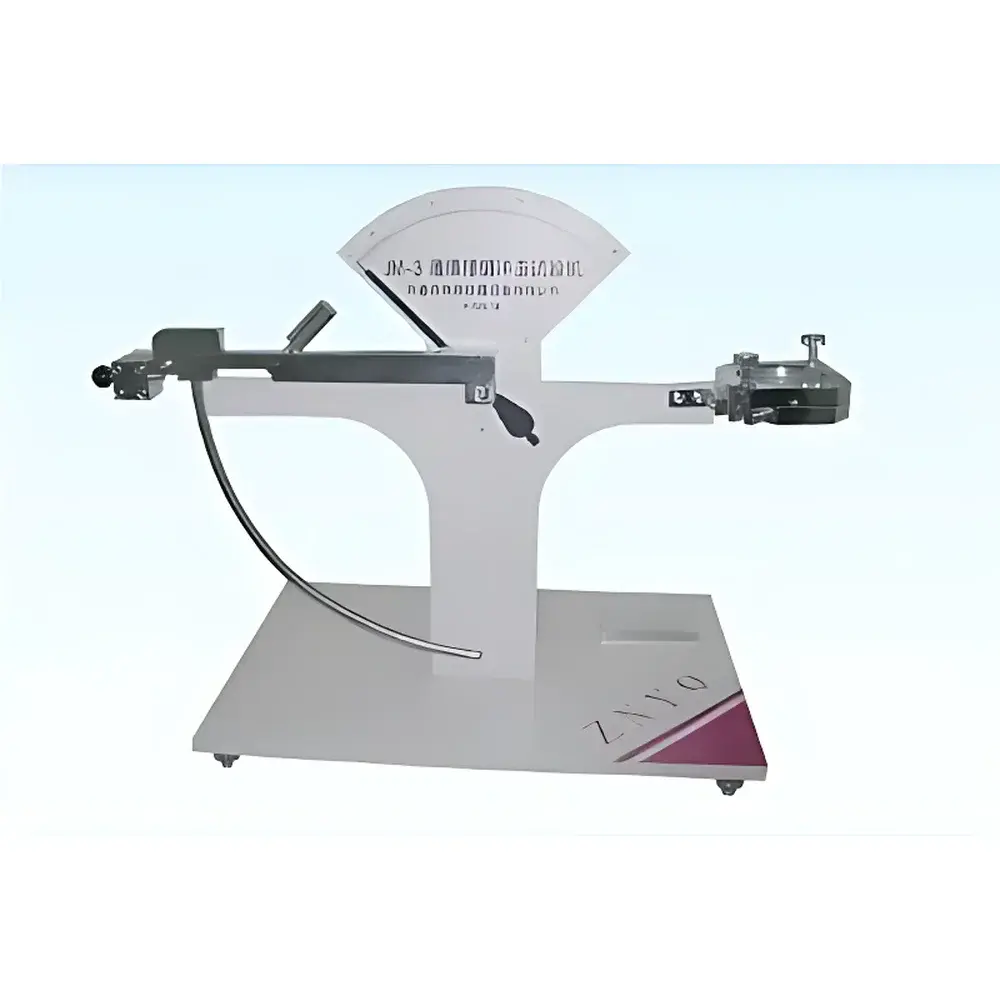
Changchun Intelligent JM-3 Film Pendulum Impact Tester
| Brand | Changchun Intelligent |
|---|---|
| Origin | Jilin, China |
| Model | JM-3 |
| Max Impact Energy | 3 J |
| Specimen Dimensions | 100 mm × 100 mm |
| Clamp Aperture Diameters | Φ89 mm, Φ60 mm |
| Punch Diameters | Φ25.4 mm, Φ12.7 mm |
| Pendulum Arm Radius | 300 mm |
| Pendulum Lift Angle | 90° |
Overview
The Changchun Intelligent JM-3 Film Pendulum Impact Tester is a precision mechanical instrument engineered for the quantitative evaluation of impact resistance in thin polymeric films and flexible sheet materials—including thermoplastics, elastomers, laminates, and coated substrates. It operates on the classical pendulum impact principle derived from ASTM D1709 (Standard Test Methods for Impact Resistance of Plastic Film by the Free-Falling Dart Method) and ISO 6603-2 (Plastics—Determination of Impact Behaviour—Part 2: Instrumented Pendulum Impact Testing), adapted for controlled pendulum-based energy delivery. A calibrated pendulum arm, released from a fixed 90° elevation, accelerates a hemispherical punch along a fixed arc (R = 300 mm) to strike a clamped film specimen at defined velocity. The residual kinetic energy after penetration is measured via angular displacement, enabling calculation of absorbed impact energy (up to 3 J) with traceable mechanical reproducibility. Testing is conducted under standardized ambient conditions (23 ± 2 °C, 45–55 % RH) following ISO 291 preconditioning requirements to ensure material state consistency.
Key Features
- Robust cast-iron base and rigid frame construction ensures minimal vibration transmission and long-term alignment stability during repeated impact cycles.
- Dual interchangeable clamp apertures (Φ89 mm and Φ60 mm) accommodate varying specimen restraint geometries while maintaining uniform edge clamping pressure per ISO 6603-2 Annex A.
- Two precision-machined hemispherical punches (Φ25.4 mm and Φ12.7 mm) enable comparative assessment across thickness regimes and deformation modes—larger diameter for low-modulus films, smaller for high-stiffness or multilayer structures.
- Mechanically indexed 90° lift angle guarantees repeatable initial potential energy input; pendulum swing path conforms to ASTM D256-compliant trajectory constraints.
- No electronic sensors or software dependency—purely mechanical energy measurement eliminates calibration drift and supports GLP-compliant manual data recording in regulated QC environments.
Sample Compatibility & Compliance
The JM-3 is validated for use with planar, non-reinforced polymeric films ranging from 12 µm to 500 µm in thickness. Compatible specimens include LDPE, PET, BOPP, PVC, TPU, and silicone-coated release liners. All test procedures align with preconditioning protocols specified in ISO 291 and testing methodology referenced in ASTM D1709 Type A (free-falling dart) and Type B (pendulum impact) frameworks. While not an ISO/IEC 17025-accredited system, its mechanical design permits audit-ready documentation for internal quality systems operating under ISO 9001 or IATF 16949. No electrical safety certifications (e.g., CE, UL) apply, as the device contains no powered components.
Software & Data Management
The JM-3 operates without embedded firmware, microprocessors, or proprietary software. Impact energy values are determined manually using the calibrated scale on the pendulum housing, based on post-impact arrest angle. Users record raw angular displacement (in degrees) and convert to joules using the instrument’s certified energy constant (provided in the factory calibration certificate). This analog workflow ensures full transparency, avoids digital obsolescence, and satisfies FDA 21 CFR Part 11 requirements for handwritten or manually transcribed records when paired with controlled lab notebooks and signed test reports. Optional third-party spreadsheet templates (e.g., Excel-based calculators) may be deployed for batch reporting, provided they undergo validation per GxP Annex 11 guidelines.
Applications
- Quality control of extruded and blown films in packaging manufacturing lines.
- Comparative screening of resin formulations during R&D of barrier films and metallized substrates.
- Validation of thermal aging effects on impact performance of medical pouch laminates (per ISO 11607-1).
- Assessment of cold-temperature embrittlement in automotive interior trim films (ASTM D746).
- Supporting failure analysis investigations where puncture initiation energy correlates with seal integrity or drop-test performance.
FAQ
What standards does the JM-3 comply with?
It supports test execution aligned with ASTM D1709, ISO 6603-2, and ISO 291—though formal certification is user-responsible per local accreditation requirements.
Is calibration traceable to national standards?
Yes—each unit ships with a factory calibration certificate referencing NIM (National Institute of Metrology, China) traceability for energy scale linearity and pendulum geometry.
Can the JM-3 test specimens thinner than 12 µm?
Not recommended; sub-12 µm films risk incomplete clamping and non-uniform stress distribution—validation per ASTM D882 Annex C is required prior to use.
Are spare punches and clamps available separately?
Yes—Changchun Intelligent supplies OEM-certified replacement punches (Φ25.4 mm / Φ12.7 mm) and clamp inserts (Φ89 mm / Φ60 mm) with documented hardness and surface finish compliance.
Does the instrument require periodic recalibration?
Annual mechanical verification of pendulum pivot friction, punch sphericity (±0.02 mm), and clamp concentricity is advised per ISO/IEC 17025 Clause 6.5.2 for continued reliability.



