
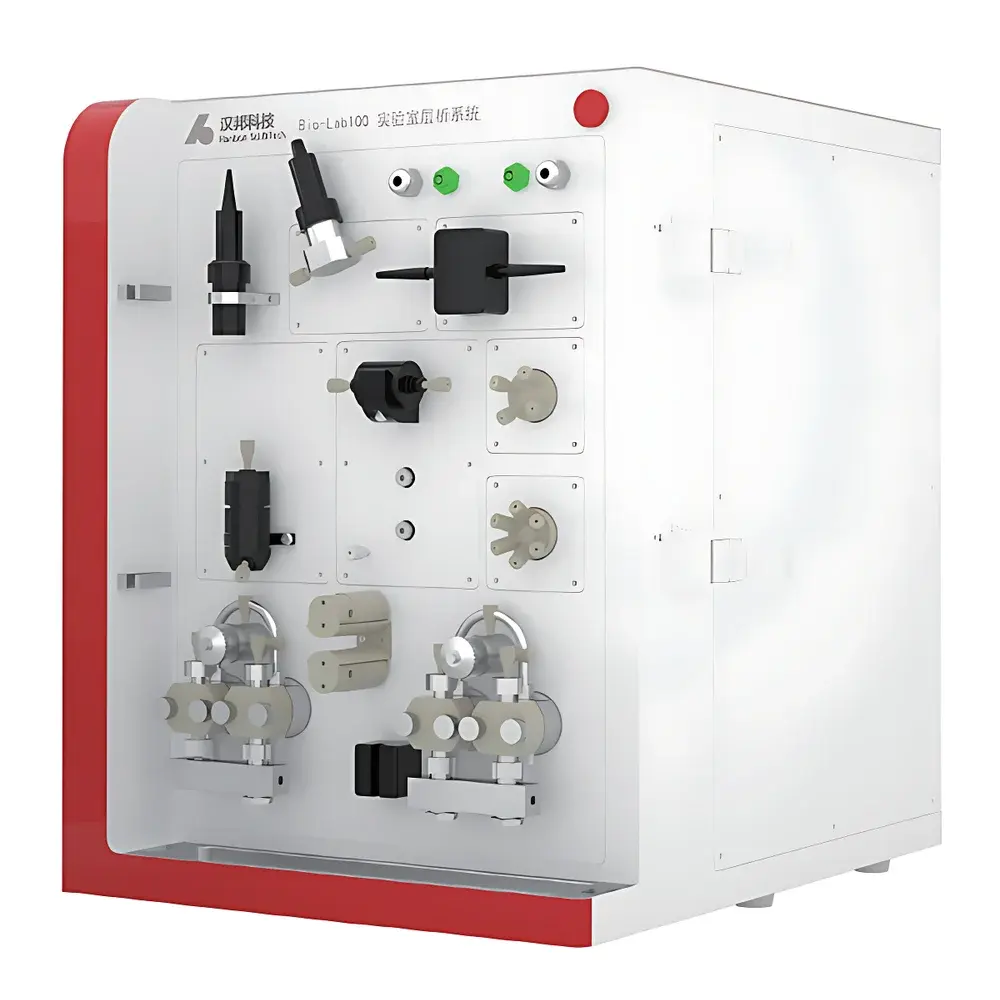
Hanbon Bio-Lab300 Laboratory-Scale Chromatography System
| Brand | Hanbon |
|---|---|
| Origin | Jiangsu, China |
| Manufacturer Type | Direct Manufacturer |
| Product Origin | Domestic (China) |
| Model | Bio-Lab300 |
| Purification Principle | Ion Exchange Chromatography (IEX) |
| Detectors | UV, pH, Conductivity |
| UV Wavelength Range | 190–800 nm |
| Flow Rate Range | 0–30 mL/min, 0–100 mL/min, 0–300 mL/min |
| Column Options | 16 mm, 26 mm, 50 mm ID |
| Valve Configurations | Single-column (forward/reverse/bypass), 6-position multi-column selector valve |
| Pressure Monitoring | Pre- and post-column |
| Fraction Collection | 2-channel or 8-channel fraction collector |
| Solvent Selection | 2-, 6-, or 8-channel solvent selector valve |
| Injection | Auto-sampling valve + sample pump + mobile phase inlet valve |
| UV Detection Channels | Dual-channel or quad-channel |
| Software Compliance | GLP, GMP, FDA 21 CFR Part 11 |
Overview
The Hanbon Bio-Lab300 is a modular, laboratory-scale chromatography system engineered for reproducible, scalable protein purification under controlled analytical and preparative conditions. Based on classical liquid chromatography principles—specifically ion exchange chromatography (IEX)—the system enables high-resolution separation of biomolecules by exploiting differences in surface charge density at defined pH and ionic strength. Its architecture supports method development from scouting to optimization, with full traceability and regulatory alignment for early-stage bioprocess R&D, academic research, and contract development and manufacturing organizations (CDMOs). The system operates within standard biosafety Level 2 (BSL-2) lab environments and integrates seamlessly into existing workflows for monoclonal antibody (mAb), recombinant protein, and viral vector purification pipelines.
Key Features
- Modular fluidic architecture with independent, plug-and-play modules: solvent delivery, column switching, detection, fraction collection, and injection.
- Multi-range peristaltic or piston-based pumps supporting flow rates from 0–30 mL/min (analytical scale), 0–100 mL/min (semi-preparative), and 0–300 mL/min (preparative scale), each calibrated for low-pulse, high-stability operation.
- Column management with real-time pre- and post-column pressure monitoring; compatible with standard stainless-steel or PEEK columns (16 mm, 26 mm, and 50 mm internal diameter).
- Configurable valve systems: single-column manifold (with forward, reverse, and bypass positions) or 6-position automated column selector for parallel method screening or multi-step purification sequences.
- Dual- or quad-channel UV detection (190–800 nm) with integrated temperature-compensated photodiodes; simultaneous real-time acquisition of absorbance at multiple wavelengths (e.g., 280 nm for protein, 260 nm for nucleic acid contaminants).
- Simultaneous inline measurement of conductivity and pH using calibrated, low-drift electrochemical sensors—critical for IEX gradient formation and buffer exchange validation.
Sample Compatibility & Compliance
The Bio-Lab300 accommodates a broad range of biological samples including clarified cell lysates, supernatants, and purified fractions from upstream bioreactors. It supports both native and denatured protein formats and is routinely validated for use with IgG, His-tagged proteins, fusion proteins, and plasmid DNA. All wetted parts are constructed from bio-inert materials (e.g., PEEK, PTFE, 316L stainless steel) compliant with USP Class VI and ISO 10993 standards. System design and software functionality meet requirements for Good Laboratory Practice (GLP), Good Manufacturing Practice (GMP), and FDA 21 CFR Part 11—including electronic signatures, audit trails, role-based access control, and immutable logbook records with timestamped operator actions.
Software & Data Management
The Bio-Lab® Chromatography Workstation provides a validated, dual-language (English/Chinese) interface with intuitive workflow navigation. Real-time data visualization includes synchronized plots of UV absorbance, conductivity, pH, pressure, and flow rate across all active channels. Method development tools include Scouting mode for rapid buffer and gradient screening, as well as automated peak integration and retention time alignment algorithms. All raw data, method files, and event logs are stored in vendor-neutral HDF5 format with SHA-256 checksum integrity verification. The system implements automatic save-on-interrupt functionality and supports scheduled backup to network-attached storage (NAS) or secure cloud repositories. Audit trail records capture user login/logout events, parameter changes, run start/stop commands, and manual interventions—retained for ≥36 months per internal SOP.
Applications
- Ion exchange chromatography (IEX) method development and transfer for therapeutic protein purification.
- Buffer scouting and gradient optimization for elution window definition and impurity clearance assessment.
- Process intermediate analysis during downstream purification steps (e.g., capture, polishing, desalting).
- Stability-indicating assays for assessing aggregation, fragmentation, or deamidation under varying pH/conductivity conditions.
- Academic and industrial training platforms for chromatography fundamentals, regulatory compliance, and QC/QA procedures.
- Support for platform process development aligned with ICH Q5A(R2), Q5B, and Q5D guidelines.
FAQ
Is the Bio-Lab300 compliant with FDA 21 CFR Part 11?
Yes—the system includes full electronic signature capability, user authentication, audit trail generation, and data integrity controls required for regulated environments.
Can the system be integrated with third-party LIMS or ELN platforms?
Yes—it supports ASTM E1384-compliant data export via CSV, XML, and HDF5 formats, and offers optional OPC UA connectivity for enterprise-level integration.
What column dimensions are supported out-of-the-box?
Standard configurations support columns with internal diameters of 16 mm, 26 mm, and 50 mm, with custom adapters available upon request.
Does the software support method transfer to larger-scale systems?
Yes—method parameters (gradient slope, flow rate, dwell volume compensation) are exportable and scalable to Hanbon’s Bio-Prep series (e.g., Bio-Prep600, Bio-Prep1200) with minimal re-optimization.
How is data security enforced during remote operation?
All remote access is secured via TLS 1.2+ encrypted connections; no unencrypted HTTP or FTP interfaces are exposed. Session timeouts and certificate-based authentication are configurable.





