
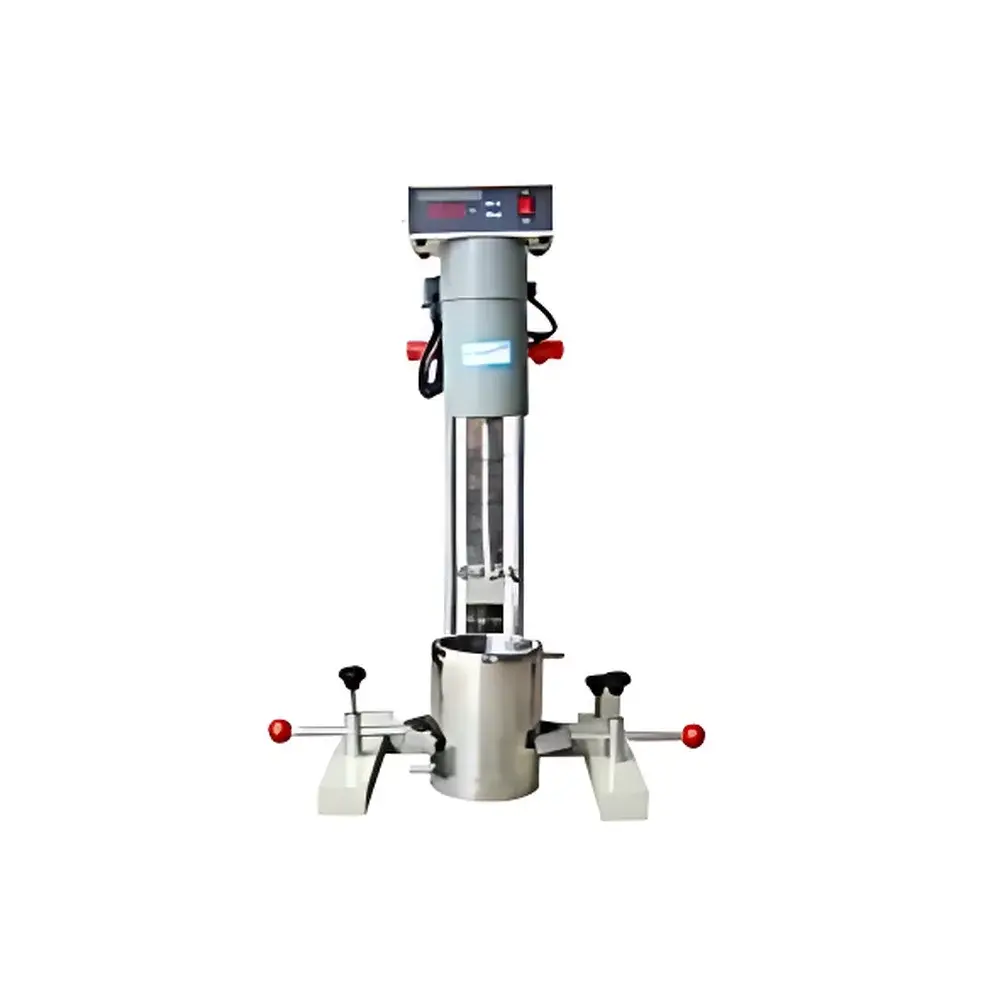
Hanuo SFS-S400 Laboratory High-Speed Disperser
| Brand | Hanuo |
|---|---|
| Origin | Shanghai, China |
| Model | SFS-S400 |
| Motor Power | 400 W |
| Motor Type | Precision Micro-Motor |
| Voltage | 220 V / 50 Hz |
| Speed Range | 0–8000 rpm |
| Processing Volume | 0.2–5 L (water-based) |
| Contact Materials | AISI 304 Stainless Steel |
| Dispersion Discs | Φ50 mm and Φ80 mm |
| Sand Mill Discs | Φ45 mm and Φ60 mm |
| Net Weight | 20 kg |
| Dimensions (W×D×H) | 450 × 420 × 860 mm |
| Packaging | Standard Wooden Crate |
Overview
The Hanuo SFS-S400 Laboratory High-Speed Disperser is an engineered solution for controlled, reproducible dispersion, homogenization, and wet-milling of liquid-phase formulations in research and development environments. It operates on the principle of hydrodynamic shear generation via high-rotational-speed dispersion discs, inducing turbulent vortex flow patterns within the sample vessel. As the disc rotates at up to 8000 rpm, it drives radial fluid ejection and axial recirculation—creating a dynamic flow field where suspended particles experience intense interfacial shear, collision, and frictional energy transfer. This mechanism enables rapid deagglomeration of pigments, fillers, nanoparticles, and functional additives into viscous or low-viscosity media, supporting formulation optimization across coatings, inks, pharmaceutical suspensions, cosmetics, and battery slurries. Designed for benchtop R&D use, the SFS-S400 delivers consistent mechanical energy input without thermal runaway, thanks to its precision micro-motor architecture and thermally stable stator winding.
Key Features
- 400 W brushless precision micro-motor with high torque retention across the full 0–8000 rpm speed range
- Digital LED speed display with ±10 rpm resolution and real-time feedback for protocol repeatability
- Continuously variable electronic speed control enabling precise ramping and dwell-time stabilization
- Interchangeable processing heads: two stainless steel dispersion discs (Φ50 mm and Φ80 mm) and two sand mill discs (Φ45 mm and Φ60 mm), all fabricated from AISI 304 for corrosion resistance and cleanability
- Manually actuated counterbalanced lift column with dual-position locking—ensures repeatable immersion depth and operator safety during head changes
- Robust cast-aluminum housing with vibration-damping feet; noise level ≤68 dB(A) at 1 m under load
- Compact footprint (450 × 420 × 860 mm) optimized for fume hood integration and shared lab space
Sample Compatibility & Compliance
The SFS-S400 accommodates aqueous and organic solvent-based systems with viscosities up to 5,000 mPa·s (measured at 25 °C using standard spindle geometry). Its 0.2–5 L working volume range (referenced to water) supports scalable process development—from gram-scale screening to pilot-batch preparation. All wetted parts conform to FDA-compliant AISI 304 stainless steel specifications, meeting material traceability requirements under ISO 13485 and USP . While not certified for GMP manufacturing, the unit supports GLP-aligned documentation workflows when paired with external loggers for speed, time, and temperature tracking. It complies with IEC 61000-6-2 (immunity) and IEC 61000-6-4 (emissions) for laboratory electromagnetic compatibility.
Software & Data Management
The SFS-S400 operates as a standalone instrument with no embedded firmware or proprietary software dependency. Speed setpoints and runtime are manually configured via front-panel controls. For audit-ready process recording, users may integrate optional external data loggers (e.g., Omega OM-DAQPRO-5300) connected to the analog tachometer output signal (0–10 V DC proportional to rpm). This configuration supports 21 CFR Part 11–compliant electronic records when deployed with validated timestamped acquisition software and user-access-controlled databases—commonly implemented in pharmaceutical pre-formulation labs adhering to ICH Q5C stability guidelines.
Applications
- Rapid dispersion of TiO₂, carbon black, and iron oxide pigments in acrylic and epoxy resin systems
- Preparation of nanosuspensions for oral solid dosage form development (e.g., amorphous solid dispersions)
- Homogenization of silicone oil emulsions and lipid nanoparticle precursors
- Slurry deagglomeration for Li-ion cathode/anode electrode R&D (NMC, LFP, graphite, silicon composites)
- Viscosity-dependent evaluation of rheological modifiers (e.g., fumed silica, cellulose ethers) in architectural coatings
- Batch-to-batch consistency testing in QC laboratories supporting ASTM D1210 (Hegman fineness-of-grind gauge correlation)
FAQ
What is the maximum viscosity this disperser can handle effectively?
The SFS-S400 maintains stable operation up to ~5,000 mPa·s with appropriate disc selection (e.g., Φ80 mm disc at lower rpm); however, optimal dispersion efficiency is achieved below 2,000 mPa·s for most particulate systems.
Can the unit be used with corrosive solvents such as THF or DMF?
Yes—provided all seals and gaskets are chemically compatible; AISI 304 contact surfaces resist general organic solvents, though prolonged exposure to halogenated or strong acid media requires verification per NACE MR0175/ISO 15156.
Is there a recommended maintenance schedule for the motor and bearings?
Annual inspection of bearing preload and motor brush wear (if applicable) is advised; the brushless micro-motor design eliminates routine brush replacement but benefits from dust-filter cleaning every 200 operating hours.
Does the device support automated start/stop or timer functions?
No—the SFS-S400 features manual operation only; external programmable timers or PLC interfaces must be added for timed protocols.
How is reproducibility ensured across different operators?
By standardizing immersion depth (via lift column scale marks), disc type/speed combination, and sample temperature prior to initiation—practices documented in internal SOPs aligned with ISO/IEC 17025 method validation principles.



