
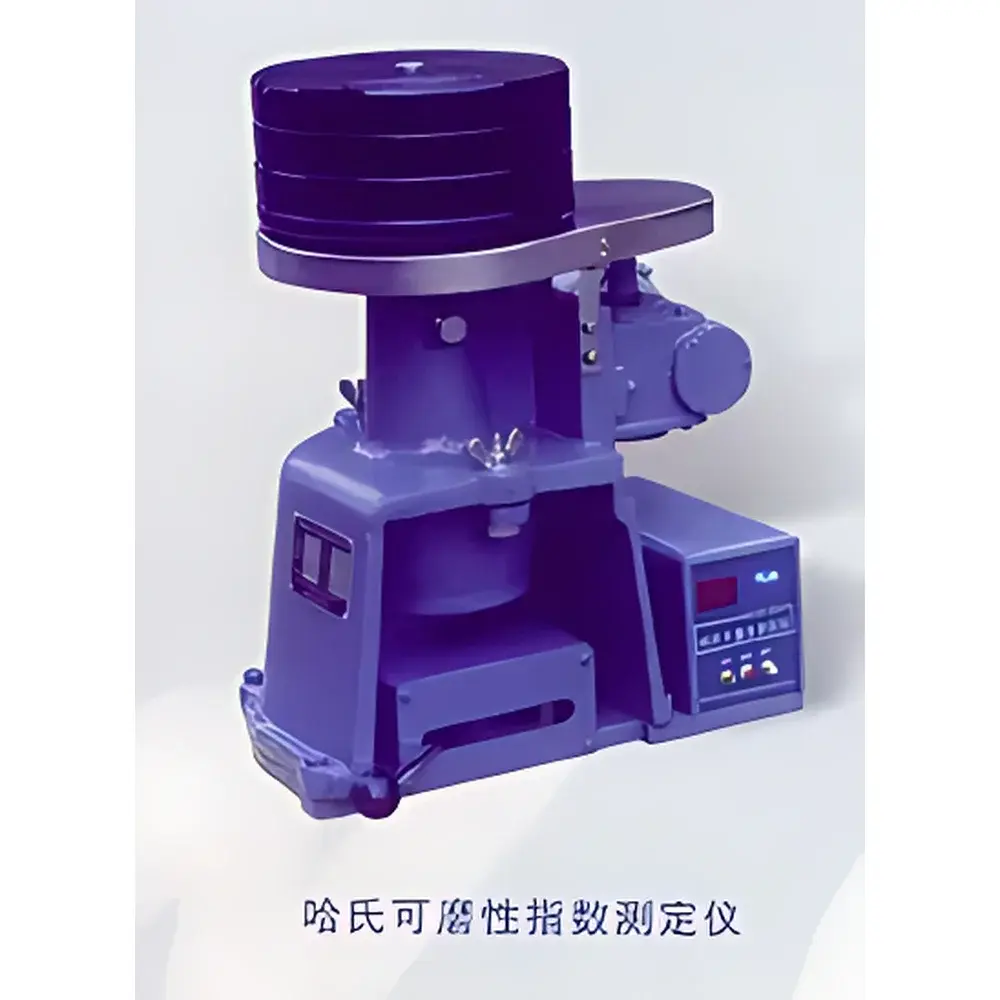
Hargrove Hardgrove Grindability Index (HGI) Tester
| Key | Speed 20 ± 1 rpm |
|---|
Overview
The Hargrove Hardgrove Grindability Index (HGI) Tester is a precision mechanical instrument engineered for the standardized determination of coal grindability according to ASTM D409, ISO 5074, and GB/T 2565—2014 (the Chinese national standard equivalent to the Hardgrove method). Based on the fundamental principle of grinding energy proportionality—where the energy required to reduce coal particle size is directly proportional to the newly generated surface area—the instrument quantifies relative resistance to pulverization under controlled mechanical stress. This measurement is critical for power plant boiler design, coal mill selection, pulverizer maintenance scheduling, and coal blending optimization in thermal generation and cement manufacturing. The device replicates the standardized Hardgrove test protocol: a 50 g sample of air-dried coal (60–100 mesh) is placed between two rotating steel grinding rings and a stationary steel ball under a fixed normal load of 284 N. After precisely 60 revolutions at 20 rpm, the ground product is sieved through a 74 µm (200-mesh) screen, and the percentage passing is used to interpolate the HGI value from a calibration curve established with reference standard coals traceable to NIST or CNAS-accredited reference materials.
Key Features
- Microprocessor-controlled rotation counter with real-time digital display and automatic stop at exactly 60 ± 0.25 revolutions—ensuring strict compliance with ASTM D409 timing and repeatability requirements.
- Electromechanical loading system delivering a stable, calibrated normal force of 284 ± 2 N across the grinding assembly, verified per ISO/IEC 17025-compliant load cell calibration procedures.
- Robust cast-iron frame and hardened steel grinding components (rings and ball) designed for long-term dimensional stability and minimal wear-induced drift over thousands of test cycles.
- Emergency stop button with hardware-level circuit interruption, independent of microcontroller operation—meeting IEC 60204-1 safety standards for industrial machinery.
- Resume-on-restart functionality: if interrupted mid-test, the counter retains accumulated rotation count and resumes from the last valid position—supporting GLP-aligned procedural continuity and audit trail integrity.
- Three-phase 380 V AC motor drive (90 W) ensures consistent torque delivery across voltage fluctuations typical in industrial laboratory environments.
Sample Compatibility & Compliance
The tester accommodates standard 50 g air-dried coal samples prepared to specifications outlined in ASTM D3174 (moisture determination), D3175 (volatile matter), and D3176 (ultimate analysis)—all prerequisites for valid HGI reporting. Sample feed size must be 16–30 mesh (approximately 0.6–1.2 mm), as defined in GB/T 2565. The instrument conforms to the mechanical and procedural requirements of ISO 5074:2015 (“Hard coal — Determination of Hardgrove grindability index”), ASTM D409–16a, and GB/T 2565–2014. All critical components—including load application mechanism, rotational encoder, and timing circuit—are subject to annual verification using traceable reference standards. Documentation supports full traceability for ISO/IEC 17025 accreditation and regulatory audits under China’s CNCA and international QA frameworks.
Software & Data Management
While the base unit operates via embedded microcontroller without proprietary software, optional RS-232 or USB-to-serial interface modules enable integration with laboratory information management systems (LIMS) or custom data acquisition platforms. Rotation count, start/stop timestamps, and operator ID (via keypad entry) are logged in non-volatile memory with time-stamped records retained for ≥12 months—satisfying minimum retention requirements under GLP (21 CFR Part 58) and internal quality control policies. Calibration logs, maintenance history, and performance verification reports (e.g., daily blank runs with certified reference coal) can be exported in CSV format for trend analysis and statistical process control (SPC) charting.
Applications
- Predictive modeling of coal pulverizer throughput and power consumption in utility-scale coal-fired power stations.
- Quality assurance screening of incoming coal shipments against contractual HGI specifications (e.g., HGI 40–80 for bituminous coals).
- Supporting ASTM E1312-compliant coal blend optimization to balance grindability, ash fusion, and slagging behavior.
- Research applications in coal petrography and maceral composition studies correlating HGI with vitrinite reflectance and microlithotype distribution.
- Validation of alternative grinding methods (e.g., stirred media mills) by benchmarking against Hardgrove-derived baseline energy indices.
FAQ
What standards does this HGI tester comply with?
It fully satisfies the mechanical and procedural requirements of ASTM D409–16a, ISO 5074:2015, and GB/T 2565–2014.
Is operator training required for accurate results?
Yes—consistent sample preparation (drying, sizing, blending) accounts for >70% of inter-laboratory variability; users must follow ASTM D2013 for sample handling and participate in annual proficiency testing per ISO/IEC 17043 guidelines.
Can the instrument be calibrated in-house?
Load calibration requires certified deadweight standards; rotation counting accuracy is verified using a Class 0.05 optical tachometer traceable to national metrology institutes—recommended annually by an accredited service provider.
Does the unit support automated sieve analysis integration?
No—the HGI calculation requires manual sieving and gravimetric analysis per standard method; however, optional digital balance interfaces (0.001 g resolution) and LIMS-ready data output facilitate seamless workflow integration.
What maintenance intervals are recommended?
Grinding rings and ball require hardness verification every 500 tests; grease lubrication of main shaft bearings every 6 months; and full mechanical inspection—including load spring tension and gear backlash—annually per manufacturer’s technical bulletin TB-HGI-2023.



