
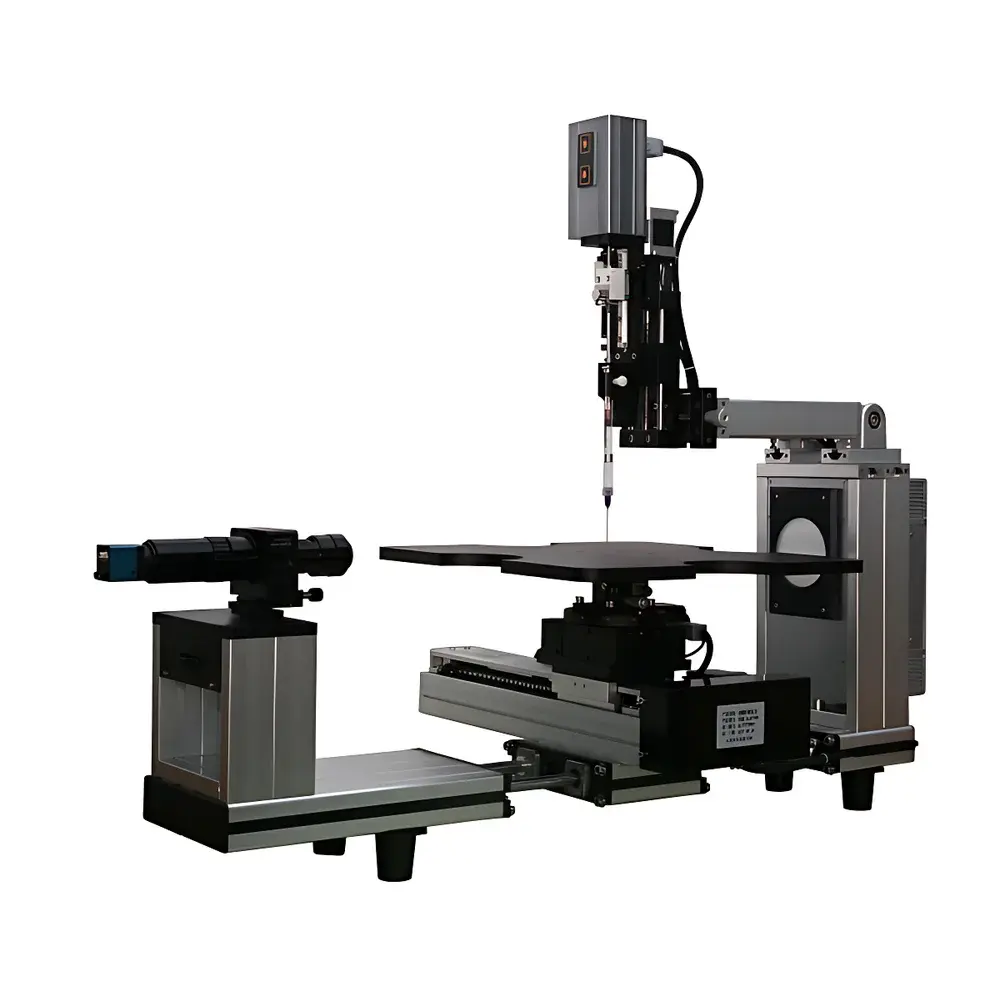
HARKE PV35 Video-Based Optical Contact Angle Analyzer
| Brand | HARKE |
|---|---|
| Origin | Beijing, China |
| Manufacturer Type | Direct Manufacturer |
| Instrument Category | Domestic |
| Model | HARKE-PV35 |
| Instrument Type | Benchtop Laboratory System |
| Contact Angle Measurement Range | 0–180° |
| Contact Angle Measurement Accuracy | ±0.1° |
| Sample Stage Dimensions | 100 × 100 mm |
| Optical Zoom Ratio | 0.7×–0.5× (Fixed-Position Zoom Lens) |
| Surface/Interfacial Tension Measurement Range | 0–1000 mN/m |
| Surface/Interfacial Tension Measurement Accuracy | ±0.1 mN/m |
| Imaging Frame Rate | Up to 1000 fps (USB 3.0 Camera, Software-Controlled) |
| Software Platform | HKCA35 |
| Measurement Methods | Automatic Circle Fitting, Automatic Ellipse Fitting, Sessile Drop, Captive Bubble, Tilting Plate (Dynamic CA), Pendant Drop (Surface/Interfacial Tension) |
| Temperature Control | Ambient (Optional Heating, Thermostatic, or Constant-Temperature Modules) |
| Motorized Stage Positioning Accuracy | ±0.1 mm |
| Syringe Dispenser Travel | 60 mm |
| Power Supply | 220 V / 3 A / 50 Hz |
| Weight | 35 kg |
| Dimensions (L × H) | 160 × 710 mm (Extendable) |
Overview
The HARKE PV35 is a fully automated, benchtop video-based optical contact angle analyzer engineered for high-precision interfacial characterization in research and quality control laboratories. It operates on the sessile drop method—capturing high-resolution images of liquid droplets deposited on solid substrates—and applies advanced image analysis algorithms to determine contact angle values via circle or ellipse fitting. The system also supports pendant drop analysis for surface and interfacial tension quantification, leveraging Young–Laplace equation modeling. Designed with a large 100 × 100 mm motorized sample stage and programmable multi-point positioning, the PV35 enables reproducible spatial mapping of wettability across heterogeneous or macro-scale surfaces—critical for coating uniformity assessment, membrane development, biomaterial evaluation, and functionalized substrate validation.
Key Features
- Fully automated measurement sequence: auto-drop dispensing, real-time droplet formation recognition, dynamic acquisition at up to 1000 fps, and automatic stage repositioning between measurement points
- Motorized XYZ stage with ±0.1 mm positioning repeatability and programmable polar-coordinate rotation for radial multi-site analysis on circular or wafer-like samples
- High-stability optical path: fixed-ratio zoom lens (0.7×–0.5×) with calibrated magnification steps, optimized for low-distortion imaging and pixel-level edge detection
- Integrated USB 3.0 high-speed camera supporting selectable frame rates (40, 100, 300, or 1000 fps), enabling robust dynamic contact angle studies including advancing/receding angle determination via expansion–contraction cycles
- HKCA35 software platform compliant with GLP data integrity requirements: full audit trail, user access levels, electronic signatures, and raw image + metadata archiving per measurement
- Modular expandability: optional modules include temperature-controlled stages (–20°C to 200°C), environmental chambers, dual-syringe systems for biphasic droplet generation, and multi-channel liquid handling for high-throughput screening
Sample Compatibility & Compliance
The PV35 accommodates rigid and flexible substrates up to 100 mm × 100 mm and 30 mm in thickness—including silicon wafers, polymer films, textiles, porous membranes, metallic foils, and biological tissues. Its open-stage architecture allows direct integration with external stimuli (e.g., humidity control, gas flow, or electrochemical cells). All measurement protocols align with ASTM D7334 (Standard Practice for Surface Wettability Assessment), ISO 19403-2 (Contact Angle Measurement – Static Method), and ISO 19403-4 (Dynamic Contact Angle), supporting traceable reporting for regulatory submissions. Data export formats (CSV, XML, TIFF) meet FDA 21 CFR Part 11 requirements when deployed with validated HKCA35 configuration and networked authentication.
Software & Data Management
HKCA35 is a Windows-based analytical suite offering real-time visualization of contact angle evolution, simultaneous multi-droplet tracking, and automated curve generation (θ vs. time, θ vs. volume). It computes solid surface free energy using Owens–Wendt, Wu, or van Oss–Chaudhury–Good models based on contact angle inputs from ≥3 probe liquids. All raw images are timestamped and embedded with instrument metadata (lens setting, frame rate, illumination intensity, stage coordinates). The software supports batch processing, statistical summary reports (mean, SD, CV%), and customizable PDF/HTML export templates compatible with LIMS integration. Audit logs record operator ID, parameter changes, calibration events, and data export actions—ensuring full traceability for ISO/IEC 17025 or GMP environments.
Applications
- Quality assurance of hydrophobic/hydrophilic coatings in automotive, aerospace, and medical device manufacturing
- Development and validation of anti-fouling, self-cleaning, or superhydrophobic surfaces
- Characterization of printed electronics substrates and inkjet-printed functional layers
- Surface energy mapping of polymer blends, composites, and recycled plastics for adhesion prediction
- Stability assessment of emulsions and foams via interfacial tension kinetics
- Biomedical research: cell-substrate interaction screening, protein adsorption behavior, and implant surface modification verification
FAQ
What measurement methods does the HARKE PV35 support?
Sessile drop (static and dynamic), captive bubble, tilting plate (for advancing/receding angles), and pendant drop (for surface/interfacial tension calculation using Young–Laplace fitting).
Is the system compliant with FDA 21 CFR Part 11?
Yes—when configured with HKCA35 v4.2+ under validated operational conditions, including user authentication, electronic signatures, and immutable audit trails.
Can the PV35 measure contact angles on curved or irregular surfaces?
It supports limited topography compensation via Z-axis auto-focus and stage tilt adjustment; however, highly non-planar surfaces require custom fixtures or complementary profilometry alignment.
What is the minimum droplet volume resolvable for dynamic measurements?
With 1000 fps capture and sub-pixel edge detection, the system reliably resolves droplets as small as 0.1 µL, depending on liquid volatility and substrate absorption rate.
Does the system include calibration standards?
A certified glass reference slide (contact angle ≈ 65° ± 0.5°) and stainless steel goniometer standard (10°–170° range) are supplied with each unit for daily verification.



