
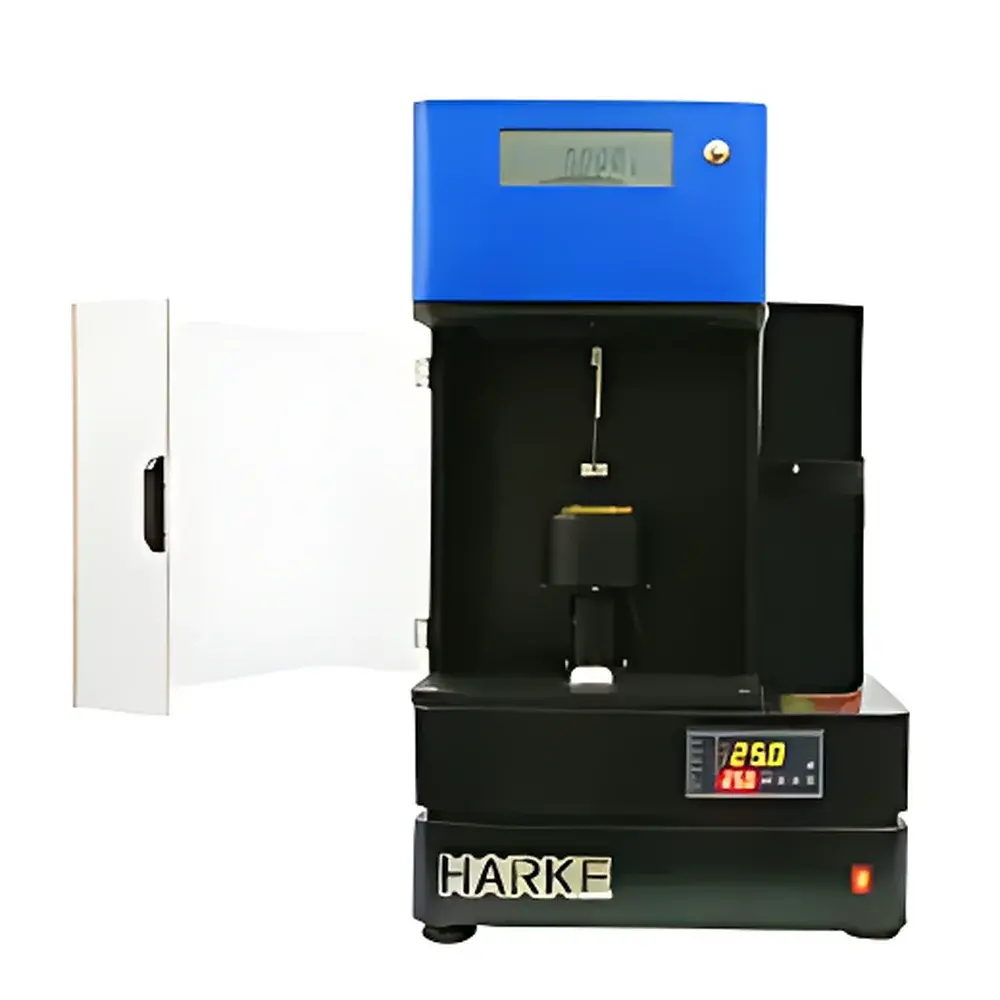
HARKE SFT-A1 Powder Contact Angle Analyzer
| Brand | HARKE |
|---|---|
| Origin | Beijing, China |
| Manufacturer Type | Direct Manufacturer |
| Instrument Category | Domestic |
| Model | SFT-A1 |
| Instrument Type | Benchtop Laboratory System |
| Contact Angle Measurement Range | 0–180° |
| Contact Angle Measurement Accuracy | ±0.01° |
| Sample Stage Diameter | 60 mm |
| Surface/Interfacial Tension Measurement Range | 0–400 mN/m |
| Surface/Interfacial Tension Measurement Accuracy | ±0.1 mN/m |
| Surface/Interfacial Tension Display Resolution | ±0.01 mN/m |
| Force Sensor Capacity | 0–120 g |
| Vertical Stage Speed | 0–10 mm/s |
| Vertical Stage Travel Distance | 0–80 mm |
| Vertical Stage Positioning Accuracy | ±0.1 mm |
| Sample Vessel Dimensions | Φ50 mm |
| Software | SFT-A |
| Operating Temperature | Ambient |
| Dimensions (L×W×H) | 360 × 360 × 620 mm |
| Weight | 20 kg |
| Optional Accessories | Electrically Heated Thermostatic Circulation Jacket |
Overview
The HARKE SFT-A1 Powder Contact Angle Analyzer is a precision benchtop instrument engineered for the quantitative characterization of wettability and interfacial interaction between solid particulates and liquid phases. Unlike conventional sessile-drop contact angle systems designed for flat, homogeneous surfaces, the SFT-A1 implements the modified Wilhelmy plate method—specifically adapted for powders and granular materials—wherein capillary rise or immersion force is measured as a function of time and liquid penetration depth. This principle enables direct determination of the dynamic contact angle (advancing and receding) and effective surface energy parameters of porous or irregularly shaped powder beds. The system operates under ambient laboratory conditions and supports standardized protocols aligned with ASTM D7490 (Standard Test Method for Measuring the Contact Angles of Solid Surfaces) and ISO 19403-2 (Paints and varnishes — Contact angle measurement — Part 2: Static contact angle), with methodological extensions validated for powdered pharmaceutical excipients, catalyst supports, battery electrode materials, and ceramic precursors.
Key Features
- High-resolution contact angle measurement across full 0–180° range with ±0.01° repeatability, achieved via real-time force transduction and digital signal processing.
- Dual-mode operation: supports both static and dynamic contact angle analysis using automated vertical stage control (0–10 mm/s speed, ±0.1 mm positioning accuracy).
- Integrated Wilhelmy balance architecture with 0–120 g load cell, calibrated to ISO/IEC 17025 traceable standards, enabling simultaneous surface tension (0–400 mN/m) and contact angle derivation.
- Benchtop design with compact footprint (360 × 360 × 620 mm) and modular sample chamber accommodating standard Φ50 mm powder vessels.
- Optional electrically heated thermostatic circulation jacket for temperature-controlled measurements (e.g., simulating process-relevant thermal environments in pharmaceutical wet granulation or slurry-based coating).
Sample Compatibility & Compliance
The SFT-A1 accommodates a broad spectrum of dry and pre-compacted powder samples—including metal oxides, polymers, carbon blacks, API powders, and mineral fillers—with minimal sample preparation. Its non-destructive, bulk-phase measurement approach eliminates edge effects common in drop-based imaging techniques. All hardware components comply with CE electromagnetic compatibility (EMC) directives and RoHS material restrictions. Data acquisition and reporting workflows are structured to support GLP and GMP documentation requirements, including user-defined audit trails, electronic signature capability, and export formats compatible with LIMS integration (CSV, XML). While not inherently 21 CFR Part 11 compliant out-of-the-box, the SFT-A software platform permits configuration of role-based access control and data integrity safeguards upon customer request.
Software & Data Management
The proprietary SFT-A software provides intuitive graphical interface for method setup, real-time force curve visualization, automatic baseline correction, and multi-point contact angle calculation. It includes built-in algorithms for Young–Laplace fitting, Washburn equation modeling (for porous media), and surface energy component estimation via Owens–Wendt–Rabel–Kaelble (OWRK) theory. Raw force vs. immersion depth datasets are timestamped and stored with metadata (operator ID, date/time, environmental conditions). Export options include ASCII-compatible reports for statistical analysis in MATLAB, Python (Pandas), or JMP. Software updates are delivered via secure HTTPS download with version-controlled release notes and validation documentation.
Applications
- Pharmaceutical development: Quantifying wettability of excipients during formulation screening and predicting dissolution behavior of tablet compacts.
- Battery R&D: Assessing electrolyte infiltration kinetics into cathode/anode powder layers to optimize electrode slurry rheology and calendering parameters.
- Coating & ink formulation: Evaluating dispersant efficacy on pigment particles by tracking dynamic contact angle hysteresis under controlled immersion cycles.
- Geotechnical and environmental science: Characterizing hydrophobicity of soil amendments or microplastic aggregates in aqueous systems.
- Materials synthesis: Monitoring surface modification progress (e.g., silanization of silica nanoparticles) through time-resolved contact angle evolution.
FAQ
Does the SFT-A1 require calibration with certified reference liquids?
Yes—calibration is performed using ultra-pure water (γ = 72.8 mN/m at 20°C) and diiodomethane (γ = 50.8 mN/m), following ASTM D1331 and ISO 1409 guidelines.
Can the system measure contact angles for cohesive or electrostatically charged powders?
Yes—the Wilhelmy immersion method mitigates particle agglomeration artifacts; optional vibration-assisted sample loading accessories are available upon request.
Is third-party software integration supported?
The SFT-A SDK (Software Development Kit) provides documented COM/ActiveX interfaces for custom automation scripts and enterprise-level data ingestion pipelines.
What maintenance is required for long-term measurement stability?
Annual recalibration of the force sensor and stage encoder is recommended; cleaning protocols for the platinum Wilhelmy plate and sample vessel are included in the operator manual.



