
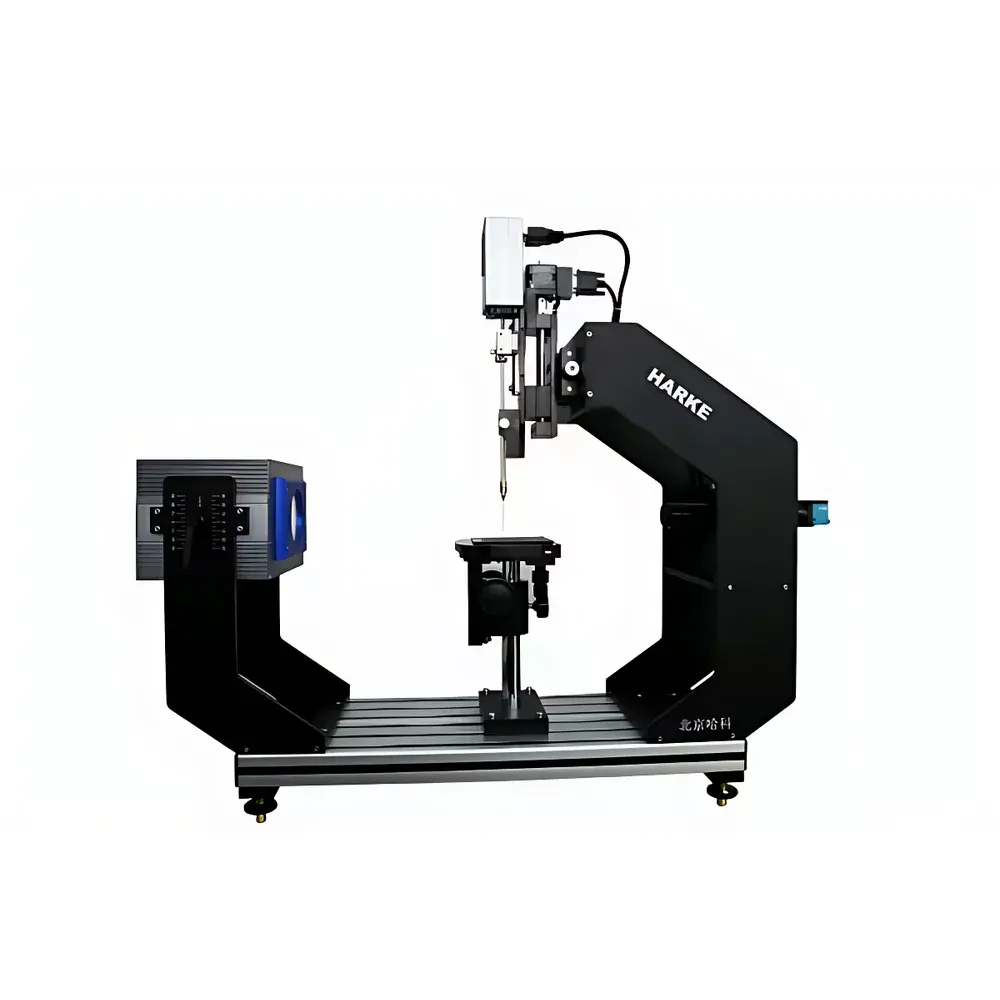
HARKE SPCAX1 Video Contact Angle Analyzer
| Brand | HARKE |
|---|---|
| Origin | Beijing, China |
| Manufacturer Type | Direct Manufacturer |
| Instrument Category | Domestic |
| Model | HARKE–SPCAX1 |
| Pricing | Upon Request |
| Instrument Class | Dynamic Contact Angle Analyzer |
| Form Factor | Benchtop Laboratory System |
| Contact Angle Measurement Range | 0–180° |
| Contact Angle Accuracy | ±0.1° |
| Sample Stage Dimensions | 400 mm × 400 mm |
| Optical Magnification | 0.7× to 4.5× |
| Surface/Interfacial Tension Range | 0–1000 mN/m |
| Surface/Interfacial Tension Accuracy | ±0.1 mN/m |
| Imaging Frame Rate | Up to 1000 fps (optional) |
| Software | HARKE-SPCA v1.0 |
| Surface Energy Method | Equation of State (EOS) |
| Analysis Algorithms | Circle, Ellipse, and Small-Drop Fitting |
| Tension Method | Pendant Drop |
| Temperature Range | Ambient |
| Power Supply | 220 V / 3 A / 50 Hz |
| Weight | ~30 kg |
| Dimensions (W × D) | 260 mm × 700 mm |
| Lens Travel | 120 mm |
| Camera Interface | USB 2.0 |
Overview
The HARKE SPCAX1 Video Contact Angle Analyzer is a precision optical benchtop instrument engineered for quantitative characterization of solid–liquid–gas interfacial phenomena. It operates on the principle of high-resolution silhouette imaging combined with advanced contour detection algorithms to determine contact angles via sessile drop, pendant drop, tilting plate, and captive bubble methodologies. The system captures dynamic interfacial behavior—including advancing/receding angles, contact angle hysteresis, roll-off (sliding) angles, and time-dependent wetting kinetics—with sub-degree angular resolution. Designed for rigorous laboratory environments, the SPCAX1 supports both static and dynamic surface analysis under ambient conditions, enabling reproducible quantification of wettability, surface energy, adhesion work, and interfacial tension—critical parameters in materials science, surface engineering, and quality control workflows.
Key Features
- High-precision optical path: ZF-180 fixed-position zoom lens with 0.7×–4.5× continuous magnification and 120 mm vertical travel for optimal focus across diverse sample topographies.
- Real-time high-speed imaging: Standard USB 2.0 camera at 30 fps; optional upgrade paths to 100 fps, 300 fps, or 1000 fps for transient wetting event capture (e.g., droplet impact, absorption kinetics).
- Automated fluid delivery: Motorized syringe pump with programmable dispensing volume, rate, and pause intervals for repeatable droplet formation and multi-cycle dynamic angle measurement.
- Motorized tilt stage: Precision-controlled inclination (±90° range) with software-synchronized image acquisition for sliding angle and hysteresis analysis.
- Comprehensive analytical engine: HARKE-SPCA v1.0 software implements ISO 19403-compliant circle, ellipse, and small-drop fitting models; supports Young–Laplace curve fitting for pendant drop interfacial tension calculation.
- Broad sample compatibility: 400 mm × 400 mm adjustable stage accommodates large-area substrates, curved surfaces, porous media, powders (via compressed pellet method), and ultra-hydrophobic/hydrophilic films.
Sample Compatibility & Compliance
The SPCAX1 is validated for use with rigid and semi-rigid planar samples (glass, silicon wafers, metals, polymers), textured or microstructured surfaces, and heterogeneous coatings. With optional accessories—including immersion cells for captive bubble analysis and powder holders—the system extends to submerged contact angle measurement and granular material characterization. All measurement protocols align with internationally recognized standards: contact angle methodology follows ASTM D7334 and ISO 27448; surface energy calculation employs the Equation of State (EOS) model per ISO 14210; interfacial tension determination adheres to ISO 14355 (pendant drop method). Data integrity is maintained through timestamped audit trails, user-access controls, and exportable raw image + metadata packages—supporting GLP/GMP-aligned documentation requirements.
Software & Data Management
HARKE-SPCA v1.0 provides an intuitive, menu-driven interface with real-time video overlay, manual and auto-threshold segmentation, and batch processing capability. Each measurement session logs full experimental parameters (dispense volume, frame rate, lighting intensity, lens position), annotated images, and numerical outputs in CSV and PDF formats. The software supports dual-curve plotting (e.g., contact angle vs. time, θA/θR vs. cycle number), statistical summary reports (mean, SD, CV%), and surface energy decomposition (polar/dispersive components via Owens–Wendt or Wu methods). Exported datasets are compatible with third-party analysis tools (MATLAB, Origin, Python pandas) and comply with FDA 21 CFR Part 11 when configured with electronic signature and role-based permissions.
Applications
- Surface treatment validation: Plasma, corona, flame, or chemical modification efficacy assessment via contact angle shift and hysteresis reduction.
- Coating development: Quantitative evaluation of anti-fouling, anti-reflective, hydrophobic, or oleophobic film performance on display glass, semiconductor wafers, and medical devices.
- Biomedical material screening: Wettability profiling of scaffolds, membranes, and implant surfaces to predict protein adsorption and cell adhesion behavior.
- Textile and fiber science: Dynamic wicking rate analysis, oil/water repellency grading, and durability testing after laundering or abrasion.
- Pharmaceutical solid dosage forms: Tablet surface energy mapping to correlate with dissolution kinetics and binder distribution uniformity.
- Electronics manufacturing: Solder mask wettability verification, conformal coating coverage assessment, and flux residue analysis.
FAQ
What measurement methods does the SPCAX1 support?
Sessile drop (static and dynamic), pendant drop (surface/interfacial tension), tilting plate (advancing/receding/sliding angles), captive bubble (underwater contact angle), and sessile drop evaporation kinetics.
Can it measure surface energy of low-energy surfaces like PTFE?
Yes—using multi-liquid EOS analysis with at least three probe liquids (e.g., water, diiodomethane, ethylene glycol), the system calculates total surface energy and polar/dispersive fractions with uncertainty < ±1.5 mJ/m².
Is the software compliant with regulatory data integrity requirements?
When deployed with user authentication, audit trail logging, and electronic signature modules enabled, HARKE-SPCA v1.0 meets core elements of FDA 21 CFR Part 11 and EU Annex 11 for traceable, attributable, legible, and contemporaneous records.
What accessories are required for powder surface energy analysis?
A compression die accessory kit is required to fabricate flat, homogeneous pellets from dry powder samples—enabling conventional sessile drop contact angle measurement and subsequent surface energy derivation.
Does the system support automated long-term kinetic studies?
Yes—programmable dispensing sequences, time-lapse imaging, and background subtraction routines allow unattended monitoring of contact angle evolution over hours or days (e.g., polymer hydration, ink spreading, or surfactant diffusion).
Related Products



