
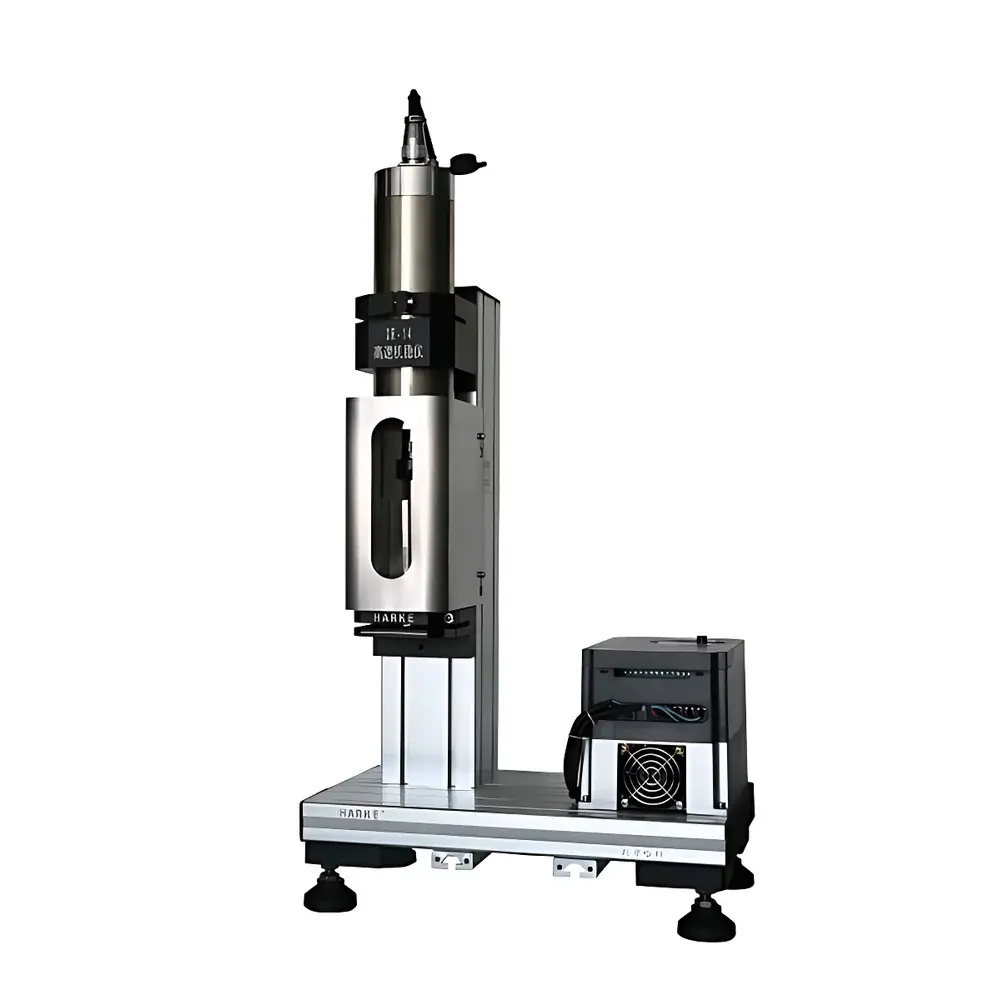
HARKE XR-14S High-Speed Mechanical Stability Tester for Latex
| Brand | HARKE |
|---|---|
| Model | XR-14S |
| Origin | Beijing, China |
| Manufacturer | HARKE Instrument Co., Ltd. |
| Application | Mechanical stability testing of natural and synthetic latex per ISO 2006 |
| Speed Range | 3,000–20,000 rpm (standard test speed: 14,000 ± 200 rpm) |
| Speed Stability | ≤ ±100 rpm at 14,000 rpm |
| Stirring Disk Dimensions | Natural latex disk: Ø20.83 ± 0.03 mm × 1.57 ± 0.05 mm |
| Synthetic latex disk | Ø36.12 ± 0.03 mm × 1.58 ± 0.05 mm |
| Container | Internal diameter 58 ± 0.25 mm, height 127 mm, wall thickness 2.5 mm |
| Disk-to-Bottom Distance | 13 ± 1 mm |
| Power Supply | 220 V ± 10%, 5 A |
| Operating Temperature | 10–40 °C |
| Compatible Media | Natural or synthetic latex, pH 1–14 |
| Cooling Option | Optional recirculating water cooling (inlet/outlet ports provided) |
Overview
The HARKE XR-14S High-Speed Mechanical Stability Tester is a precision-engineered instrument designed exclusively for quantifying the mechanical stability of natural and synthetic latex dispersions under standardized high-shear conditions. It operates on the principle of controlled high-speed rotational shear—where a precisely dimensioned metal stirring disk rotates horizontally within a defined volume of latex, inducing controlled destabilization through hydrodynamic stress. The resulting coagulum formation is measured gravimetrically or volumetrically after a fixed duration (typically 5–30 minutes), yielding a quantitative stability index critical for quality control in rubber processing, glove manufacturing, dipped goods production, and latex-based adhesive formulation. Fully compliant with ISO 2006 (“Rubber — Natural rubber — Determination of mechanical stability of centrifuged field latex”), the XR-14S delivers repeatable, traceable, and auditable results required for ISO 9001-certified laboratories and GMP-aligned production environments.
Key Features
- High-fidelity speed control via industrial-grade frequency converter, enabling precise setting across 3,000–20,000 rpm with ≤ ±100 rpm fluctuation at nominal 14,000 rpm operation.
- Dual interchangeable stainless-steel stirring disks—calibrated to ISO 2006 specifications for natural (Ø20.83 ± 0.03 mm) and synthetic (Ø36.12 ± 0.03 mm) latex testing—ensuring metrological consistency between material classes.
- Optimized mechanical architecture: brushless synchronous high-speed motor coupled to a rigid, dynamically balanced shaft assembly, delivering low vibration, minimal acoustic emission (<65 dB(A)), and extended service life under continuous duty cycles.
- Adjustable container elevation mechanism with micrometer-scale positioning (±0.1 mm resolution), guaranteeing exact 13 ± 1 mm disk-to-container-bottom clearance—critical for reproducible shear field geometry.
- Integrated thermal management interface: dual quick-connect ports support external recirculating coolant (e.g., 15–25 °C deionized water) to maintain motor winding temperature below 60 °C during extended runs (>60 min).
- Real-time operational safety: interlocked transparent polycarbonate guard, emergency stop circuitry, and automatic current-limiting protection prevent overloading or thermal runaway.
Sample Compatibility & Compliance
The XR-14S accommodates both natural (e.g., Hevea brasiliensis centrifuged field latex) and synthetic (e.g., SBR, NBR, CR, or neoprene latices) dispersions across pH 1–14. Its geometric tolerances—including container inner diameter (58 ± 0.25 mm), height (127 mm), and wall thickness (2.5 mm)—are strictly aligned with ISO 2006 Annex A. All wetted components are chemically resistant: stainless-steel disk, borosilicate glass container, and PTFE-sealed elevation mechanism. The system supports GLP-compliant workflows through documented calibration records (disk dimensions, speed verification via calibrated tachometer), operator training logs, and maintenance history tracking. While not intrinsically 21 CFR Part 11–compliant (as it produces analog output only), its mechanical outputs integrate seamlessly into validated LIMS or ELN platforms when paired with external digital data loggers.
Software & Data Management
The XR-14S is a hardware-dedicated instrument without embedded firmware or touchscreen UI. Speed setpoint, run duration, and status indicators are managed via front-panel controls on the integrated frequency converter (displaying Hz and rpm). For regulated environments, HARKE provides a companion Calibration & Operation Manual (Rev. 3.1) containing: full dimensional drawings with GD&T callouts; torque specification tables for disk-mounting; traceable speed verification protocol using NIST-traceable optical tachometers; and preventive maintenance schedules (bearing lubrication intervals, belt tension checks, coolant flow rate validation). Raw test data—coagulum mass (% w/w), time-to-onset, and visual grading per ISO 2006 Clause 8—is recorded manually in laboratory notebooks or imported into validated spreadsheets compliant with ALCOA+ principles (Attributable, Legible, Contemporaneous, Original, Accurate, Complete, Consistent, Enduring, Available).
Applications
- Quality assurance of field-collected natural rubber latex prior to ammoniated preservation or centrifugation.
- Batch release testing of synthetic latices used in medical glove compounding, where mechanical stability directly correlates with dip-film integrity and pinhole incidence.
- R&D evaluation of stabilizer systems (e.g., rosin soaps, fatty acid salts, nonionic surfactants) under accelerated shear stress.
- Process optimization of coagulant addition sequences in dipped product manufacturing lines.
- Root-cause analysis of premature coagulation events in storage tanks or transfer piping—correlating lab-scale XR-14S data with plant-scale agitation parameters.
- Regulatory submission support for FDA 510(k) or CE-marking dossiers requiring ISO 2006–aligned mechanical stability evidence.
FAQ
What standards does the XR-14S comply with?
The instrument fully satisfies the mechanical and dimensional requirements of ISO 2006 for natural rubber latex and is routinely used for synthetic latex stability assessment under internally validated protocols aligned with ASTM D1076 and GB/T 8297.
Can the XR-14S be integrated into an automated QA/QC workflow?
Yes—while the base unit is manually operated, its analog speed signal (0–10 V) and digital run-status relay output enable integration with PLCs or SCADA systems for centralized monitoring and pass/fail logic triggering.
Is calibration certification included with delivery?
Each unit ships with a Factory Calibration Certificate verifying disk dimensions (CMM report), container ID/OD/height (micrometer + bore gauge), and speed accuracy at 14,000 rpm (verified using a Fluke 80PK-141 tachometer traceable to NIST Standard SP 250-97).
What maintenance is required for long-term reliability?
Biannual inspection of motor bearings, annual replacement of cooling hose O-rings, quarterly verification of disk concentricity (runout < 0.02 mm), and monthly cleaning of the glass container with dilute nitric acid (1% v/v) to remove residual protein or soap films.
Does HARKE offer application support for method development?
Yes—HARKE’s Technical Applications Team provides remote method transfer assistance, including SOP drafting, uncertainty budgeting per EURACHEM/CITAC Guide, and inter-laboratory comparison study design upon request.




