
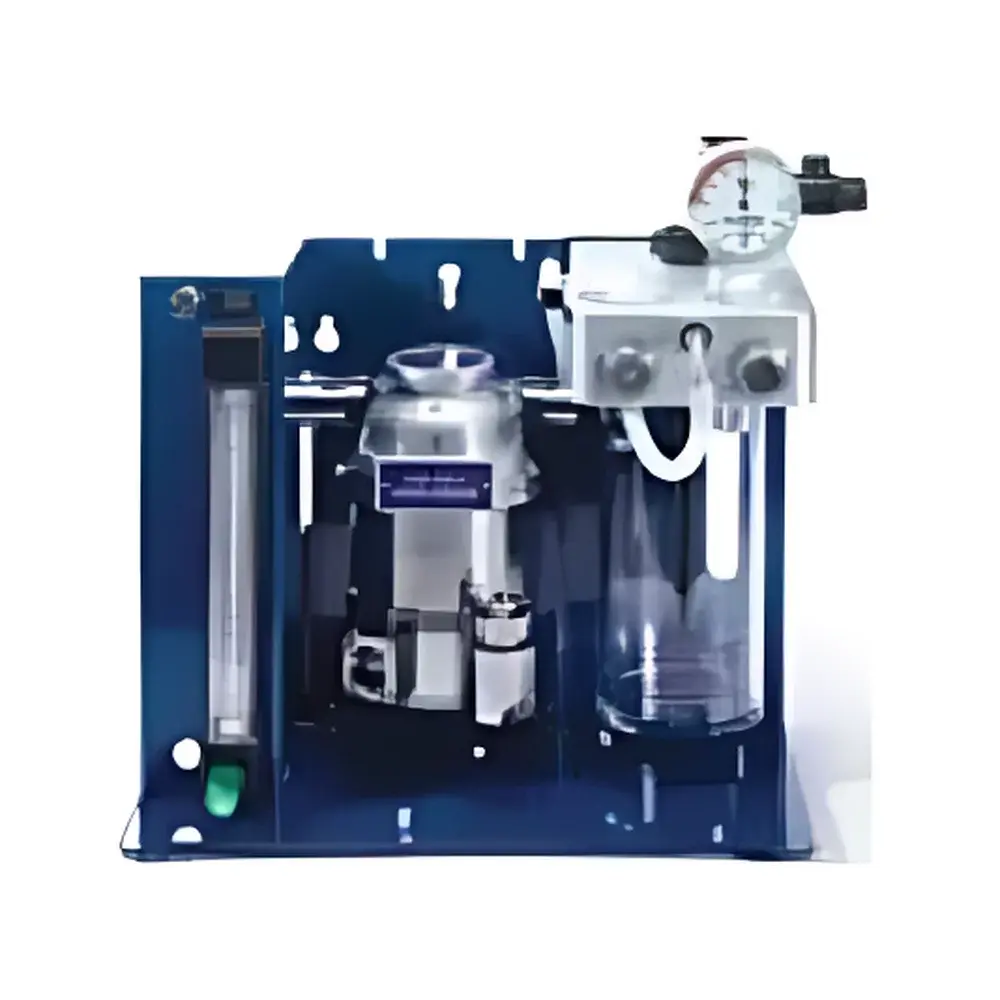
Harvard Apparatus CDS9000 Desktop Animal Anesthesia Machine
| Brand | Harvard Apparatus |
|---|---|
| Origin | USA |
| Model | CDS9000 |
| Certification | CE, ISO 13485 |
| Gas Flow Range (O₂) | 0.2–4 L/min |
| Vaporizer | 100 Series Isoflurane Vaporizer (≥250 mL capacity, ±0.5% output accuracy) |
| CO₂ Absorbent Canister Volume | ≥900 mL |
| Pressure Gauge Range | 0–60 cm H₂O |
| Fresh Gas Outlet | Yes |
| Inhalation/Exhalation Ports (Closed-Circuit) | Yes |
| Pop-off Valve | Adjustable, provides continuous −2 cm H₂O baseline pressure for rebreathing bag |
| Oxygen Bypass Switch | Integrated |
| Construction | Anodized matte-finish aluminum chassis |
Overview
The Harvard Apparatus CDS9000 is a precision-engineered desktop animal anesthesia machine designed for reliable, repeatable, and compliant delivery of inhalational anesthetics in preclinical research settings. Built upon dual-circuit architecture—supporting both open-circuit (non-rebreathing) and closed-circuit (rebreathing) configurations—the CDS9000 enables rigorous control over gas composition, flow dynamics, and respiratory mechanics during surgical and longitudinal studies in rodents, rabbits, non-human primates, and other laboratory species. Its operation adheres to fundamental principles of veterinary anesthetic delivery: precise oxygen concentration regulation, calibrated volatile anesthetic vaporization via temperature- and flow-compensated mechanisms, and real-time monitoring of airway pressure and fresh gas dynamics. The system meets ISO 13485 medical device quality management standards and carries CE marking for conformity with EU Medical Device Regulation (MDR 2017/745), ensuring suitability for GLP-compliant and IACUC-reviewed protocols.
Key Features
- Dual independent gas pathways: Dedicated fresh gas outlet for open-circuit use and fully segregated inhalation/exhalation ports for closed-circuit setups—eliminating cross-contamination risk and enabling rapid configuration switching.
- Integrated Pop-off (pressure-limiting) valve calibrated to maintain a consistent −2 cm H₂O baseline suction on the rebreathing bag, facilitating stable tidal volume delivery and preventing barotrauma during spontaneous or assisted ventilation.
- High-accuracy oxygen flowmeter with linear scale covering 0.2–4 L/min, optimized for small- to medium-sized animal models; optional secondary flowmeter supports N₂O, N₂, or CO₂ for hypoxic or hypercapnic challenge studies.
- Factory-installed 100 Series isoflurane vaporizer (≥250 mL reservoir), engineered for ±0.5% output accuracy across clinically relevant flow rates (0.5–2 L/min) and ambient temperatures (15–30°C), meeting ASTM F1875 and ISO 8535-1 performance benchmarks.
- Large-capacity (≥900 mL) CO₂ absorbent canister with colorimetric indicator, compatible with soda lime or Baralyme, supporting extended procedures without mid-experiment replacement.
- Oxygen bypass switch provides direct O₂ delivery independent of flowmeter or vaporizer—critical for induction, recovery, or emergency oxygenation without interrupting circuit integrity.
- Robust anodized aluminum chassis with matte surface finish resists corrosion, facilitates wipe-down disinfection with ethanol or quaternary ammonium agents, and complies with ISO 14971 risk management requirements for biomedical equipment housing.
Sample Compatibility & Compliance
The CDS9000 accommodates a broad range of animal models—from neonatal mice (via microflow adapters) to adult swine—when paired with appropriately sized endotracheal tubes, face masks, or nose cones. All wetted components are biocompatible and autoclavable (per manufacturer guidelines). The system supports compliance with AAALAC International accreditation standards, NIH OLAW policies, and EU Directive 2010/63/EU on animal welfare. Its CE marking confirms conformity with essential health and safety requirements under Annex I of MDR 2017/745, including electromagnetic compatibility (EN 60601-1-2), mechanical safety (EN 60601-1), and software validation (IEC 62304 Class B).
Software & Data Management
While the CDS9000 operates as a standalone analog-analog hybrid platform (no embedded digital controller), its modular design permits integration with third-party data acquisition systems via analog pressure and flow outputs (0–5 V or 4–20 mA). When deployed alongside Harvard Apparatus’ AcqKnowledge or LabChart software suites—or validated SCADA platforms—it supports synchronized logging of airway pressure, O₂ concentration (via optional inline sensor), and vaporizer output status. Audit trails, user access logs, and parameter change timestamps may be maintained externally per FDA 21 CFR Part 11 requirements when used in regulated toxicology or pharmacokinetic studies.
Applications
- Induction and maintenance of surgical anesthesia in rodent stereotaxic, cardiovascular, and neuroimaging experiments.
- Chronic inhalational exposure studies requiring stable, low-flow anesthetic delivery over hours or days.
- Respiratory physiology investigations—including PEEP titration, compliance measurement, and dead-space analysis—using closed-circuit configuration with integrated pressure monitoring.
- Training platforms for veterinary students and research staff in safe anesthetic practice, IACUC protocol execution, and emergency response drills.
- Support for ISO/IEC 17025-accredited testing laboratories performing method validation of inhalational anesthetic delivery systems.
FAQ
Does the CDS9000 support sevoflurane or desflurane?
No—the 100 Series vaporizer is calibrated exclusively for isoflurane. Use of other agents voids calibration accuracy and violates ISO 8535-1 vaporizer certification.
Can the Pop-off valve be adjusted to pressures other than −2 cm H₂O?
Yes—its setpoint is manually adjustable within a range of −1 to −5 cm H₂O using the factory-supplied calibration tool, per user-defined ventilation strategy.
Is the CO₂ absorbent canister reusable?
Yes—provided it is regenerated according to manufacturer instructions and verified via pH-indicator discoloration and moisture content testing prior to reuse.
What maintenance intervals are recommended?
Vaporizer calibration verification annually; flowmeter accuracy check semiannually; absorbent canister replacement after each 8–12 hr of continuous use or upon color change; full system leak test before each experimental session.
Does Harvard Apparatus provide installation qualification (IQ) or operational qualification (OQ) documentation?
Yes—customizable IQ/OQ protocols compliant with GxP and ISO/IEC 17025 are available upon request through authorized service partners.




