
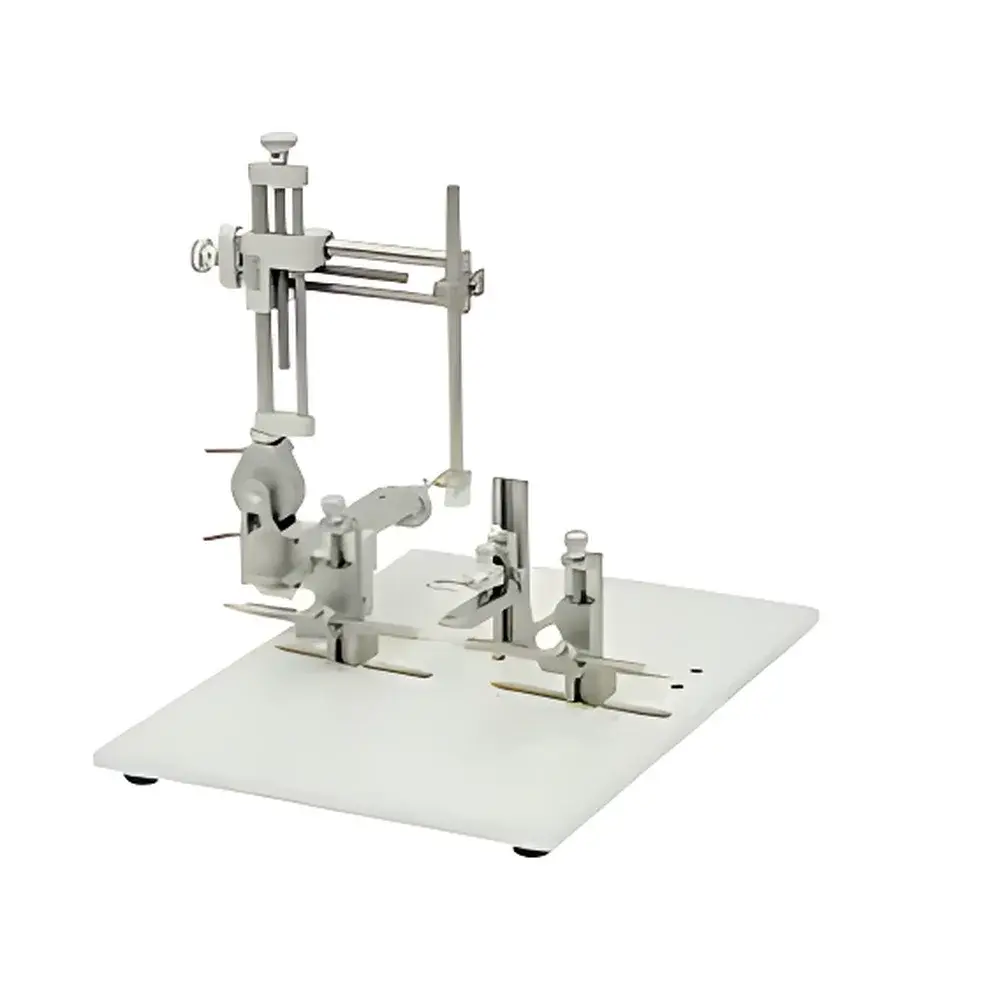
Stoelting 51500 New Standard Universal Rodent Stereotaxic Instrument
| Brand | Harvard Apparatus |
|---|---|
| Origin | USA |
| Manufacturer Type | Authorized Distributor |
| Origin Category | Imported |
| Model | 51500 |
| Pricing | Available Upon Request |
Overview
The Stoelting 51500 New Standard Universal Rodent Stereotaxic Instrument is an engineered precision platform for intracranial targeting in both rats and mice, grounded in classical stereotaxic methodology—namely, the use of bregma and lambda as fiducial landmarks to define a three-dimensional Cartesian coordinate system relative to the brain’s anatomical axes (anterior–posterior, medial–lateral, dorsal–ventral). Unlike legacy Lab Standard systems, the 51500 integrates a re-engineered universal baseplate architecture that eliminates the need for adapter swaps or recalibration when transitioning between species. This design reflects over five decades of empirical refinement in neurosurgical instrumentation, aligning with established neuroanatomical atlases (e.g., Paxinos & Watson) and supporting reproducible targeting accuracy within ±10 µm under optimal mounting conditions. The instrument operates manually via micrometer-driven manipulators with 0.1 mm graduation and fine-adjustment verniers, enabling controlled, tactile positioning without electronic dependency—critical for GLP-compliant behavioral pharmacology studies where signal integrity and protocol traceability are prioritized.
Key Features
- Universal baseplate compatible with both rat and mouse skull dimensions without accessory substitution
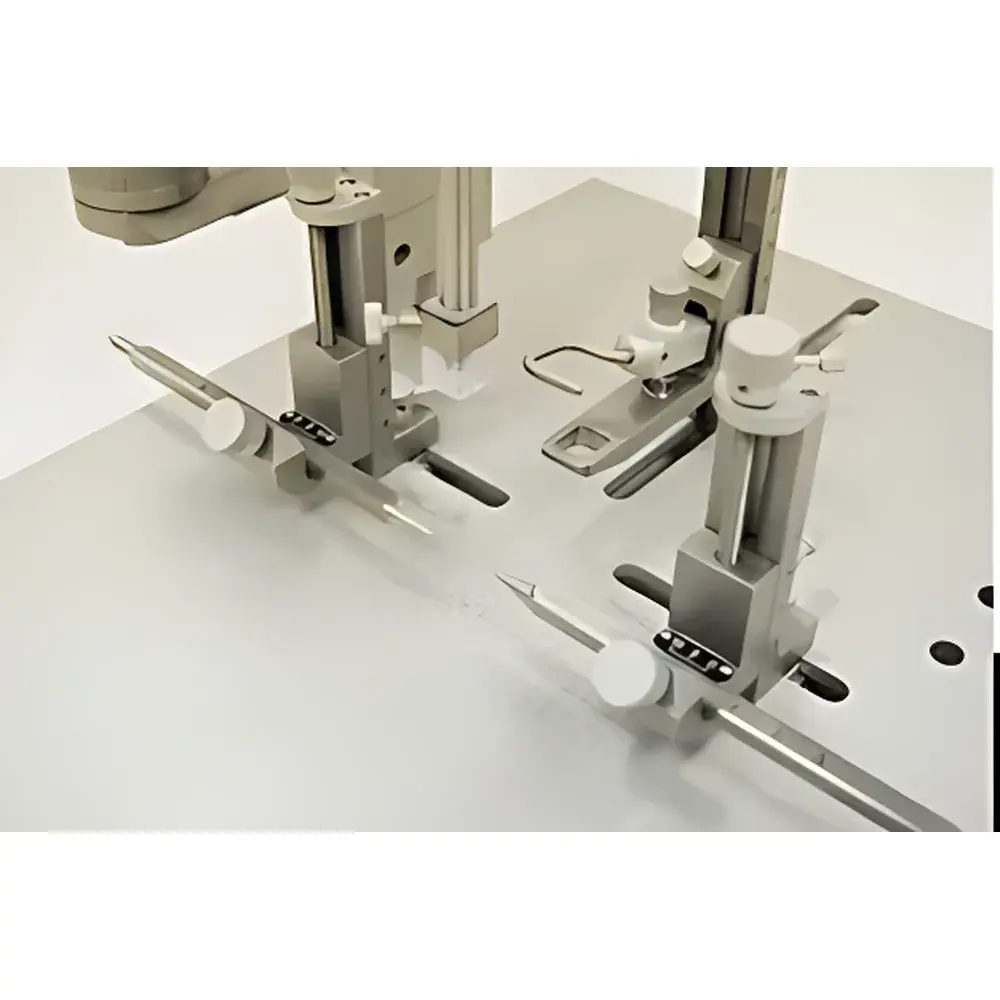
- Dual-angle rat ear bars (18° and 45° taper) for secure, strain-agnostic fixation across Sprague-Dawley, Wistar, and Long-Evans strains
- Mouse-specific ear bars with reduced diameter and optimized curvature for C57BL/6, BALB/c, and CD-1 craniometric profiles
- Open-frame elliptical design replacing traditional U-shaped arches—increasing lateral access by 35% and permitting unobstructed bilateral electrode insertion or dual cannula placement
- Interchangeable manipulator mounts accommodating standard 18 mm and 25 mm rod diameters, compatible with Stoelting’s full accessory ecosystem (e.g., hydraulic microinjection systems, electrophysiology electrodes, optical fiber holders)
- Corrosion-resistant stainless steel construction compliant with ISO 13485–aligned manufacturing practices for long-term dimensional stability
Sample Compatibility & Compliance
The 51500 supports head fixation and stereotactic alignment for rodents weighing 15–500 g, covering common models including transgenic mice, aged rats, and post-stroke or tumor-bearing cohorts. Its mechanical repeatability meets ASTM E29–22 requirements for measurement system resolution in preclinical instrumentation. All contact surfaces adhere to USP Class VI biocompatibility standards; no plastics or adhesives interface directly with animal tissue during procedure. The system is routinely validated in AAALAC-accredited facilities and conforms to NIH OLAW guidelines for surgical stereotaxy. While not inherently digital, its analog architecture ensures full audit trail compatibility with GLP/GMP documentation workflows—no software validation burden or 21 CFR Part 11 compliance overhead is introduced.
Software & Data Management
As a purely mechanical instrument, the 51500 requires no embedded firmware, drivers, or proprietary software. Coordinate entry, trajectory planning, and depth recording are performed using standardized laboratory notebooks or third-party ELN platforms (e.g., LabArchives, Benchling). Users may integrate optional digital calipers (e.g., Mitutoyo Absolute Digimatic) or external motion-tracking cameras for post-hoc verification—data exported as CSV or ASCII for statistical analysis in R, Python (SciPy), or MATLAB. This hardware-first paradigm avoids version-locking, cybersecurity vulnerabilities, or vendor-dependent update cycles—ensuring uninterrupted operation across multi-year longitudinal studies.
Applications
- Unilateral/bilateral intracerebral injection of viral vectors (AAV, lentivirus) in hippocampal, striatal, or cortical targets
- Implantation of chronic EEG or LFP electrodes for seizure monitoring or optogenetic闭环 experiments
- Establishment of 6-OHDA or MPTP-induced Parkinson’s disease models via substantia nigra pars compacta targeting
- Photothrombotic or endothelin-1–mediated focal ischemia modeling with precise thalamic or sensorimotor cortex localization
- Neural stem cell grafting into subventricular zone or dentate gyrus with concurrent BrdU labeling and histological co-registration
- Validation of fMRI-defined functional regions via post-scan histological verification using stereotaxically guided lesion mapping
FAQ
Is the 51500 compatible with non-rodent species such as guinea pigs or ferrets?
No—the 51500 is specifically calibrated for murine and rat cranial geometry per Paxinos atlas normalization. For larger species, Stoelting offers the 51700 Large Animal Stereotaxic Frame.
Can the 51500 be retrofitted with motorized actuators?
Not natively—the 51500M variant is a separate model with integrated stepper motors and controller. Mechanical retrofitting voids calibration certification and compromises structural rigidity.
Does the instrument include stereotaxic coordinates for common brain regions?
No built-in database is provided; users must reference peer-reviewed atlases or institutional SOPs. Stoelting supplies a printed coordinate guide aligned with Paxinos & Watson (7th ed.) for baseline orientation.
What maintenance is required for long-term accuracy?
Annual verification using NIST-traceable gauge blocks and optical alignment tools is recommended. Lubrication of micrometer threads with Dow Corning 111 silicone grease every 12 months preserves torque consistency.
Related Products





