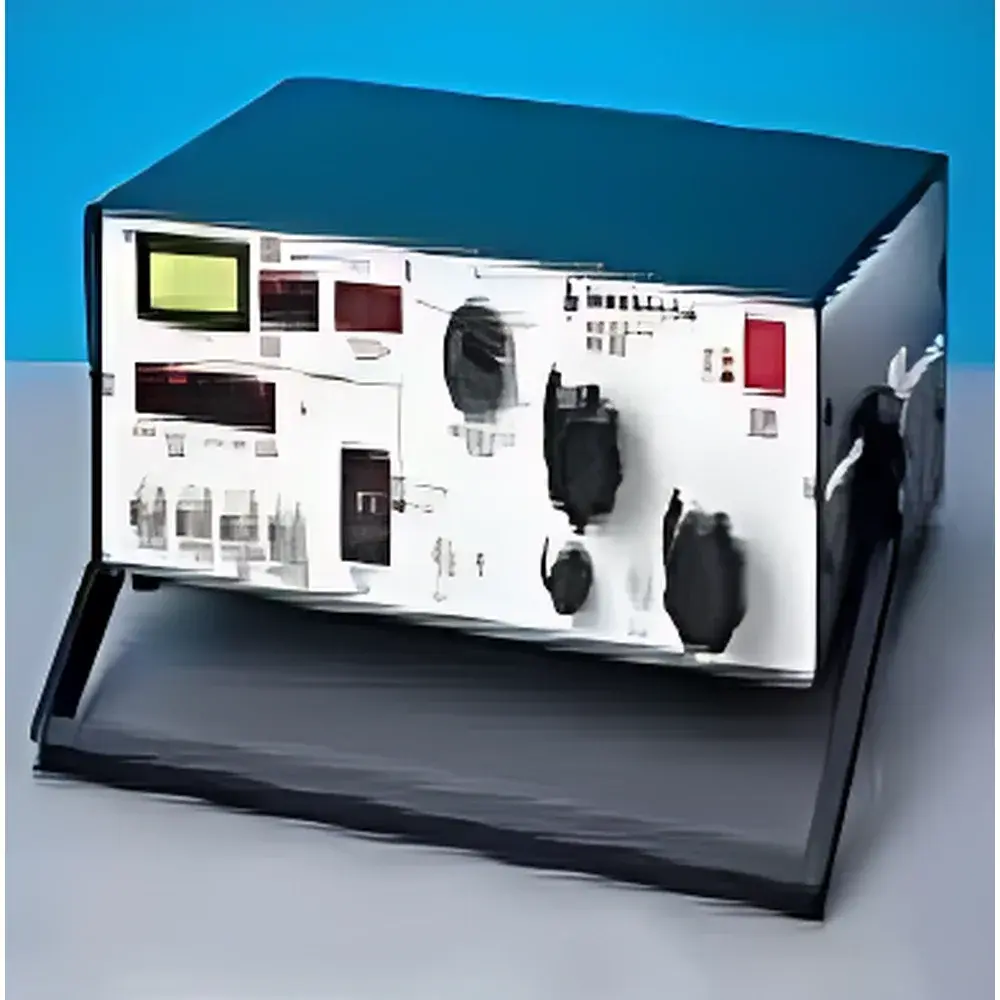
Harvard Apparatus PLI-100A Picoliter Injector
| Brand | Harvard Apparatus |
|---|---|
| Origin | USA |
| Model | PLI-100A |
| Pressure Modes | 5 (Inject, Balance, Clear, Fill, Hold) |
| Volume Range | 1 fL to ~1 mL (dependent on pipette geometry and pressure/time settings) |
| Control | Digital time setting (0.01–99 s in 10-ms or 1-s increments) |
| Interface | BNC TTL input/output for external synchronization |
| Valve Type | Precision solenoid with integrated vacuum/pressure regulation |
| Compliance | Designed for GLP-compliant microinjection workflows |
Overview
The Harvard Apparatus PLI-100A Picoliter Injector is a precision pneumatic microinjection system engineered for reproducible, low-volume fluid delivery in demanding physiological, pharmacological, and neurological research applications. Operating on the principle of regulated gas pressure—rather than mechanical displacement—the PLI-100A delivers controlled volumes ranging from femtoliters (fL) to milliliters (mL) by modulating transient positive or negative pressure pulses across calibrated glass or quartz micropipettes. Its core architecture integrates dual vacuum generators and five discrete pressure modes (Inject, Balance, Clear, Fill, Hold), enabling not only precise ejection but also active pipette loading, cell immobilization, post-injection backflow suppression, and rapid tip clearance—functions rarely unified in single-platform microinjectors. Developed for use in high-precision settings—including Cold Spring Harbor Laboratory and other tier-1 academic and pharmaceutical research facilities—the PLI-100A supports rigorous experimental repeatability under both manual and automated (TTL-triggered) operation.
Key Features
- Five independent pressure modes: Inject (positive pulse), Balance (sustained low positive pressure), Clear (high-pressure purge), Fill (vacuum-assisted loading), and Hold (cell fixation via negative pressure)
- Digital timing control with dual resolution: 10-ms steps from 0.01–0.99 s; 1-s steps from 1–99 s—enabling fine-grained calibration of delivered volume based on pipette tip geometry and fluid viscosity
- Integrated dual-vacuum system for reliable pipette filling from the tip end—minimizing sample waste and eliminating air bubble entrapment common in rear-loading methods
- BNC TTL interface for hardware synchronization with electrophysiology rigs, confocal imaging systems, or data acquisition platforms (e.g., National Instruments DAQ, Axon Digidata)
- Multi-turn digital pressure regulator with visual readout—ensuring consistent pressure application across repeated experiments and facilitating inter-lab protocol transfer
- Robust solenoid valve design rated for >1 million actuation cycles; compatible with aqueous buffers, nucleic acids, proteins, dyes, and microbeads without chemical degradation
Sample Compatibility & Compliance
The PLI-100A accommodates standard borosilicate, aluminosilicate, or quartz capillaries (1–2 mm OD) pulled to tip diameters from 5 µm. It is routinely employed in oocyte microinjection (Xenopus, mouse, zebrafish), intranuclear delivery in cultured neurons and stem cells, extracellular neurotransmitter uncaging, and localized tracer deposition in brain slice preparations. The device meets essential requirements for Good Laboratory Practice (GLP) workflows: pressure and timing parameters are manually recorded or logged via external software; its analog/digital interface supports audit-trail-capable integration with 21 CFR Part 11–compliant data systems when paired with validated acquisition software. While not a medical device per FDA classification, it is widely adopted in preclinical research supporting IND-enabling studies compliant with ICH-GCP and ISO 14155 standards.
Software & Data Management
The PLI-100A operates as a stand-alone instrument with no proprietary software dependency. All operational parameters—pressure level, injection duration, and mode selection—are set locally via front-panel controls and displayed on an LED readout. For traceable, repeatable protocols, users integrate the BNC TTL output into third-party acquisition environments (e.g., Clampex, Spike2, MATLAB, Python-based PyDaq) to timestamp injection events alongside electrophysiological or optical recordings. Pressure calibration curves (kPa vs. volumetric output) are established empirically per pipette batch using fluorescent microbead dilution assays or capacitance-based volume sensors—procedures documented in peer-reviewed microinjection methodology papers (e.g., J. Neurosci. Methods, Dev. Biol.). No firmware updates or cloud connectivity are required, ensuring long-term operational stability in regulated environments.
Applications
- Oocyte and embryo microinjection: mRNA, CRISPR-Cas9 ribonucleoprotein complexes, morpholinos, and lineage tracers in Xenopus laevis, Danio rerio, and Mus musculus models
- Single-cell neurophysiology: Intracellular dye filling, patch-clamp-assisted cytoplasmic delivery, and subcellular caged-compound photorelease
- Cellular mechanobiology: Controlled hydrostatic loading during live-cell AFM or traction force microscopy
- Developmental biology: Spatially resolved growth factor delivery in explant cultures and organoids
- High-content screening: Automated serial injection in multi-well plate formats when coupled with motorized micromanipulators and vision-guided positioning
FAQ
What is the smallest reliably deliverable volume with the PLI-100A?
Volumes as low as 1–10 femtoliters can be achieved using sub-micron pipettes (<0.3 µm tip ID), calibrated empirically via fluorescence intensity quantification or Coulter counting.
Can the PLI-100A be used with oil-immersion objectives or inverted microscopes?
Yes—the compact footprint (20 × 15 × 10 cm) and modular tubing layout allow seamless integration beneath most inverted and upright microscope stages without obstructing optical paths.
Does the PLI-100A support pressure calibration against known standards?
While it does not include NIST-traceable internal calibration, its linear pressure response permits user validation using manometer-coupled test rigs or gravimetric fluid displacement assays per ASTM E29-23 guidelines.
Is the “Balance” mode necessary for routine injections?
It is strongly recommended for intracellular or nuclear delivery: sustained low positive pressure prevents cytoplasmic backflow, maintains pipette patency, and eliminates post-injection diffusion artifacts.
How does the “Clear” function differ from standard pressure purging?
The Clear mode delivers a programmable, high-amplitude pressure spike (up to 100 kPa) lasting ≤50 ms—optimized to dislodge protein aggregates or particulate blockages without damaging fine-tipped pipettes.