
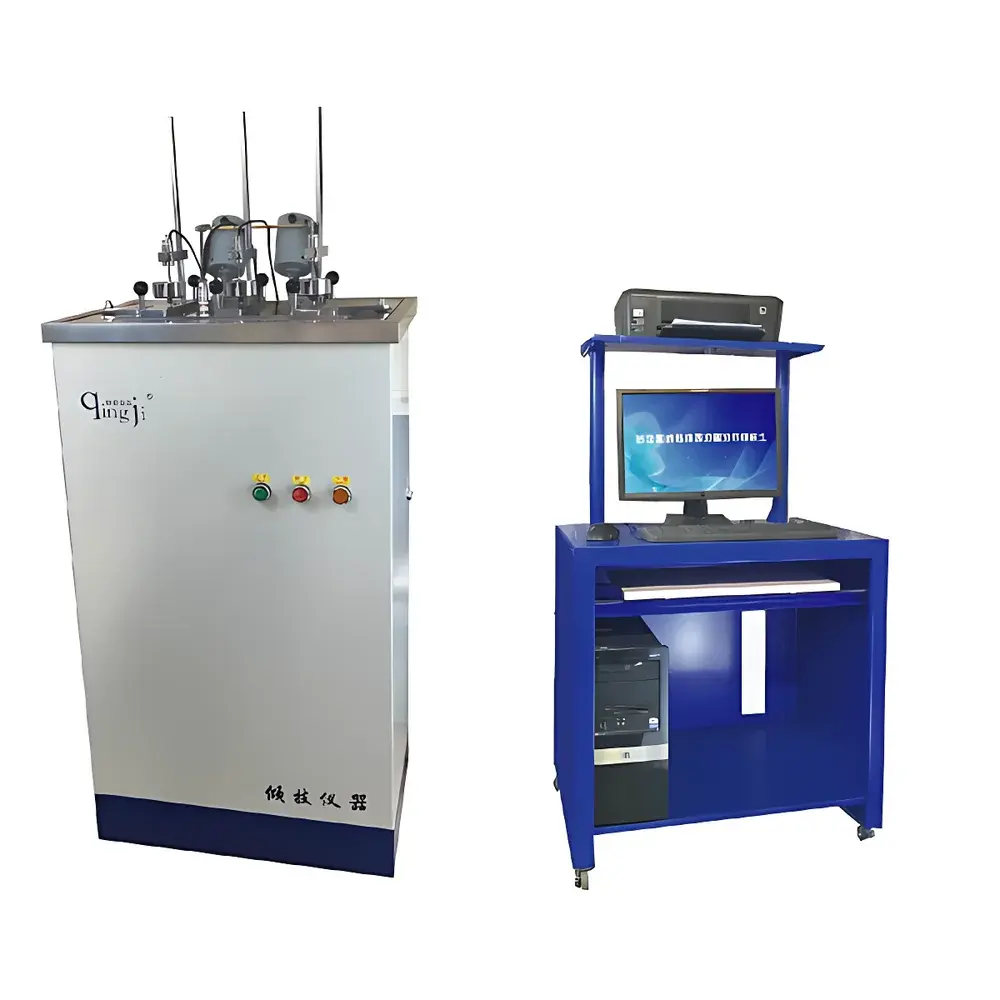
Heat Deflection Temperature Tester (HDT/VST Tester) – Model HDT-300
| Key | Origin: Shanghai, China |
|---|---|
| Manufacturer Type | Authorized Distributor |
| Origin Category | Domestic (PRC) |
| Instrument Type | Electromechanical Universal Testing Machine |
| Temperature Range | RT–300 °C |
| Heating Rate Options | (12 ± 1) °C/6 min or (5 ± 0.5) °C/6 min |
| Temperature Accuracy | ±1 °C |
| Deflection Measurement Range | 0–10 mm |
| Deflection Resolution | 0.001 mm |
| Heat Transfer Medium | Methyl Silicone Oil |
| Heating Power | 4 kW |
| Cooling Mode | Natural cooling above 150 °C |
| Power Supply | AC 220 V, 20 A, 50 Hz |
| Dimensions (L×W×H) | 540 × 520 × 1360 mm |
Overview
The Heat Deflection Temperature Tester (HDT/VST Tester) Model HDT-300 is a precision electromechanical testing system engineered for the standardized determination of two critical thermomechanical properties of polymeric materials: the Heat Deflection Temperature (HDT) under specified flexural load and the Vicat Softening Temperature (VST). These parameters reflect the temperature at which a thermoplastic specimen deforms under a defined bending stress or needle penetration force, respectively—serving as essential benchmarks for material selection, quality control, and regulatory compliance in polymer R&D, manufacturing, and certification laboratories. The instrument operates on the principle of controlled thermal ramping combined with high-resolution mechanical displacement measurement, conforming to the fundamental test physics described in ISO 75 (HDT), ISO 306 (VST), ISO 2507 (PVC pipe applications), ASTM D648, ASTM D1525, and corresponding Chinese national standards GB/T 1633, GB/T 1634, and GB 8802. Its architecture integrates a thermostatically regulated silicone oil bath, dual-mode heating/cooling management, and a calibrated linear displacement transducer—ensuring repeatable, traceable, and auditable results under routine laboratory conditions.
Key Features
- Electromechanical universal testing platform with integrated load frame, precision crosshead positioning, and digital displacement feedback loop
- Dual selectable heating rates: (12 ± 1) °C/6 min (120 ± 10) °C/h and (5 ± 0.5) °C/6 min (50 ± 5) °C/h—programmable via front-panel controller or PC interface
- High-stability methyl silicone oil bath (flash point >300 °C) ensuring uniform thermal distribution and minimal convection-induced measurement drift
- Sub-micrometer deflection resolution: 0.001 mm measurement accuracy across full 0–10 mm range, validated per ISO 17025 calibration protocols
- Thermal uniformity maintained within ±1 °C across test zone, verified by NIST-traceable PT100 sensors and independent verification points
- Modular cooling strategy: passive air cooling above 150 °C; optional water-cooled heat exchanger or ambient cooling below 150 °C for rapid thermal cycle recovery
- Robust mechanical construction with corrosion-resistant stainless steel bath housing and reinforced aluminum alloy structural frame
Sample Compatibility & Compliance
The HDT-300 accommodates standard test specimens per ISO 75-1 (rectangular bars, 80 × 10 × 4 mm or 120 × 15 × 10 mm) and ISO 306 (cylindrical or flat discs, 10 mm diameter × ≥3 mm thick), supporting both 3-point bending (HDT) and needle penetration (VST) configurations. Specimen supports, loading noses, and penetration pins are manufactured from hardened stainless steel and supplied with dimensional certification. All operational procedures and calibration routines align with GLP requirements and support audit readiness for ISO/IEC 17025-accredited laboratories. Test reports generated include full metadata: operator ID, environmental conditions (ambient T/RH), calibration certificate numbers, raw deflection vs. time curves, and pass/fail evaluation against selected standard thresholds.
Software & Data Management
The system supports standalone operation via embedded LCD controller with real-time temperature/deflection display and manual data logging. For advanced workflow integration, optional PC-based software provides full test method configuration, automated ramp/hold sequencing, live curve visualization, statistical analysis (mean, SD, CV%), and export to CSV, PDF, or XML formats. Audit trail functionality records all user actions—including parameter changes, calibration events, and report generation—with timestamps and operator authentication. Software complies with FDA 21 CFR Part 11 requirements when configured with electronic signatures, role-based access control, and immutable data archiving—enabling use in GMP-regulated environments such as medical device polymer qualification or pharmaceutical packaging validation.
Applications
- Quality assurance of thermoplastics (PP, PE, ABS, PC, POM) and thermosets (epoxy, phenolic) in automotive, electrical, and construction sectors
- Comparative thermal performance screening during polymer formulation development and additive optimization (e.g., flame retardants, fillers, plasticizers)
- Regulatory submission support for CE marking (EN ISO 75/306), UL recognition, and RoHS-compliant material declarations
- In-process verification of extrusion, injection molding, and thermoforming process stability
- Failure analysis of heat-related deformation in end-use components subjected to elevated service temperatures
- Educational use in polymer science curricula for hands-on instruction in structure–property relationships and thermal transition behavior
FAQ
What standards does the HDT-300 fully comply with?
The instrument meets the mechanical, thermal, and procedural requirements of ISO 75-1/-2/-3 (HDT), ISO 306 (VST), ISO 2507-2 (PVC pipes), ASTM D648, ASTM D1525, GB/T 1633, GB/T 1634, and GB 8802—including mandated specimen geometry, load application, heating rate tolerances, and measurement uncertainty specifications.
Can the system be calibrated and certified for ISO/IEC 17025 accreditation?
Yes—factory calibration includes traceable certificates for temperature (PT100), displacement (LVDT), and load (where applicable). Optional on-site calibration services provide documented uncertainty budgets and compliance statements aligned with ISO/IEC 17025 Clause 6.5.
Is remote monitoring or network integration supported?
The optional Ethernet-enabled controller allows integration into LAN-based lab information systems (LIMS) via Modbus TCP or HTTP API. Real-time status, alarm logs, and summary metrics can be streamed to central dashboards without requiring proprietary middleware.
What maintenance is required to sustain long-term accuracy?
Routine tasks include quarterly verification of silicone oil level and clarity, annual replacement of thermal insulation gaskets, biannual cleaning of immersion heaters and sensor wells, and semi-annual recalibration of displacement transducers using certified gauge blocks per ISO 9277.



