
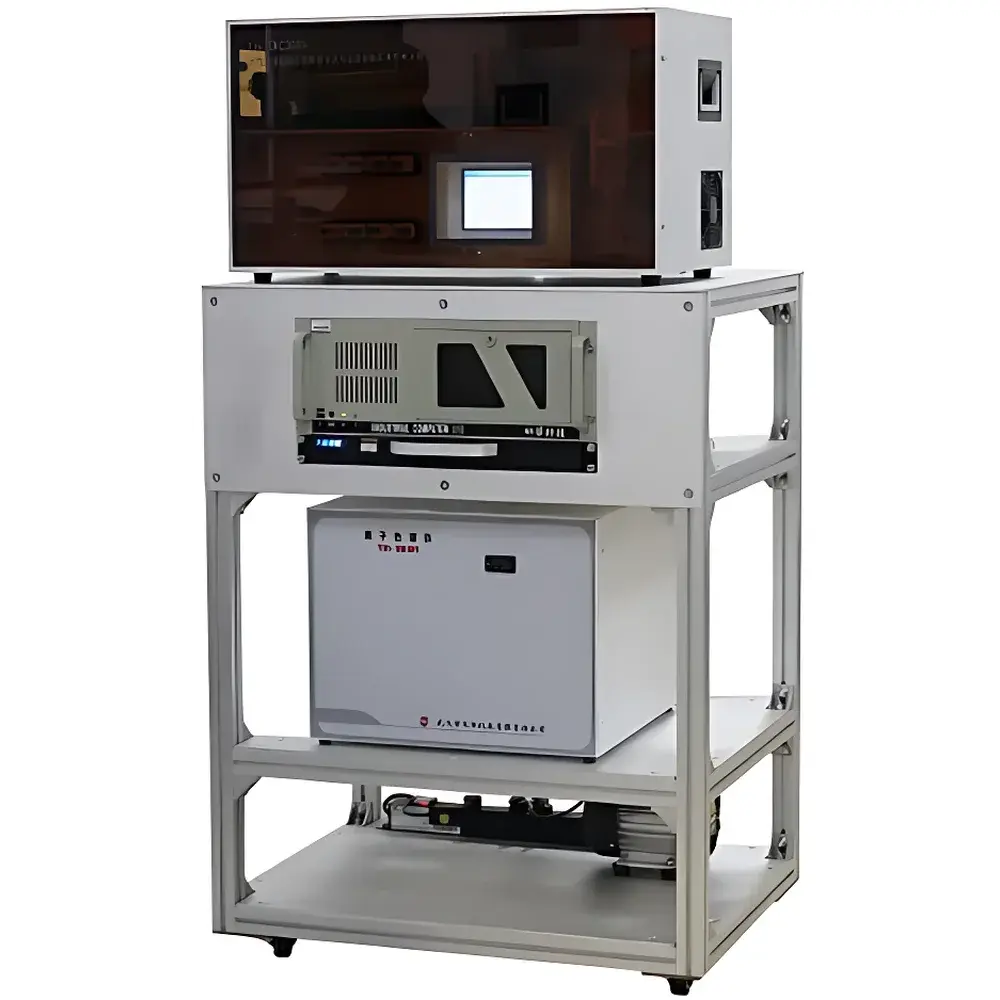
Tianhong TH-GAC-IC3000 Online Monitoring System for Water-Soluble Ionic Species in PM2.5 and Gaseous Precursors
| Brand | Tianhong |
|---|---|
| Origin | Hubei, China |
| Manufacturer Type | Authorized Distributor |
| Product Origin | Domestic |
| Model | TH-GAC-IC3000 |
| Price Range | USD 140,000 – 225,000 |
| Separation Efficiency (Gas/Aerosol) | 98% |
| Aerosol Collection Efficiency | 99% |
| Time Resolution | 30 min (15 min per phase, alternating) |
| Detection Targets | F⁻, Cl⁻, NO₂⁻, NO₃⁻, SO₄²⁻, Na⁺, NH₄⁺, K⁺, Mg²⁺, Ca²⁺ (aerosol) |
| Analytical Method | Dual-channel Ion Chromatography (IC) with Wet Annular Denuder + Aerosol Enlargement Chamber |
| Optional IC Platforms | Domestic IC or Thermo Fisher Dionex ICS-600/ICS-5000+ |
Overview
The Tianhong TH-GAC-IC3000 is an integrated, fully automated online monitoring system engineered for simultaneous, time-resolved quantification of water-soluble ionic species in both fine particulate matter (PM2.5) and co-located gaseous precursors. It operates on a dual-path separation principle rooted in differential mass transfer kinetics: gaseous pollutants—characterized by high molecular diffusivity—are selectively captured by a wet annular denuder via aqueous film absorption, while submicron aerosols maintain inertial trajectory and bypass the denuder to enter an aerosol enlargement chamber. There, controlled humidification induces particle growth, enhancing collection efficiency in a subsequent mist-chamber-based aerosol trap. The resulting aqueous extracts—separately derived from gas-phase absorber solution and aerosol leachate—are alternately introduced into parallel anion- and cation-specific ion chromatography (IC) systems. This architecture enables unattended, synchronized speciation of major inorganic ions across both phases, supporting mechanistic studies of secondary aerosol formation, haze evolution, and atmospheric acid–base chemistry under ambient conditions.
Key Features
- High-efficiency dual-phase separation: Wet annular denuder achieves ≥98% gaseous removal efficiency for HF, HCl, HONO, HNO₃, SO₂, and NH₃ without aerosol breakthrough.
- Optimized aerosol collection: Humidification-assisted enlargement chamber coupled with a high-efficiency mist collector delivers ≥99% capture rate for PM2.5-bound ions (F⁻, Cl⁻, NO₂⁻, NO₃⁻, SO₄²⁻, Na⁺, NH₄⁺, K⁺, Mg²⁺, Ca²⁺).
- True time-synchronized analysis: 30-minute operational cycle—15 minutes for gaseous extraction, 15 minutes for aerosol leaching—ensures temporally aligned ion concentration profiles for source apportionment and process modeling.
- Dual-channel IC architecture: Independent anion and cation IC modules eliminate cross-contamination risk and support concurrent calibration, peak integration, and retention time validation per ICH Q2(R2) and EPA IO-3.2 guidelines.
- Modular IC compatibility: Supports integration with either certified domestic ion chromatographs or Thermo Fisher Dionex ICS-600/ICS-5000+ platforms, ensuring flexibility in method transfer, regulatory alignment, and service lifecycle management.
- Uninterrupted operation: Designed for continuous field deployment (7×24 h), with automated reagent replenishment, leak detection, pressure monitoring, and system self-diagnosis compliant with ISO 17025 quality assurance requirements.
Sample Compatibility & Compliance
The TH-GAC-IC3000 is validated for ambient air sampling at standard temperature and pressure (STP), accommodating variable relative humidity (20–90% RH) and wind-driven particulate loading (0.1–200 µg/m³ PM2.5). Its separation and extraction protocols align with EPA Methods TO-14A (gaseous pollutants) and IO-3.2 (aerosol water-soluble ions), while data acquisition and audit trails conform to FDA 21 CFR Part 11 requirements when paired with compliant IC software. All hardware components—including PFA-lined fluidic paths, platinum-coated electrodes, and quartz-glass denuder surfaces—resist corrosion from acidic gases and oxidizing species, ensuring long-term measurement stability and minimizing memory effects. The system meets China’s HJ 657–2013 and HJ 800–2016 standards for online ion monitoring and supports GLP/GMP-aligned environmental laboratories in generating defensible datasets for regulatory reporting and peer-reviewed publication.
Software & Data Management
The embedded control software provides real-time visualization of flow rates, denuder temperature, chamber RH, IC baseline stability, and peak area reproducibility (RSD 0.2 min), peak asymmetry (>1.5), or conductivity baseline noise (>5 µS/cm RMS)—triggering automatic re-injection or manual review. Audit logs record all user actions, method changes, calibration events, and instrument faults with timestamped digital signatures, satisfying ISO/IEC 17025 Clause 7.7 traceability requirements. Remote access via TLS-encrypted web interface enables multi-site fleet monitoring and centralized QA/QC oversight.
Applications
- Regulatory air quality networks: Continuous PM2.5 water-soluble ion monitoring for national and provincial environmental protection agencies, supporting real-time haze early warning and source contribution analysis.
- Supersite observatories: High-temporal-resolution ion budgets for evaluating secondary inorganic aerosol (SIA) formation pathways—e.g., NH₃–HNO₃–NH₄NO₃ equilibrium, SO₂ oxidation kinetics, and chloride depletion mechanisms—in complex urban–rural–coastal gradients.
- Academic and institutional research: Mechanistic studies of aerosol hygroscopicity, cloud condensation nuclei (CCN) activation potential, and heterogeneous reaction kinetics using co-located meteorological and gas-phase oxidant measurements.
- Industrial emission verification: Quantitative assessment of stack-derived ionic precursors (e.g., NH₃ from SCR systems, HCl from waste incineration) against ambient receptor data for dispersion modeling and compliance auditing.
FAQ
What is the minimum detectable concentration (MDC) for key ions such as NO₃⁻ and NH₄⁺?
MDC values depend on the selected IC configuration and injection volume; typical MDCs range from 0.02–0.05 µg/m³ for major anions/cations under standard 30-min sampling cycles.
Can the system operate reliably in high-humidity or freezing-temperature environments?
Yes—the denuder heating module maintains 30–40 °C operation, and the aerosol chamber incorporates anti-condensation thermal management; optional cold-trap and heated inlet kits extend operational range to −20 °C to 45 °C.
Is method validation documentation available for regulatory submission?
Comprehensive validation packages—including precision, accuracy, linearity, carryover, and robustness data per ISO 80000-1 and EPA SW-846 Chapter 1—can be supplied upon request for method accreditation.
How is data integrity ensured during power interruption or network outage?
Onboard non-volatile memory retains 72 hours of raw sensor and chromatographic data; UPS-integrated operation preserves active IC runs and prevents column damage during brownouts.
Does the system support remote calibration and QC sample injection?
Yes—automated liquid handler supports scheduled standard injections, blank checks, and recovery spikes; all events are logged with full chain-of-custody metadata.







