
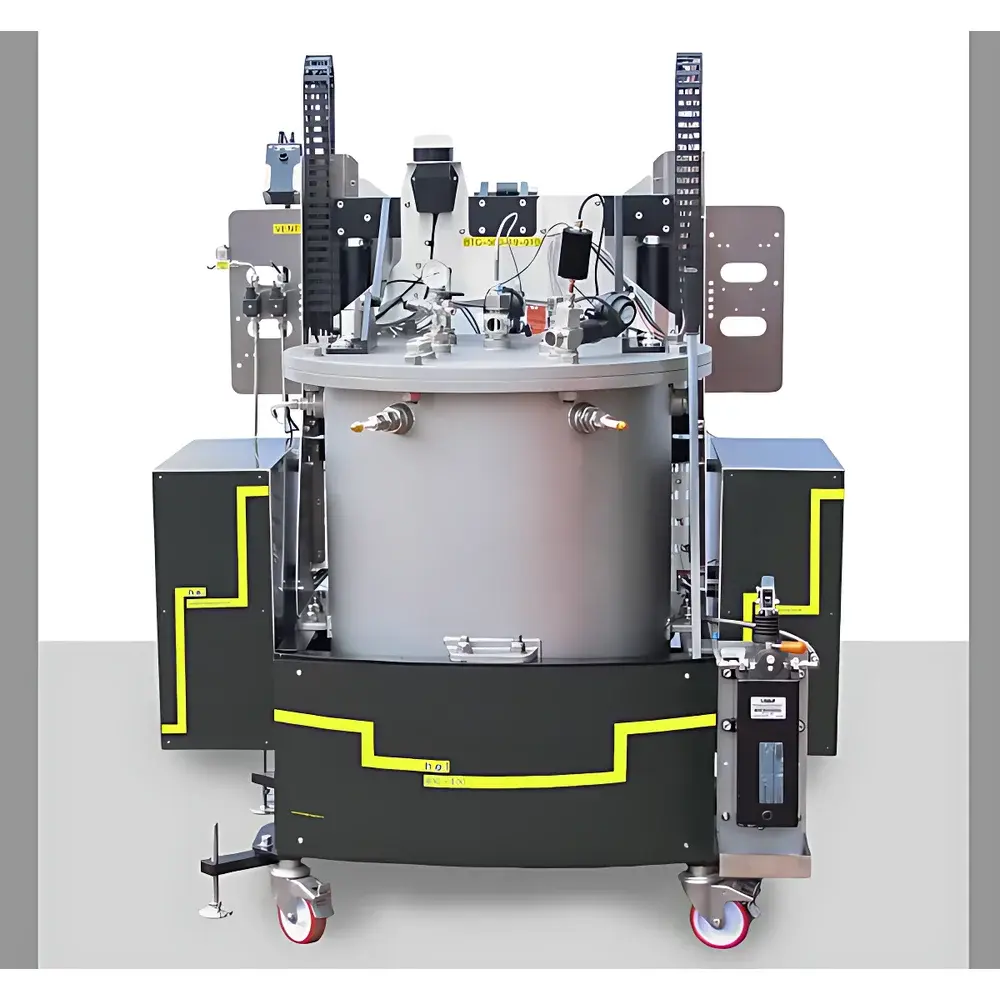
HEL BTC-500 Large-Battery Adiabatic Calorimeter
| Brand | H.E.L |
|---|---|
| Origin | United Kingdom |
| Model | BTC-500 |
| Instrument Type | Accelerating Rate Calorimeter (ARC) |
| Measurement Mode | Adiabatic Calorimetry |
| Temperature Range | −80 °C to 500 °C |
| Temperature Resolution | 0.001 K |
| Precision | ±0.01 K |
| Single-Sample Test Duration | Up to 1000 min |
| Heat Capacity | 60,000 J |
| Outer Bath Volume | 1000 mL |
| Inner Bath Volume | 1000 mL |
| Adiabatic Control Method | Real-time Online PhiTEC Calibration |
| Sample Chamber Dimensions | Φ50 × 50 cm (standard), Φ35 × 35 cm (optional) |
| Pressure Rating | Up to 30 MPa |
| Data Channels | Expandable to 8 or 16 independent temperature inputs |
Overview
The HEL BTC-500 Large-Battery Adiabatic Calorimeter is a purpose-engineered thermal safety assessment platform designed specifically for the rigorous evaluation of electrochemical energy storage systems—from individual electrode materials and 18650 cells to EV traction batteries, military-grade battery packs, and custom-format energy modules up to Φ50 × 50 cm. As an evolution of the industry-standard PhiTEC (ARC) platform, the BTC-500 integrates adiabatic calorimetry with integrated electrochemical control, enabling quantitative characterization of thermal runaway initiation, propagation kinetics, total enthalpy release, and pressure generation under realistic abuse conditions—including overcharge, external short circuit, nail penetration, and mechanical crush. Its core measurement principle relies on dynamic adiabatic tracking: the instrument continuously adjusts the furnace temperature to match the sample’s instantaneous temperature, eliminating heat exchange between the sample and its surroundings. This ensures that all observed temperature rise is attributable solely to exothermic internal reactions—providing thermodynamically rigorous data for kinetic modeling, safety margin quantification, and thermal management system validation.
Key Features
- True adiabatic operation validated via HEL’s proprietary real-time online PhiTEC calibration—no “blank bomb” calibration required; single 30-minute pre-test calibration suffices, with optional 10-minute in-run recalibration for long-duration experiments
- Dual-mode thermal control: selectable adiabatic or isothermal operation within the same platform, supporting both safety screening (e.g., onset temperature Tonset) and controlled cycling studies
- Ultra-wide temperature range: −80 °C to 500 °C, enabled by cryogenic-compatible furnace architecture and direct liquid-medium cooling (not air-based), ensuring laminar thermal environments and eliminating convective artifacts
- High-integrity containment: multi-layer annular stainless-steel pressure vessel rated to 30 MPa, equipped with dual redundant safety systems—mechanical burst disc and programmable pressure-relief valve—with automatic emergency shutdown and optional rapid-cooling module
- Modular electrochemical integration: built-in programmable charge/discharge unit (current up to ±200 A, voltage up to ±1000 V) synchronized with thermal acquisition; supports CC/CV, pulse, and abuse-profile protocols
- Multi-point thermal mapping: expandable to 16 independent high-accuracy thermocouple inputs (Type K or T), enabling spatial resolution of thermal gradients across large-format cells and stacks
- Optional real-time visual monitoring: motorized auto-focus HD camera system with LED illumination, mounted internally to capture morphological changes, gas venting, swelling, and ignition events without compromising adiabatic integrity
Sample Compatibility & Compliance
The BTC-500 accommodates heterogeneous sample geometries and chemistries without hardware modification: cylindrical (AA to 4680), prismatic, pouch, and custom-packaged cells; dry electrode powders; slurry-coated foils; separator films; electrolyte formulations; and full-module assemblies. It complies with internationally recognized frameworks for thermal hazard assessment, including ASTM E1981 (Standard Guide for Evaluating Thermal Stability of Chemicals by Differential Scanning Calorimetry), ISO 11357-7 (Plastics — Differential Scanning Calorimetry — Part 7: Determination of Oxidative Induction Time), and UN Manual of Tests and Criteria, Part III, subsection 38.3 (Lithium Battery Testing). For regulated environments, the system supports audit-ready data handling per FDA 21 CFR Part 11 (electronic records/signatures), with full electronic audit trail, user access controls, and immutable raw-data archiving. All thermal and electrochemical test sequences are fully scriptable and reproducible—meeting GLP and GMP documentation requirements for battery qualification in automotive, aerospace, and medical device applications.
Software & Data Management
Control and analysis are unified within HEL’s ThermoKinetics™ software suite—a deterministic, deterministic, Windows-based application engineered for traceability and scientific rigor. The interface provides synchronized visualization of temperature, pressure, voltage, current, and time-resolved derivative signals (dT/dt, dP/dt). All raw sensor data are stored in vendor-neutral HDF5 format with embedded metadata (test parameters, calibration logs, operator ID, timestamped version history). Kinetic analysis modules implement isoconversional methods (e.g., Friedman, Ozawa-Flynn-Wall) and model-fitting approaches (e.g., nth-order, autocatalytic) to extract activation energy (Ea), pre-exponential factor (A), and reaction order. Export options include CSV, MATLAB .mat, and PDF reports compliant with internal SOPs or external regulatory submissions. Remote monitoring and secure cloud backup are supported via optional HEL Connect™ gateway—enabling cross-site collaboration while maintaining data sovereignty and encryption-in-transit compliance (TLS 1.3).
Applications
- Thermal runaway threshold determination: precise measurement of self-heating onset temperature (Tonset), time-to-thermal-runaway (TTR), and maximum self-heat rate ((dT/dt)max) under adiabatic conditions
- Battery material screening: comparative stability assessment of cathode/anode formulations, solid-electrolyte interphases (SEI), and novel electrolyte additives
- Thermal management validation: quantification of heat generation profiles during standardized drive cycles (e.g., UDDS, WLTC) and correlation with CFD-simulated cooling performance
- Abuse tolerance certification: nail penetration, crush, overcharge, and external short-circuit testing per UL 1642, IEC 62133, and GB/T 31485
- Low-temperature safety profiling: characterization of lithium plating risk, SEI instability, and delayed exotherms below −20 °C—critical for arctic EV operation and aviation battery qualification
- Process safety scaling: derivation of phi-factor-corrected kinetic parameters for reactor-scale thermal hazard prediction using DIERS methodology
FAQ
What distinguishes the BTC-500 from conventional ARC instruments?
The BTC-500 extends the PhiTEC ARC architecture with battery-specific engineering: larger adiabatic chamber volume, integrated high-power electrochemical control, cryogenic capability down to −80 °C, and multi-zone thermal sensing—all while retaining HEL’s real-time online calibration and low-phi-factor accuracy.
Can the BTC-500 test full battery modules used in electric vehicles?
Yes. With standard Φ50 × 50 cm chamber dimensions and 30 MPa pressure rating, it accommodates OEM-grade traction battery modules (e.g., Tesla 2170 packs, BYD Blade modules) and enables direct measurement of module-level thermal propagation behavior.
Is the system compliant with FDA 21 CFR Part 11 for pharmaceutical battery applications?
Yes. ThermoKinetics™ software includes role-based access control, electronic signatures, audit trail logging, and immutable data archiving—fully validated for use in GxP-regulated environments.
How is adiabaticity maintained during low-temperature operation?
By combining direct liquid-mediated cooling (eliminating airflow-induced thermal noise) with adaptive furnace control algorithms that maintain ΔT < 0.005 K between sample and environment—even at −80 °C—without requiring recalibration.
Does the BTC-500 support automated test sequencing for high-throughput screening?
Yes. Users can define unattended test libraries—including variable ramp rates, hold times, voltage limits, and trigger conditions—enabling overnight or weekend operation with email/SMS alerts upon completion or fault detection.



