
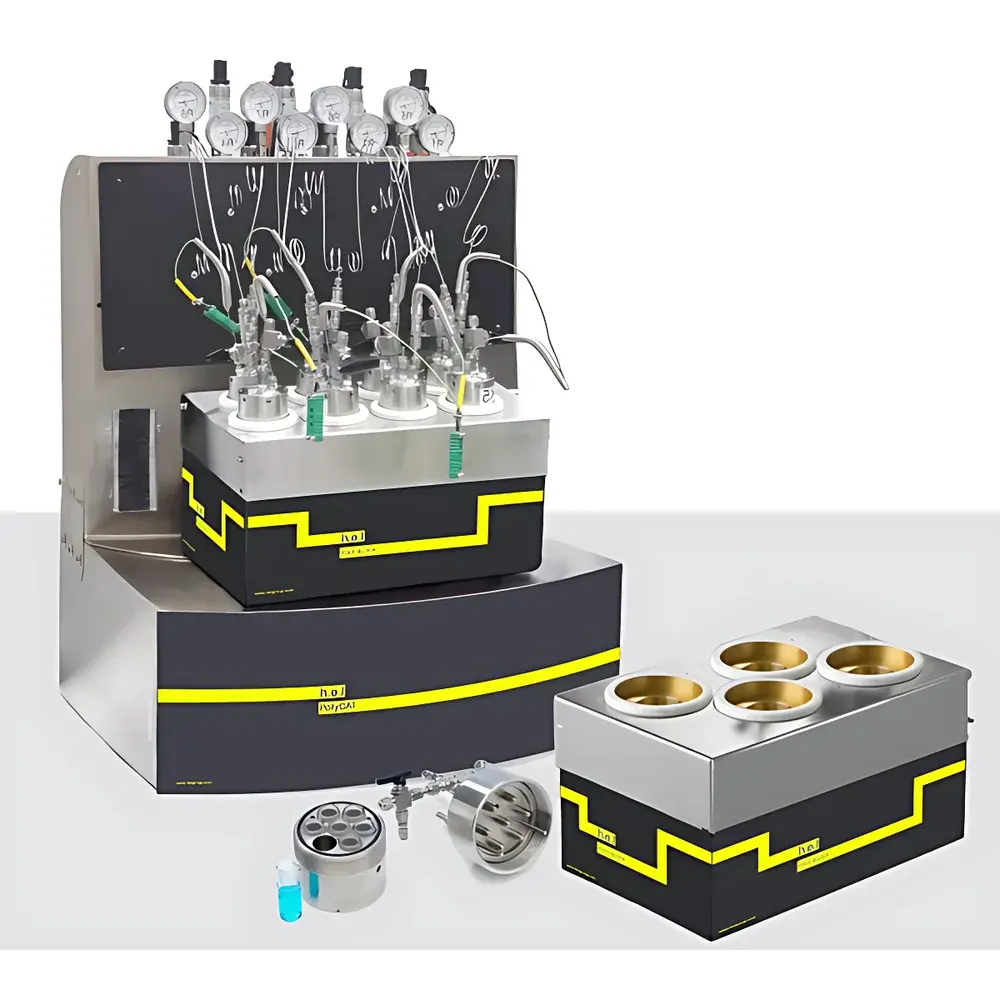
HEL PolyCAT 4 & PolyCAT 8 High-Throughput Automated High-Pressure Catalyst Screening Platform
| Brand | HEL (UK) |
|---|---|
| Origin | United Kingdom |
| Model | PolyCAT 4, PolyCAT 8 |
| Maximum Operating Pressure | 200 bar |
| Maximum Operating Temperature | 550 °C |
| Catalyst Bed Volume | 30 mL |
| Reactor Volume | 16 mL (standard) |
| Temperature Control Range | 25–250 °C (inter-reactor ΔT ≤ 100 °C) |
| Liquid Feed Rate | 0.001–10 mL/min or 0.01–50 mL/min |
| Gas Feed | Mass-flow controlled (e.g., H₂), continuously adjustable |
| Configuration Options | 4-channel parallel or 8-channel parallel |
Overview
The HEL PolyCAT 4 and PolyCAT 8 are fully integrated, automated high-pressure catalytic screening platforms engineered for rapid, reproducible evaluation of heterogeneous and homogeneous catalysts under industrially relevant process conditions. Based on continuous-flow fixed-bed reactor architecture—compliant with Couette-type flow dynamics and plug-flow assumptions—the systems enable precise control over residence time, pressure, temperature, and reactant stoichiometry. Designed for operation up to 200 bar and 550 °C, the platforms support rigorous kinetic studies, catalyst deactivation profiling, and reaction pathway mapping across hydrogenation, oxidation, carbonylation, polymerization, Fischer–Tropsch synthesis, and biofuel upgrading applications. Each unit integrates gas and liquid mass-flow controllers, independent reactor-zone thermal management, and programmable sampling logic—ensuring traceable, GLP-aligned experimental execution without manual intervention.
Key Features
- Modular parallel reactor configuration: Select between 4-channel (PolyCAT 4) or 8-channel (PolyCAT 8) operation, each with individual PID-controlled heating zones and real-time temperature monitoring (±0.5 °C accuracy).
- High-fidelity fluid delivery: Dual-path liquid dosing (0.001–10 mL/min or 0.01–50 mL/min range) and calibrated mass-flow gas injection (H₂, CO, O₂, CH₄, etc.) ensure stoichiometric precision and repeatability across >100 sequential runs.
- Automated sampling protocol: Time- or event-triggered sampling (pre- and post-condition change) with pressurized loop capture; samples routed directly to external GC, HPLC, or online FTIR via standardized 1/16″ SS tubing interfaces.
- Method-driven workflow engine: Predefined reaction protocols—including ramp/soak temperature profiles, pressure ramps, feed ratio sweeps, and catalyst aging cycles—execute autonomously with full parameter logging at 1 Hz resolution.
- Robust mechanical architecture: All-welded Hastelloy C-276 or Inconel 625 reactor tubes; ISO-KF and VCR sealing; ASME Section VIII Div. 1–rated pressure housings; integrated rupture disc and pressure relief valve.
Sample Compatibility & Compliance
The PolyCAT platforms accommodate powdered, extrudate, pelletized, and monolithic catalyst forms within standard 30 mL fixed beds. Tubular reactor inserts are available in multiple diameters (3–12 mm ID) and lengths (50–500 mm), fabricated from quartz, stainless steel 316, Inconel, or silicon carbide to match corrosivity, thermal stability, and catalytic inertness requirements. System design conforms to ISO 4126-1 (pressure equipment safety), PED 2014/68/EU, and ATEX Directive 2014/34/EU for Zone 1 hazardous area operation. Data integrity complies with FDA 21 CFR Part 11 requirements via electronic signatures, audit trails, and immutable parameter history export (CSV, XML, HDF5).
Software & Data Management
Control and analysis are executed through HEL’s proprietary CatalystManager™ software (v5.2+), a Windows-based application supporting method creation, real-time visualization (live pressure/temperature/reactant flow overlays), and synchronized chromatographic data ingestion. Software enforces role-based access control (RBAC), automatic metadata tagging (operator, timestamp, batch ID, catalyst lot), and configurable report generation per ISO/IEC 17025 clause 7.8. Raw sensor logs, method definitions, and calibration certificates are stored in encrypted local repositories with optional network backup. Export formats include ASTM E1392-compliant .jdx for spectral integration and USP –aligned instrument qualification templates.
Applications
- Accelerated catalyst formulation screening for refinery hydrotreating units (e.g., NiMo/Al₂O₃ under 130–180 bar H₂, 320–400 °C).
- Kinetic modeling of low-pressure Fischer–Tropsch reactions using Fe- or Co-based catalysts under syngas (H₂:CO = 1–2.2) at 220–260 °C.
- Structure–activity relationship (SAR) studies for asymmetric hydrogenation catalysts (e.g., chiral Ru-diphosphine complexes) in pharmaceutical intermediate synthesis.
- Thermal and hydrothermal stability assessment of zeolite-supported acid catalysts during methanol-to-hydrocarbons (MTH) conversion.
- Process intensification trials for continuous-flow biomass-derived platform molecule upgrading (e.g., furfural hydrogenation to tetrahydrofurfuryl alcohol).
FAQ
What catalyst bed geometries are supported?
Standard configurations use 30 mL fixed-bed cartridges (ID 12 mm × L 300 mm); custom tubular reactors (ID 3–12 mm, L 50–500 mm) are available in quartz, SS316, Inconel 625, or SiC.
Can the system operate in batch mode?
No—PolyCAT platforms are exclusively continuous-flow systems optimized for steady-state kinetic analysis; transient startup/shutdown profiles are programmable but not intended for closed-vessel batch synthesis.
Is remote monitoring supported?
Yes—CatalystManager™ supports secure TLS 1.2–encrypted remote desktop access and real-time dashboard streaming via institutional VPN or HEL Cloud Connect (optional subscription).
How is calibration traceability maintained?
All mass-flow controllers are factory-calibrated against NIST-traceable standards; temperature sensors are certified to IEC 60751 Class A; calibration records are embedded in method files and archived with run data.
What analytical interfaces are validated?
GC (Agilent 8890/8860, Shimadzu GC-2030), HPLC (Waters Acquity UPLC, Thermo Vanquish), and online FTIR (Bruker Tensor II) integrations are pre-validated; third-party instrument drivers comply with ASTM E1392 and OPC UA 1.04 specifications.



