
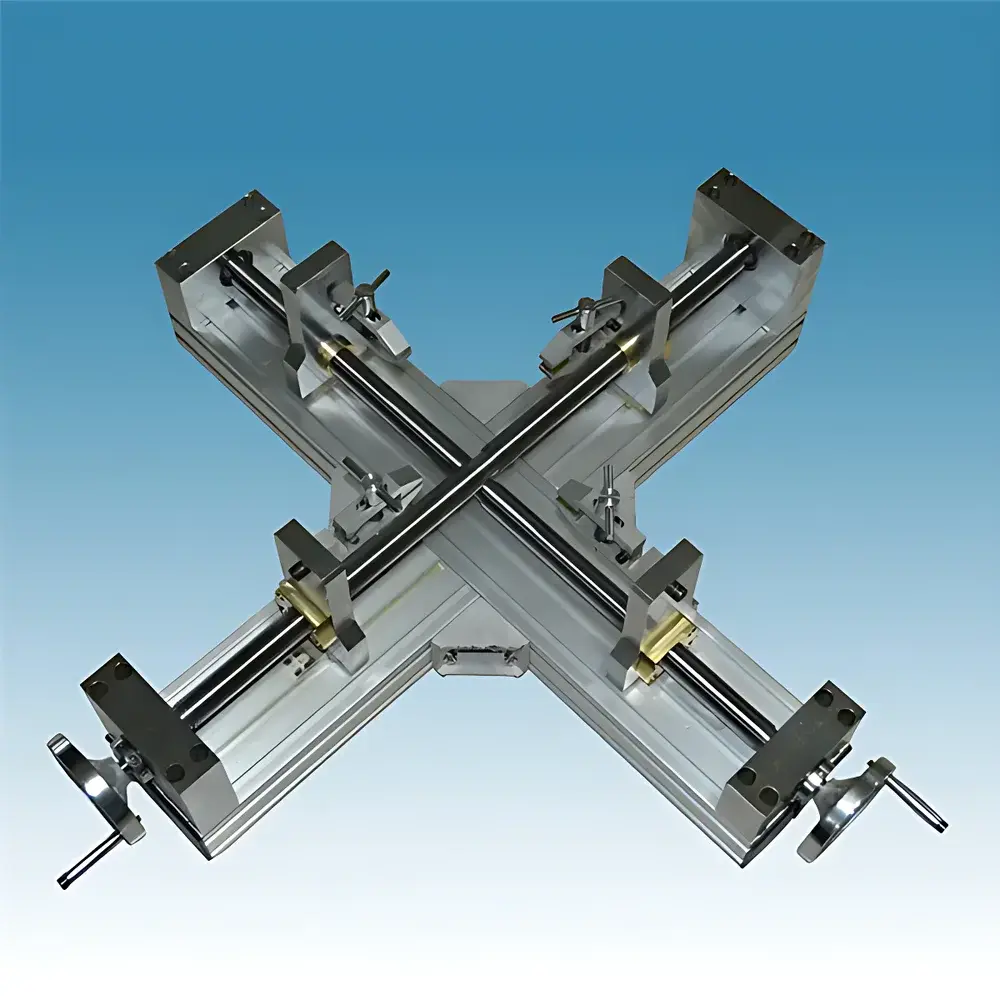
Hengyi HY-0130 Microcomputer-Controlled Biaxial Tensile Testing Machine
| Brand | Hengyi |
|---|---|
| Origin | Shanghai, China |
| Manufacturer Type | Direct Manufacturer |
| Product Origin | Domestic (China) |
| Model | HY-0130 |
| Instrument Type | Electromechanical Tensile Testing Machine |
| Maximum Test Load | 1 kN |
| Force Measurement Range | 0.001%–100% FS |
| Force Accuracy | ±0.5% of reading |
| Crosshead Travel (X/Y-axis) | 300 mm each |
| Displacement Resolution | 0.001 mm |
| Test Speed Range | 0.001–300 mm/min |
| Speed Accuracy | ±0.5% of set value |
| Strain Control Rate Range | 0.002–6% FS/s |
| Stress Control Rate Range | 0.005–6% FS/s |
| Displacement Measurement Accuracy | ±0.5% of reading |
| Deformation Measurement Accuracy | ±0.5% of reading |
| Load Cell Resolution | ±500,000 counts, full-scale不分档 |
| Power Supply | 220 V AC, 400 W |
| Host Dimensions | 800 × 800 × 800 mm |
| Net Weight | 80 kg |
Overview
The Hengyi HY-0130 Microcomputer-Controlled Biaxial Tensile Testing Machine is an electromechanical testing system engineered for precise, synchronized biaxial mechanical characterization of thin-film and sheet materials. Unlike conventional uniaxial tensile testers, the HY-0130 integrates two independently programmable actuation axes (X and Y), enabling true planar stress-state loading under controlled displacement, force, or strain rate conditions. Its measurement principle is based on high-resolution load cell transduction (1 kN capacity, ±0.5% accuracy) coupled with sub-micron displacement feedback via precision linear encoders (0.001 mm resolution). The system supports static and quasi-static mechanical testing in accordance with ASTM D882 (tensile properties of thin plastic sheeting), ISO 527-3 (plastics — determination of tensile properties — part 3: films and sheets), and ISO 6892-1 (metallic materials — tensile testing — part 1: method of test at room temperature). Designed for R&D laboratories and quality control environments, it delivers repeatable, traceable data for evaluating anisotropy, yield behavior, necking onset, and post-yield deformation under multiaxial constraint.
Key Features
- High-rigidity monolithic cast-iron “square-frame” architecture with zero-gap structural design, minimizing frame compliance and ensuring <0.1% deflection under maximum load.
- Dual-axis synchronized motion control with independent speed regulation (0.001–300 mm/min) and real-time closed-loop feedback for displacement, force, and strain.
- Full-scale, undivided load measurement system with 500,000-count resolution and consistent linearity across 0.001%–100% of full scale (FS).
- Integrated safety architecture: electronic travel limits, overload protection (110% FS cutoff), automatic emergency stop on overpressure/overcurrent detection, and programmable test termination by load, displacement, or time.
- Motorized crosshead with dual-speed manual override (fast/slow jog) and auto-return functionality to pre-test position.
- Modular gripping interface compatible with pneumatic, wedge, and custom fixtures for film, foil, polymer sheet, and metallic thin substrates (thickness range: 10 µm–2 mm).
Sample Compatibility & Compliance
The HY-0130 accommodates specimens up to 300 mm × 300 mm in planar dimension and supports standardized dog-bone, rectangular, and cruciform geometries per ASTM D5279 (biaxial tension of plastics) and ISO 16842 (biaxial tensile testing of metallic sheet). It is routinely deployed for evaluating biaxial yield surfaces, drawing limit curves (DLCs), and formability indices in packaging films, battery separators, flexible electronics substrates, and medical device membranes. The system meets essential requirements for GLP-compliant testing environments, including audit-ready calibration traceability (NIST-traceable load cells), hardware interlocks, and deterministic test sequence execution. While not certified to IEC 61000-6-2/6-4, its EMI-hardened drive electronics ensure stable operation in shared laboratory infrastructure.
Software & Data Management
Control and analysis are performed via Hengyi’s proprietary Windows-based software suite, supporting real-time plotting of stress–strain, load–displacement, and biaxial ratio (σx/σy) trajectories. All raw data—including timestamped encoder positions, load cell voltage, and control setpoints—is logged at ≥100 Hz in ASCII CSV format for third-party post-processing (MATLAB, Python, Origin). The software implements configurable test protocols with multi-step ramp-hold sequences, supports user-defined pass/fail criteria, and generates PDF reports with embedded metadata (operator ID, calibration date, environmental conditions). Audit trail functionality records all parameter modifications and test executions—aligned with FDA 21 CFR Part 11 principles for electronic records where local validation is performed by end users.
Applications
- Constitutive modeling of polymer films (e.g., PET, PP, PE) under equi-biaxial and non-equi-biaxial loading.
- Formability assessment of aluminum and stainless steel foils used in heat exchangers and battery current collectors.
- Mechanical validation of hydrogel and elastomeric biomedical membranes under physiological strain states.
- Quality assurance of lithium-ion battery separator tensile integrity after thermal exposure (e.g., 80°C preconditioning).
- Research into strain-induced crystallization and orientation development in stretched thermoplastics.
FAQ
What types of materials can be tested on the HY-0130?
The system is optimized for thin, planar specimens including polymeric films, metal foils, composites, elastomers, and biological membranes with thicknesses between 10 µm and 2 mm.
Does the HY-0130 support ASTM or ISO standard-compliant testing?
Yes—it enables execution of ASTM D882, D5279, ISO 527-3, ISO 6892-1, and ISO 16842 when paired with appropriate specimen geometry and fixture configurations.
Is calibration documentation provided with the instrument?
Each unit ships with a factory calibration certificate referencing NIST-traceable standards for force and displacement; annual recalibration is recommended per ISO/IEC 17025 guidelines.
Can the software export data for statistical process control (SPC)?
Yes—CSV output includes all raw sensor channels and timestamps, enabling integration with JMP, Minitab, or custom SPC dashboards.
What is the typical lead time for custom fixture design?
Standard pneumatic and mechanical grips ship with the system; bespoke cruciform or clamping fixtures require 3–4 weeks from finalized CAD submission.



