
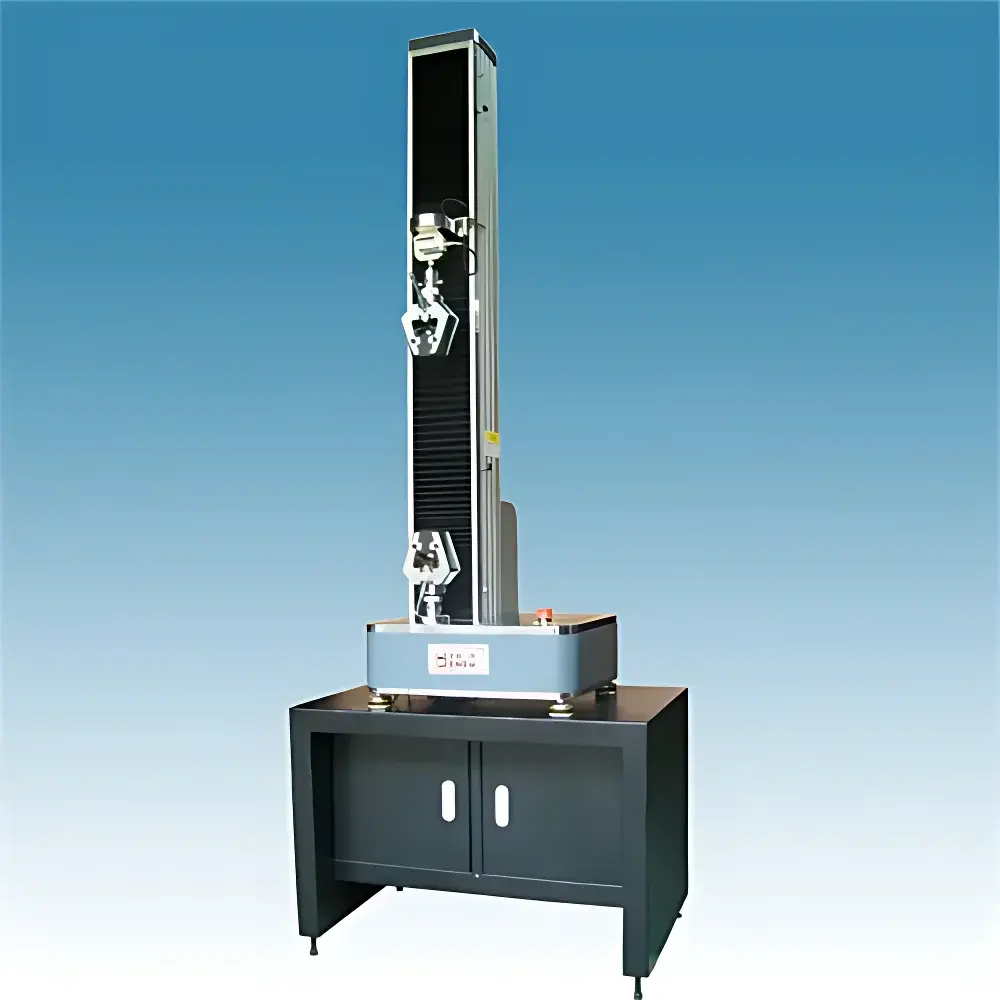
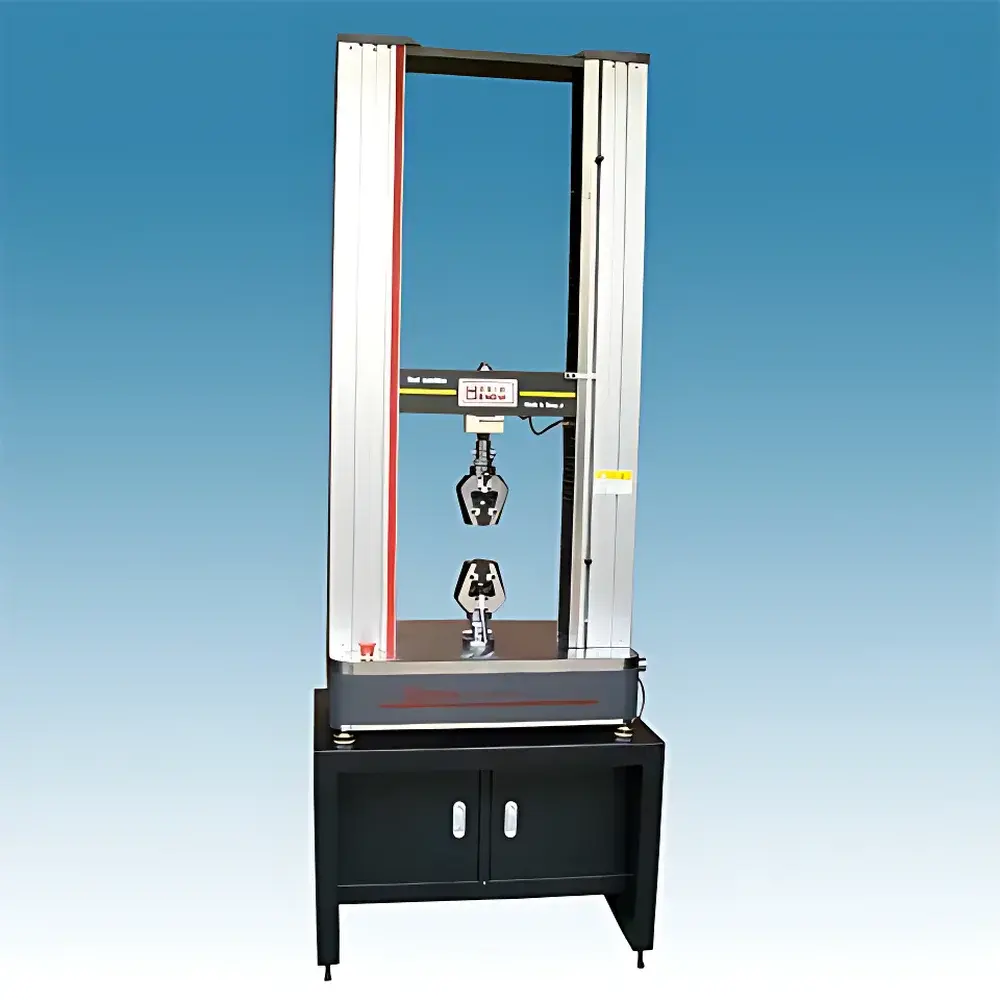
Hengyi HY-0580PLJN Hydrogel Tensile Fatigue Testing Machine
| Brand | Hengyi / Hengyitest |
|---|---|
| Origin | Shanghai, China |
| Manufacturer Type | Direct Manufacturer |
| Product Category | Domestic (China-made) |
| Model | HY-0580PLJN |
| Price Range | USD 7,000 – 14,000 |
| Instrument Type | Electromechanical Universal Testing Machine |
| Accuracy Class | ≤0.5% |
| Rated Load Options | 1 N, 5 N, 10 N, 20 N, 50 N, 100 N, 200 N, 500 N, 1000 N, 2000 N, 3000 N, 5000 N (interchangeable load cells) |
| Effective Test Width | 120 mm |
| Effective Vertical Travel | 800 mm |
| Speed Range | 0.001–500 mm/min (adjustable) |
| Speed Accuracy | ±0.5% of indicated value |
| Displacement Measurement Accuracy | ±0.5% of indicated value |
| Strain Measurement Accuracy | ±0.5% of indicated value |
| Stress Control Rate Range | 0.005–6 %FS/s |
| Strain Control Rate Range | 0.002–6 %FS/s |
| Constant-Load/Displacement/Strain Measurement Range | 0.5–100 %FS |
| Overload Protection | Activates at >110% of selected full-scale load |
| Power Supply | 220 V AC, single-phase, 750 W |
| Host Dimensions | 470 × 400 × 1510 mm |
| Net Weight | 95 kg |
Overview
The Hengyi HY-0580PLJN Hydrogel Tensile Fatigue Testing Machine is an electromechanical universal testing system engineered for high-precision static and cyclic mechanical characterization of soft, viscoelastic, and low-stiffness materials—particularly hydrogels, biological tissues, thin polymer films, adhesives, and micro-scale specimens. Based on servo-controlled electromechanical actuation and closed-loop digital feedback, the system implements standardized uniaxial tensile, compression, bending, peel, tear, relaxation, and fatigue protocols per ISO 527, ASTM D638, ASTM D3574, ISO 37, ISO 6892-1, and GB/T 228.1. Its modular architecture supports interchangeable load cells (1 N to 5000 N), pneumatic or manual grips optimized for fragile or low-force samples, and real-time synchronization of force, displacement, and strain data at up to 1 kHz sampling rate. Designed for R&D labs in biomaterials, pharmaceutical packaging, medical device validation, and soft electronics, the HY-0580PLJN delivers traceable, repeatable results under GLP-aligned workflows.
Key Features
- Precision load measurement with ≤0.5% accuracy class across full scale, using high-stability S-beam or cantilever load cells calibrated to national metrological standards.
- Ultra-low-speed capability (0.001 mm/min) combined with high-speed return (up to 500 mm/min), enabling quasi-static creep tests and rapid specimen repositioning.
- Full-range, no-dual-range force resolution: ±500,000 counts at maximum capacity ensures consistent sensitivity from 0.1% to 100% FS without range switching artifacts.
- Dual-mode control architecture supporting stress-rate, strain-rate, and displacement-rate regulation with programmable ramp-hold-step profiles for fatigue cycling and relaxation studies.
- Integrated electronic limit protection, overload cut-off (>110% FS), and self-diagnostic routines for drive voltage, current, and sensor integrity—meeting IEC 61000-6-2 EMC requirements.
- Robust frame design (95 kg mass, rigid aluminum-alloy crosshead and column assembly) minimizes vibration-induced noise during sub-mN-level measurements on hydrogel ribbons or micropatterned films.
Sample Compatibility & Compliance
The HY-0580PLJN accommodates specimens ranging from sub-millimeter hydrogel strips (e.g., PEGDA, alginate, chitosan-based formulations) to 120-mm-wide polymer sheets, thin metal foils (Cu/Al <50 µm), photovoltaic interconnect ribbons, suture threads, biomedical tubing, and composite laminates. Standardized fixtures include pneumatic parallel-jaw clamps (for uniform grip pressure), wedge-action grips (for high-friction polymers), and custom micro-grips (optional) for fibers <100 µm diameter. All test procedures comply with audit-ready documentation requirements per ISO/IEC 17025, FDA 21 CFR Part 11 (when paired with validated HYtest software configuration), and GMP-relevant validation templates (IQ/OQ/PQ). Mechanical output parameters—including ReH, ReL, Rp0.2, Fm, Rt0.5–Rt0.7, Rm, and Young’s modulus E—are calculated automatically and traceably to SI units.
Software & Data Management
HYtest v4.2 software provides multi-axis real-time plotting (load–displacement, stress–strain, stress–time, strain–time) with synchronized dual-curve overlay using customizable color palettes and scaling. Each test generates a timestamped, digitally signed .hdt binary file containing raw sensor data, control setpoints, environmental metadata (operator ID, lab temperature/humidity if interfaced), and audit trail logs. Curve analysis tools support automatic yield point detection (0.2% offset method), tangent modulus calculation, hysteresis area integration, and cycle-by-cycle fatigue degradation tracking. Export formats include CSV, PDF reports (with embedded calibration certificates), and XML for LIMS integration. Software validation packages—including URS, FRS, IQ/OQ protocols and electronic signature compliance—are available upon request for regulated environments.
Applications
- Hydrogel swelling–mechanics coupling studies under controlled humidity and temperature (when integrated with environmental chamber).
- Cyclic tensile fatigue life assessment of wound dressings, contact lens materials, and injectable hydrogel scaffolds (ISO 1099-compliant waveform generation).
- Adhesion strength quantification of tissue sealants and surgical glues via T-peel and 90° peel tests (ASTM D903, ISO 8510-2).
- Mechanical screening of biodegradable sutures, drug-eluting stent coatings, and microneedle arrays under dynamic loading.
- Quality control of thin-film packaging (e.g., blister foil lamination strength, pouch seal integrity) per ASTM F88 and ISO 11607-2.
- Stress relaxation and creep compliance modeling for viscoelastic polymers using Prony series fitting within post-processing modules.
FAQ
What load cell options are certified for use with the HY-0580PLJN?
Standard configurations include ISO/IEC 17025-accredited load cells from 1 N to 5000 N, each supplied with individual calibration certificate (as-per EN ISO 376:2011) and verified linearity, hysteresis, and repeatability performance.
Can the system perform true fatigue testing with programmable waveforms?
Yes—the controller supports sinusoidal, triangular, trapezoidal, and user-defined asymmetric waveforms with variable frequency (0.001–5 Hz), amplitude, mean load, and cycle count; all parameters logged with millisecond time stamps.
Is third-party software integration supported (e.g., MATLAB, Python, LabVIEW)?
The HY-0580PLJN provides TCP/IP and RS-232 APIs with documented command syntax and sample scripts for MATLAB and Python; LabVIEW drivers are available under NDA.
Does the system meet requirements for regulatory submissions (e.g., FDA 510(k), CE-IVD)?
While the instrument itself is not a medical device, its validated operation mode—when used with documented SOPs, calibrated transducers, and HYtest audit-trail-enabled configuration—supports mechanical evidence generation compliant with ISO 14971 and ISO 10993-12 testing protocols.
What maintenance intervals are recommended for long-term accuracy retention?
Annual recalibration of load cells and displacement encoder is advised; quarterly verification using traceable reference standards (e.g., NIST-traceable deadweights and gauge blocks) is required for GLP/GMP environments.



