
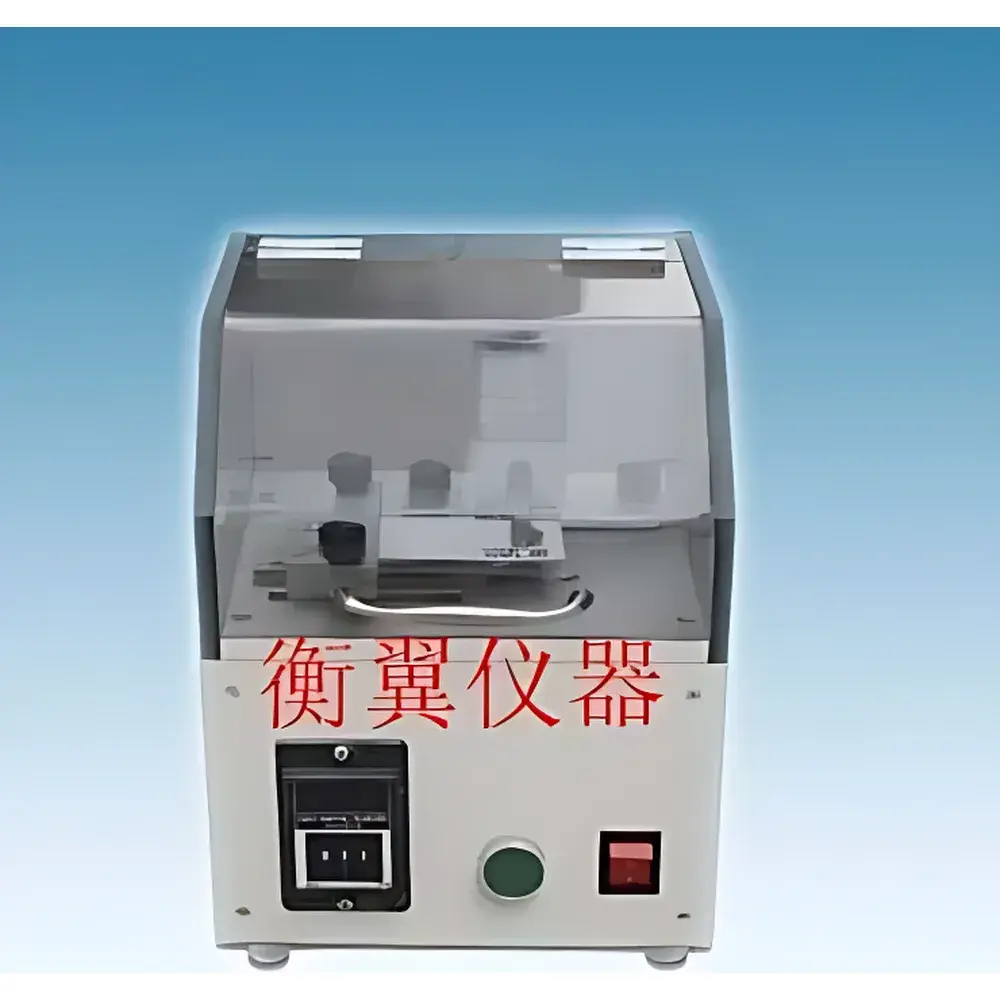
Hengyi HY(SL)RTG Smart Card Rolling Pressure Tester
| Brand | Hengyi |
|---|---|
| Origin | Shanghai, China |
| Manufacturer Type | Direct Manufacturer |
| Region Classification | Domestic (China) |
| Model | HY(SL)RTG |
| Pricing | Upon Request |
| Test Standard Compliance | ISO/IEC 7816-1/2/3, CQM P-22, MCD4, GB/T 17554.3–2006 |
| Cycle Count | 100 total reciprocating rolls (50 forward over chip front, 50 backward over chip rear) |
| Applied Load | 8 N (standard), optional 15 N weight included for CQM-recommended validation |
| Frequency | 0.5 Hz ±0.02 Hz |
| Power Supply | 110–220 V AC, 50/60 Hz |
Overview
The Hengyi HY(SL)RTG Smart Card Rolling Pressure Tester is an electromechanical test system engineered to evaluate the mechanical robustness and electrical continuity of contact-based integrated circuit cards (ICC), including EMV-compliant payment cards, SIM cards, and ID cards with ISO/IEC 7816-formatted metal contacts. It replicates real-world wear scenarios by subjecting the card’s contact zone to controlled, cyclic rolling compression—mimicking repeated insertion/removal in terminals, ATMs, and readers. The instrument operates on a precision servo-driven dual-roller mechanism that applies a calibrated normal force while maintaining strict kinematic repeatability. Its core function is to assess contact resistance stability, physical deformation of contact pads, and functional integrity of the embedded IC after standardized mechanical stress exposure. Designed in alignment with global smart card qualification protocols, the HY(SL)RTG supports both routine QC verification and formal compliance testing per CQM (Card Quality Management), MCD4, and national standard GB/T 17554.3–2006.
Key Features
- Precision-controlled dual-roller actuation system with closed-loop speed regulation ensuring stable 0.5 Hz ±0.02 Hz cycling frequency across all test runs.
- Interchangeable load application: standard 8 N force applied via calibrated spring mechanism; includes auxiliary 15 N stainless-steel weight for CQM P-22–recommended high-load validation.
- Dedicated card fixture with adjustable lateral alignment and vertical clamping to prevent slippage during 100-cycle reciprocating motion (50 cycles over chip front, 50 over chip rear).
- Integrated timing and cycle counter with non-volatile memory—records total cycles completed and allows mid-test pause/resume without data loss.
- Compliance-ready mechanical architecture: roller surface finish, diameter (Ø12.7 mm), and parallelism conform to ISO/IEC 7816-3 Annex B specifications for contact interface simulation.
- Universal power input (110–220 V AC, 50/60 Hz) with internal EMI filtering and thermal overload protection for continuous lab or production-floor operation.
Sample Compatibility & Compliance
The HY(SL)RTG accommodates standard ISO/IEC 7810 ID-1 format cards (85.6 × 53.98 × 0.76 mm) with exposed metallic contact arrays (e.g., 8-pin or 6-pin layouts). It supports cards with rigid PVC, PET, or polycarbonate substrates, as well as laminated hybrid structures. All mechanical parameters—including roller geometry, contact pressure distribution, and displacement amplitude—are traceable to CQM P-22 Section 6.1.11–12.1.5.2 and MCD4 Clause 10.3.22. The system satisfies the physical test requirements of GB/T 17554.3–2006 (equivalent to ISO/IEC 10373-6:2015 for mechanical strength testing), and its operational envelope falls within the scope of ISO/IEC 17025-accredited laboratories conducting smart card type approval.
Software & Data Management
While the HY(SL)RTG operates as a standalone hardware tester, it features an RS-232 serial interface (optional USB-to-serial adapter available) for integration into automated test benches. A companion PC utility (Windows 10/11 compatible) enables remote start/stop control, cycle logging, timestamped event capture, and export of CSV-formatted test reports. Audit trails include operator ID, test date/time, applied load configuration, and pass/fail status per cycle block. For regulated environments, the software supports configurable user roles and optional 21 CFR Part 11–compliant electronic signatures when deployed with validated third-party LIMS platforms.
Applications
- Pre-certification mechanical endurance screening for ICCs prior to EMVCo, Visa, Mastercard, or GlobalPlatform qualification.
- Production line incoming inspection of contact card batches against CQM-defined rolling fatigue thresholds.
- R&D evaluation of new contact metallization (e.g., NiAu vs. RhNi), substrate stiffness, or adhesive bonding performance under dynamic loading.
- Root cause analysis of field failures linked to contact wear, solder joint fatigue, or delamination at the chip-to-substrate interface.
- Supporting GLP/GMP documentation packages where mechanical stress history must be formally recorded and retained for ≥15 years.
FAQ
Does the HY(SL)RTG support automatic electrical continuity monitoring during rolling?
No—the instrument performs mechanical stress only. Electrical verification (e.g., contact resistance, voltage drop, or protocol handshake) requires external instrumentation such as a source-measure unit (SMU) or smart card reader with diagnostic firmware.
Can the roller speed or load be adjusted beyond the specified 0.5 Hz and 8 N / 15 N settings?
No—these parameters are fixed per CQM and GB/T 17554.3 requirements to ensure test method equivalence. Custom configurations void compliance traceability.
Is calibration certification included with shipment?
Yes—each unit ships with a factory calibration certificate traceable to CNAS-accredited standards, covering force transducer linearity (±0.5% FS) and timing accuracy (±0.01 s over 100 s).
What maintenance is required for long-term repeatability?
Biannual roller surface inspection using 100× metallurgical microscopy; annual recalibration of the load sensor and encoder feedback loop recommended.
Does the tester meet CE or UKCA marking requirements?
It complies with IEC 61000-6-2 (immunity) and IEC 61000-6-4 (emission) for industrial environments but is not CE-marked as it is classified as laboratory equipment—not placed on the EU market as a standalone “machine” under the Machinery Directive.



