
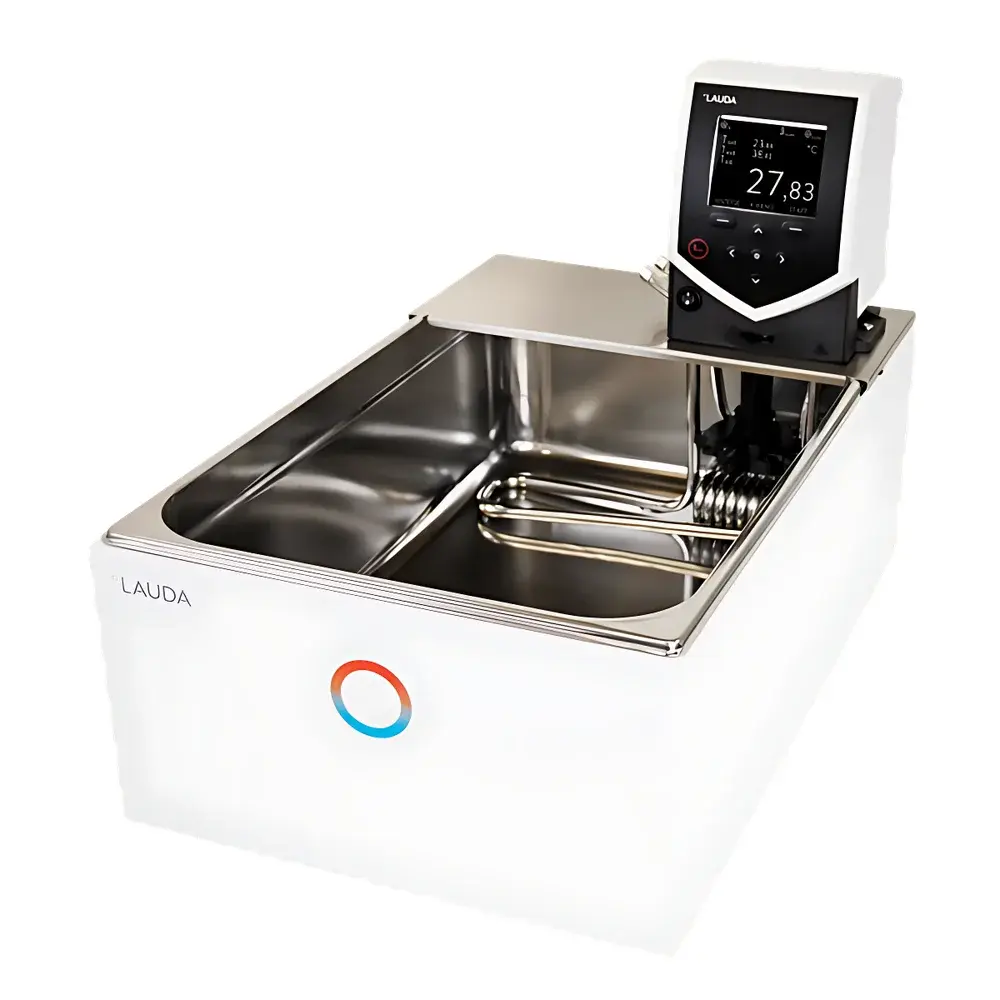
LAUDA ECO E 20 G Precision High-Temperature Circulating Bath
| Brand | LAUDA |
|---|---|
| Origin | Germany |
| Model | ECO E 20 G |
| Bath Volume | 19 L |
| Temperature Range | 20–200 °C |
| Temperature Stability | ±0.01 °C |
| Max. Heating Power | 2.6 kW |
| Max. Flow Rate | 22 L/min |
| Bath Opening | 300 × 365 mm |
| Dimensions (W×D×H) | 331 × 537 × 376 mm |
| Power Supply | 230 V, 50/60 Hz |
Overview
The LAUDA ECO E 20 G is a precision-engineered, heating-only circulating bath designed for demanding laboratory applications requiring stable thermal control across an extended temperature range—from ambient (20 °C) up to 200 °C. Built on LAUDA’s proven ECO platform, this model integrates high-efficiency resistive heating, a robust stainless steel bath vessel, and a thermally optimized circulation system to deliver exceptional temperature uniformity and long-term stability of ±0.01 °C under steady-state conditions. Unlike general-purpose water baths, the E 20 G operates as a closed-loop thermal management system—capable of both internal recirculation (for bath homogeneity) and external circulation (to condition external reactors, viscometers, or analytical instrumentation). Its Class III safety rating certifies suitability for use with flammable and non-flammable heat transfer media—including Therm 250 silicone oil—enabling safe operation at elevated temperatures without compromising personnel or equipment integrity.
Key Features
- Precision temperature control with ±0.01 °C stability over the full 20–200 °C operating range, verified under ISO/IEC 17025-accredited calibration protocols.
- Stainless steel bath vessel (19 L nominal capacity; 13–19 L operational range) with integrated drain valve at rear panel for rapid, spill-free fluid exchange.
- 6-stage adjustable circulation pump delivering up to 22 L/min flow rate with pressure-regulated output—optimized for low-noise, low-pulsation delivery to external systems.
- ECO Gold user interface: 4.3-inch color TFT display with intuitive menu navigation, real-time graphing, and multilingual support (English, German, French, Spanish).
- Built-in cooling coil enables passive heat dissipation during ramp-down or stabilization phases—reducing overshoot and improving thermal response predictability.
- USB port standard for firmware updates and optional interface module integration (e.g., Libus, Pt100 input modules, or Command controller compatibility).
- Dual independent safety layers: programmable overtemperature cutoff (user-defined limit) plus hardware-based thermal cutout per DIN EN 61000-6-2 and IEC 61010-1.
Sample Compatibility & Compliance
The E 20 G accommodates a wide spectrum of heat transfer fluids—including deionized water, glycol/water mixtures, and high-boiling-point silicone oils such as Therm 250—enabling application flexibility from biochemical assays at 37 °C to polymer melt rheology at 180 °C. Its stainless steel construction resists corrosion from aggressive media, while the sealed bath design minimizes evaporation and oxidation at elevated temperatures. The unit complies with key international standards including IEC 61010-1 (safety requirements for electrical equipment), EN 61326-1 (EMC for laboratory instruments), and meets essential requirements for GLP-compliant environments. Optional Pt100 sensor integration supports traceable temperature monitoring aligned with ISO/IEC 17025 quality systems. Though not inherently 21 CFR Part 11 compliant, audit-ready data logging is achievable via third-party software interfacing through the Libus or Command controller modules.
Software & Data Management
The embedded ECO Gold firmware supports full programmability—including ramp/soak profiles, timer-based start/stop sequences, and dual-setpoint operation (working temperature + independent overtemperature limit). All parameters are stored in non-volatile memory with battery-backed retention. USB connectivity allows direct firmware upgrades and facilitates export of temperature logs (CSV format) for post-processing in Excel or LIMS platforms. When paired with LAUDA’s optional Libus interface module, the bath integrates into distributed LabVIEW or MATLAB control architectures. The Command controller option enables centralized multi-unit management via Ethernet, supporting remote monitoring, alarm notification (email/SNMP), and synchronized temperature sequencing across instrument clusters—ideal for QC labs operating under ISO 17025 or pharmaceutical manufacturing sites aligning with Annex 11 principles.
Applications
This bath serves as a critical thermal source in diverse scientific workflows: calibration of temperature-sensitive detectors (e.g., DSC sensors, IR thermometers); conditioning of sample cells in UV-Vis spectrophotometry and FTIR; thermal pre-equilibration of viscometers and rheometers; controlled heating of reaction vessels in synthetic chemistry; and long-duration stability testing per ICH Q1A(R2) guidelines. Its external circulation capability makes it especially valuable for jacketed reactor temperature control in pilot-scale process development, where precise thermal coupling between bath and vessel is required to minimize thermal lag and ensure reproducible kinetic data.
FAQ
Is the LAUDA ECO E 20 G suitable for use with flammable heat transfer fluids?
Yes—the unit carries Class III safety certification per IEC 61010-1, permitting operation with flammable oils such as Therminol VP-1 or Dow Corning 200 Fluid when installed in accordance with local hazardous area regulations.
Can the bath be operated without external circulation?
Yes—it supports standalone internal recirculation mode for homogeneous bath temperature distribution, with pump speed adjustable in six discrete levels.
Does the E 20 G include a bath cover?
No—a bath cover is not included as standard but is available as an accessory (Order No. 8000346) to reduce evaporation and improve energy efficiency above 100 °C.
What is the maximum allowable viscosity of compatible heat transfer fluids?
The circulation system is rated for kinematic viscosities up to 50 cSt at operating temperature; higher-viscosity fluids require derating of flow rate and verification of pump head margin.
How is traceability maintained for calibration records?
Users may connect an external Pt100 probe via the optional Libus module to record reference-grade temperature data alongside bath setpoint logs—supporting ISO/IEC 17025 documentation requirements.



