
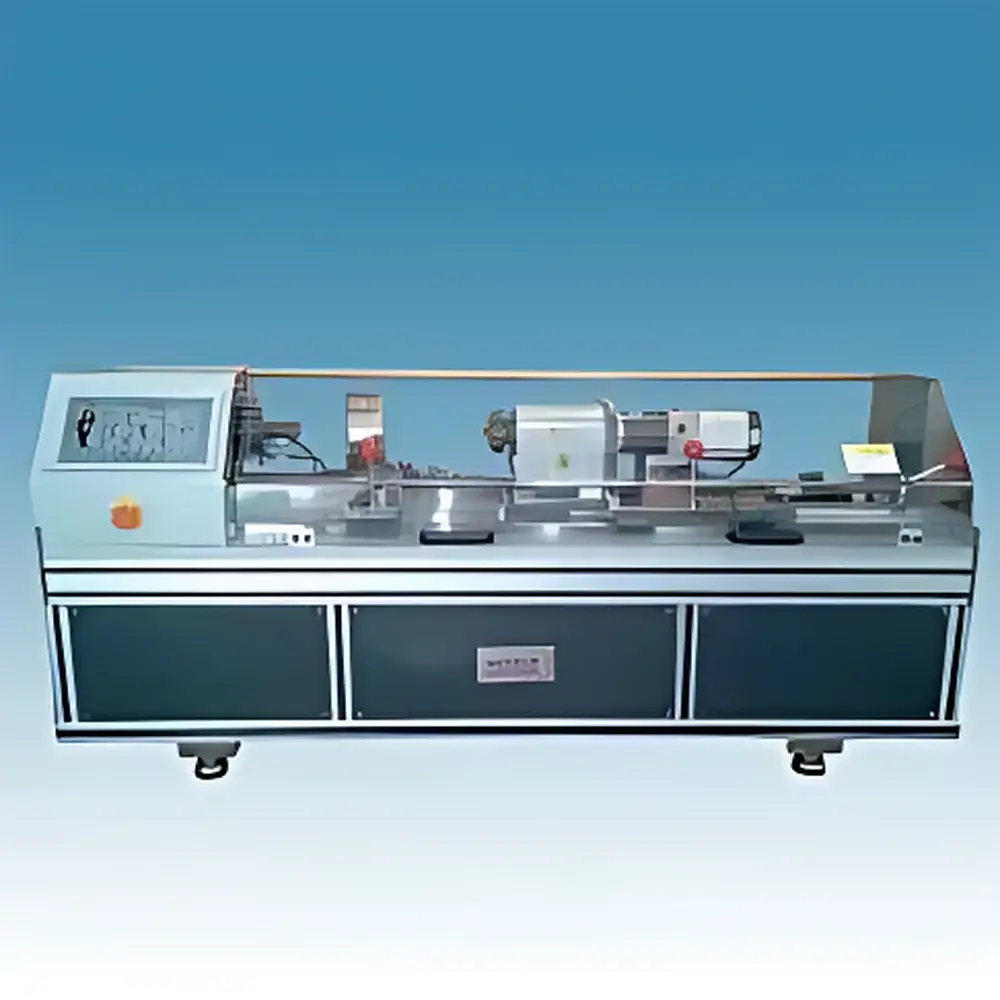
Hengyi HY-100N·m High-Frequency Dynamic Torsional Fatigue Testing Machine
| Brand | Hengyi |
|---|---|
| Origin | Shanghai, China |
| Manufacturer Type | Direct Manufacturer |
| Product Category | Domestic |
| Model | HY-100N·mU7JKJ |
| Max Torque Capacity | 100 N·m |
| Frequency Range | 0–50 Hz |
| Torque Measurement Range | 0.5–100 N·m |
| Torque Accuracy | ±0.5% (typical), ±1% (guaranteed) |
| Torsion Angle Range | 0–1000° (or continuous rotation) |
| Angular Position Accuracy | ±0.5% (typical), ±1% (guaranteed) |
| Angular Velocity Accuracy | ±0.5% |
| Maximum Specimen Gauge Length | 200 mm |
| Waveform Options | Sine, Cosine, Square, Triangle, Sawtooth |
| Power Supply | Single-phase 2 kW |
| Dimensions (L×W×H) | ~1000 × 420 × 500 mm |
| Weight | 150 kg |
Overview
The Hengyi HY-100N·m High-Frequency Dynamic Torsional Fatigue Testing Machine is an electromechanically actuated torsional fatigue system engineered for precise, repeatable mechanical characterization of biomaterials and orthopedic implants under cyclic torsional loading. It operates on a closed-loop servo-controlled architecture with high-bandwidth torque and angular displacement feedback, enabling controlled dynamic excitation up to 50 Hz—well within the physiological and regulatory testing range for orthopedic device fatigue validation. Designed in accordance with fundamental principles of torsional mechanics and fatigue life prediction (e.g., Goodman and Morrow corrections), the system supports both constant-amplitude and programmed variable-amplitude torsional waveforms. Its structural rigidity, thermal stability, and low-inertia drive train ensure minimal phase lag and high fidelity in torque-angle hysteresis loop acquisition—critical for evaluating viscoelastic energy dissipation, microstructural damage accumulation, and failure initiation in metallic alloys, polymer composites, and coated biomedical devices.
Key Features
- High-fidelity torque transduction with dual-range load cell (0.5–100 N·m), calibrated to ISO 376 Class 0.5 accuracy, delivering typical measurement uncertainty of ±0.5% full scale.
- Real-time angular position sensing via high-resolution optical encoder (≥18-bit resolution), supporting both discrete angle control and continuous rotational modes up to 1000° per cycle or infinite rotation.
- Programmable waveform generator supporting sine, cosine, square, triangle, and sawtooth profiles—configurable via amplitude, frequency, offset, and dwell parameters for ISO 14801, ASTM F1717, and ISO 7206-4 compliant test protocols.
- Rigid monolithic frame with precision-ground linear guides and preloaded ball screws minimizes parasitic bending moments and ensures pure torsional loading alignment (±0.1° axial misalignment tolerance).
- Integrated thermal management system maintains ambient temperature stability (<±1°C) during extended high-frequency operation, reducing drift in torque calibration and material response artifacts.
- Modular grip interface with customizable jaw geometries—compatible with standardized specimen holders for spinal rods, intramedullary nails, vertebral body replacements, and femoral stems per ASTM F2193 and ISO 12417-1.
Sample Compatibility & Compliance
The HY-100N·m accommodates specimens ranging from 1.2 mm diameter guidewires to 25 mm diameter spinal fixation rods, with gauge lengths adjustable between 50 mm and 200 mm. It is routinely deployed in GLP-compliant laboratories for fatigue evaluation of metallic implants (Ti-6Al-4V, CoCrMo), PEEK-based interbody cages, hydroxyapatite-coated acetabular cups, and bioresorbable polymer screws. The system supports full traceability per ISO/IEC 17025 requirements, including hardware-level audit trails for calibration history, operator ID, environmental logs, and raw data timestamps. Test methods are aligned with FDA guidance documents for orthopedic device submission (e.g., “Guidance for Industry and FDA Staff: Orthopedic Device Submissions – Premarket Notification [510(k)] Submissions”), as well as harmonized standards including ISO 14801 (dental implant fatigue), ISO 7206-4 (hip joint prostheses), and ASTM F2193 (spinal implant static and fatigue testing).
Software & Data Management
Control and analysis are executed via Hengyi’s proprietary WinTest-Fatigue v4.x software, a Windows-based platform compliant with FDA 21 CFR Part 11 requirements—including electronic signatures, role-based access control, and immutable audit trails for all test parameter changes, data exports, and report generations. Real-time plotting includes torque vs. angle, torque vs. time, and angle vs. time overlays, with automatic detection of stiffness degradation, hysteresis widening, and cycle count at first observable crack (per ASTM E647 definitions). Raw ASCII data export (CSV, TXT) preserves full 10 kHz sampling fidelity for post-hoc spectral analysis (FFT), rainflow counting, and Miner’s rule-based life estimation. All reports include metadata headers referencing test standard, specimen ID, environmental conditions, and calibration certificate numbers.
Applications
- Fatigue life assessment of pedicle screws, laminar hooks, and rod connectors under simulated in vivo torsional loading (ISO 12189, ASTM F1717).
- Mechanical validation of additively manufactured titanium spinal cages subjected to multi-axial torsional spectra.
- Dynamic torsional shear testing of bone–implant interfaces using cadaveric or synthetic composite vertebrae (ASTM F2844).
- Characterization of viscoelastic damping behavior in polymeric orthopedic bearings (UHMWPE, PEEK) across temperature-controlled torsional sweeps.
- Accelerated durability testing of cardiovascular stents and guidewires under torsional resonance conditions (ISO 25539-2).
- Material qualification of surface-treated orthopedic alloys (e.g., plasma-sprayed HA, nitrided Ti) per ISO 13779-2 adhesion fatigue criteria.
FAQ
What standards does the HY-100N·m support for orthopedic implant testing?
It natively supports test method configuration for ISO 14801, ISO 7206-4, ASTM F1717, ASTM F2193, ISO 12189, and ISO 25539-2—with preloaded templates, pass/fail thresholds, and reporting structures aligned to each standard.
Can the system perform combined torsion-compression loading?
No—the HY-100N·m is dedicated to uniaxial torsional fatigue. For biaxial or multiaxial testing, Hengyi offers complementary systems such as the HY-MultiAxial 300N·m platform.
Is the torque sensor traceably calibrated?
Yes—each unit ships with a UKAS-accredited calibration certificate (ISO/IEC 17025) valid for 12 months, covering torque, angular position, and velocity channels.
What is the maximum continuous duty cycle at 50 Hz?
Rated for uninterrupted operation at 50 Hz for ≥8 hours at ≤75% of full-scale torque (75 N·m), provided ambient temperature remains below 28°C and ventilation meets minimum 0.5 m³/min airflow requirements.
Does the software support automated pass/fail evaluation against regulatory limits?
Yes—WinTest-Fatigue allows user-defined acceptance criteria (e.g., stiffness drop >15%, torque hysteresis area increase >20% after 10⁶ cycles), triggering real-time alerts and auto-terminating tests upon breach.



