
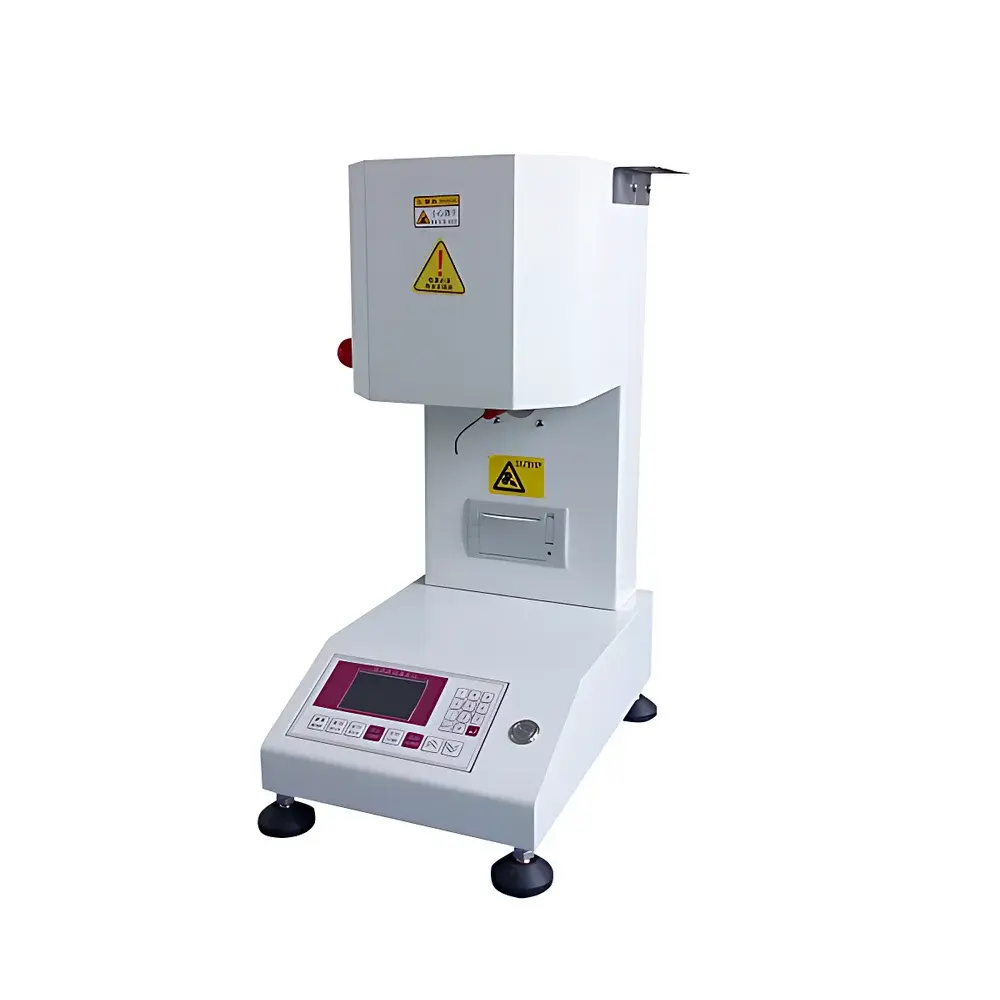
Hengyi HY(RZ) Advanced Melt Flow Rate Tester (MFR/MVR)
| Brand | Hengyi / Hengyitest |
|---|---|
| Origin | Shanghai, China |
| Manufacturer Type | Direct Manufacturer |
| Regional Category | Domestic (China) |
| Model | HY(RZ) |
| Pricing | Available Upon Request |
| Standards Compliance | GB/T 3682–2018, JB/T 5456–2005 |
| Max Operating Temperature | ≥400 °C |
| Temperature Control Accuracy | ≤±0.2 °C |
| Temp Stabilization Time (to max temp) | ≤30 min |
| Thermal Recovery Time (post-load) | 2–4 min |
| Timing Resolution | ≥0.1 s |
| Piston Displacement Resolution | ≥0.01 mm |
| Load Mass Options | 8-tier standard weights (0.325 kg to 21.600 kg, corresponding to 3.187 N to 211.82 N) |
| Die Dimensions | Ø2.095 ±0.005 mm × 8.000 ±0.025 mm |
| Barrel Dimensions | Ø9.550 ±0.025 mm × 152.0 ±0.1 mm |
| Piston Head | Ø9.475 ±0.015 mm × 6.350 ±0.100 mm |
| Test Modes | Mass Flow Rate (MFR) and Volume Flow Rate (MVR) |
| Control Interface | Full-color PLC touchscreen |
| Data Output | Real-time temperature curve, MFR/MVR results, calibration logs, timing events |
| Packaging & Transport Compliance | GB/T 13384, GB/T 191, GB/T 6388 |
Overview
The Hengyi HY(RZ) Advanced Melt Flow Rate Tester is a precision-engineered instrument designed for the standardized determination of melt mass flow rate (MFR) and melt volume flow rate (MVR) of thermoplastic polymers under controlled temperature and load conditions. Based on the fundamental principle of extrusion rheology—where molten polymer is forced through a standardized capillary die under defined gravitational or applied load—the HY(RZ) delivers repeatable, traceable, and standards-aligned measurements essential for quality control, material specification verification, and R&D process development. The system operates in accordance with internationally referenced methodologies, including GB/T 3682–2018 (equivalent in scope to ISO 1133–1 and ASTM D1238) and JB/T 5456–2005, ensuring compatibility with global polymer testing workflows and regulatory expectations in manufacturing environments.
Key Features
- Dual-mode operation supporting both mass-based (MFR, g/10 min) and volume-based (MVR, cm³/10 min) flow rate calculations, enabling comprehensive rheological characterization across diverse resin grades.
- High-temperature thermal system capable of stable operation up to 400 °C, with digital PID-controlled heating zones delivering ≤±0.2 °C accuracy and thermal recovery within 2–4 minutes after specimen loading.
- Eight-tier calibrated weight set (0.325 kg to 21.600 kg), covering standard test loads from 3.187 N to 211.82 N, compliant with ISO 1133 Annex A and GB/T 3682 load classifications.
- Precision-machined die assembly: capillary diameter Ø2.095 ±0.005 mm, length 8.000 ±0.025 mm; barrel inner diameter Ø9.550 ±0.025 mm, length 152.0 ±0.1 mm; piston head Ø9.475 ±0.015 mm — all dimensions certified per GB/T 3682 tolerances.
- Full-color industrial PLC touchscreen interface with embedded control software for parameter configuration, real-time temperature monitoring, automatic timed cutting, MFR/MVR calculation, and on-screen calibration verification.
- Integrated safety architecture: insulated high-temp zones with thermal shielding, ergonomic handling design, and fail-safe thermal cutoffs aligned with IEC 61000-6-2 and GB/T 5226.1 requirements.
Sample Compatibility & Compliance
The HY(RZ) supports routine MFR/MVR analysis of common thermoplastics including polyethylene (PE), polypropylene (PP), polystyrene (PS), polyoxymethylene (POM), ABS, polycarbonate (PC), nylon (PA6/PA66), and fluoropolymers (e.g., PTFE, PVDF). Its mechanical and thermal design ensures consistent performance across materials with varying melt viscosities and thermal degradation thresholds. All hardware components—including barrel, die, piston, and load train—are manufactured to dimensional and surface-finish specifications outlined in GB/T 3682–2018 and ISO 1133–1. The system meets general electrical safety and electromagnetic compatibility requirements per GB/T 5226.1 and GB/T 17626 series standards. While not pre-certified for FDA 21 CFR Part 11, its logging architecture (timestamped temperature curves, cut-event records, user-defined test IDs) supports GLP/GMP-aligned documentation when integrated into validated laboratory information management systems (LIMS).
Software & Data Management
The embedded PLC-based control software provides intuitive navigation via a 7-inch resistive touchscreen with multi-language support (English, Chinese, Spanish). Users configure test parameters—including target temperature, dwell time, load selection, cut interval, and measurement duration—prior to initiation. During operation, the interface displays live temperature profiles, piston displacement tracking, real-time mass accumulation (for MFR), and volumetric extrapolation (for MVR). All test data—including timestamps, ambient conditions (if external sensor-integrated), operator ID, and calibration status—are stored locally in non-volatile memory with CSV export capability via USB. Audit trails are maintained for critical actions (e.g., parameter changes, calibration events, firmware updates), facilitating internal review and alignment with ISO/IEC 17025 documentation requirements.
Applications
This instrument serves as a primary metrology tool in polymer production facilities, compounders, third-party testing labs, and academic polymer science departments. Typical use cases include batch release testing of virgin and recycled resins, incoming raw material verification against supplier specifications (e.g., ASTM D1238 Grade A/B/C), correlation studies between MFR and mechanical properties (tensile strength, impact resistance), and stability assessment of thermally sensitive grades during processing simulation. In R&D settings, the HY(RZ) supports formulation optimization—e.g., evaluating the effect of chain extenders, fillers, or plasticizers on melt viscosity—and supports accelerated aging studies where MFR drift indicates molecular weight degradation.
FAQ
What standards does the HY(RZ) comply with?
It conforms to GB/T 3682–2018 (equivalent to ISO 1133–1:2011 and ASTM D1238–13, Condition A–D), and JB/T 5456–2005 for instrument performance verification.
Can the system perform both MFR and MVR measurements automatically?
Yes—dual-mode functionality is built-in; MVR calculation requires optional volumetric displacement sensor integration (available as factory-configured upgrade).
Is the temperature calibration traceable to national standards?
The unit includes provisions for external PT100 probe validation; users may perform periodic calibration using NIST-traceable reference thermometers per GB/T 3682 Annex C.
What maintenance intervals are recommended for long-term accuracy?
Die and barrel cleaning after each test series; annual verification of load calibration and thermal uniformity per JB/T 5456–2005 Section 6.3.
Does the system support network connectivity or LIMS integration?
Native Ethernet or RS-232 interfaces are available upon request; CSV export enables manual import into LIMS or statistical process control (SPC) platforms.



