
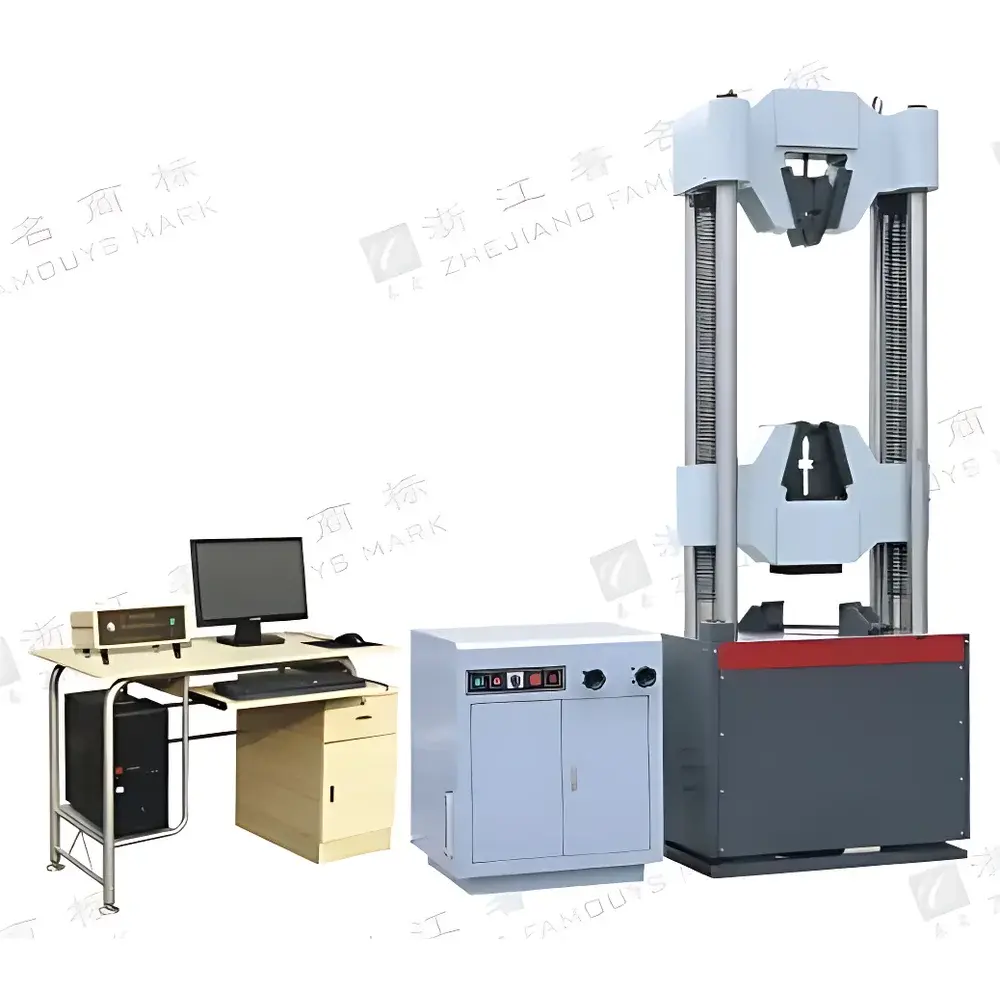
Hengyi HY(WE)30060-300 kN Microcomputer-Controlled Electro-Hydraulic Servo Universal Testing Machine
| Brand | Hengyi |
|---|---|
| Origin | Shanghai, China |
| Manufacturer Type | Direct Manufacturer |
| Model | HY(WE)30060-300 kN |
| Max Load Capacity | 300 kN |
| Load Accuracy | ±1% of reading |
| Load Resolution | ≤0.5% of full scale |
| Compression Space | 600 mm |
| Tensile Space | 600 mm |
| Round Specimen Grip Range | Φ10–32 mm |
| Flat Specimen Grip Thickness | 0–15 mm |
| Piston Stroke | 150 mm |
| Bend Support Span Adjustment | 100–460 mm |
| Shear Specimen Diameter | Φ10 mm |
| Deformation Measurement Accuracy | ±0.5% of reading |
| Displacement Measurement Accuracy | ±0.5% of reading |
| Stress Rate Control Range | 1–60 N/mm²/s |
| Strain Rate Control Range | 0.00025–0.0025 s⁻¹ |
| Closed-Loop Control Accuracy (Force/Displacement/Deformation) | ±1% of setpoint |
| Host Dimensions (W×D×H) | 760 × 460 × 1965 mm |
| Motor Power | 1.5 kW, 3-phase |
| Weight | 1900 kg |
Overview
The Hengyi HY(WE)30060-300 kN Microcomputer-Controlled Electro-Hydraulic Servo Universal Testing Machine is a high-stiffness, load-frame-based mechanical testing system engineered for precision static mechanical characterization of metallic and non-metallic materials under tension, compression, bending, and shear loading conditions. It operates on the principle of electro-hydraulic servo actuation—where a high-bandwidth servo valve regulates hydraulic oil flow to drive a bottom-mounted piston cylinder, enabling precise force application and displacement control. The machine implements a fully digital closed-loop control architecture compliant with ISO 7500-1 (Class 1) and ASTM E4 calibration standards for force measurement systems. Its dual-zone test space—adjustable via motorized crosshead elevation—supports standardized specimen geometries per ISO 6892-1, ASTM E8/E9, and GB/T 228.1. The system integrates real-time synchronization of load, displacement, and extensometer-derived strain signals, ensuring traceable, reproducible mechanical property derivation including yield strength (Rp0.2), ultimate tensile strength (Rm), modulus of elasticity (E), and fracture elongation (A%).
Key Features
- Electro-hydraulic servo actuation with high-dynamic-response servo valve (bandwidth ≥ 100 Hz) for stable force and displacement tracking across wide rate ranges.
- Bottom-mounted hydraulic cylinder design with motor-driven crosshead adjustment, providing flexible test space configuration (600 mm tensile/compression clearance) and enhanced structural rigidity.
- High-accuracy multi-channel data acquisition: dual 24-bit ADC channels for simultaneous force (±1% FS accuracy) and displacement (±0.5% FS) measurement; optional extensometer input for strain resolution down to 0.1 µm.
- Real-time closed-loop control modes: constant stress rate (1–60 N/mm²/s), constant strain rate (0.00025–0.0025 s⁻¹), constant load, constant displacement, and constant deformation—with control deviation maintained within ±1% of setpoint.
- Modular grip system accommodating round specimens (Φ10–32 mm), flat specimens (up to 15 mm thick), bend fixtures (span adjustable from 100–460 mm), and standardized shear tooling (Φ10 mm).
- Integrated safety interlocks including overload protection, emergency stop circuitry, hydraulic pressure monitoring, and software-based limit enforcement per ISO 12100.
Sample Compatibility & Compliance
The HY(WE)30060 supports standardized test specimens conforming to ISO 6892-1 (metallic tensile), ISO 15630-1 (reinforcing steels), ASTM A370, ASTM C39 (concrete compression), ASTM D695 (rigid plastics), and GB/T 228.1–2021. It meets mechanical verification requirements of ISO 7500-1 Class 1 and is validated for use in GLP-compliant laboratories. The system satisfies essential requirements of the EU Machinery Directive 2006/42/EC and incorporates hardware and firmware safeguards aligned with IEC 61508 SIL1. Test reports generated include full metadata (operator ID, timestamp, environmental conditions, calibration status) to support audit readiness for ISO/IEC 17025 accreditation.
Software & Data Management
The included Hengyi TestMaster™ software (v5.x, Windows 10/11 compatible) provides a validated, menu-driven interface for test method definition, real-time curve overlay (load–displacement, stress–strain), automatic feature detection (yield point, UTS, fracture), and customizable report generation (PDF/Excel). All raw data are stored in binary format with embedded checksums and time-stamped audit trails. Software supports 21 CFR Part 11 compliance through user role management, electronic signatures, and immutable data archiving. Export modules enable direct integration with LIMS platforms via OPC UA or CSV API. Firmware and software updates are delivered via secure HTTPS portal with version-controlled release notes and impact assessments.
Applications
This universal testing machine is routinely deployed in metallurgical QA/QC labs for incoming material verification of structural steels, aluminum alloys, and fasteners; in R&D settings for constitutive modeling of advanced composites and additive-manufactured metals; and in civil engineering labs for compressive strength evaluation of concrete, mortar, and cementitious composites. Its bending capability supports beam deflection analysis per ISO 178, while shear fixture compatibility enables interlaminar shear strength (ILSS) assessment of fiber-reinforced laminates. The system also serves as a platform for creep and relaxation studies when paired with extended-duration test modules and temperature-controlled environmental chambers (optional).
FAQ
What international standards does this machine support out-of-the-box?
It natively implements test sequences and reporting templates for GB/T 228.1–2021, GB/T 232–2010, ASTM E8/E9, ISO 6892-1, and ISO 15630-1. Custom method development is supported via scriptable test logic.
Is the system suitable for accredited testing laboratories?
Yes—when operated with certified calibration certificates (force, displacement, strain), documented maintenance logs, and validated software, it fulfills ISO/IEC 17025 technical requirements for mechanical testing competence.
Can third-party extensometers be integrated?
Yes—the system provides analog and digital (LVDT/TTL) input channels compatible with commercial clip-on and video extensometers meeting ISO 9513 Class 1 specifications.
What maintenance intervals are recommended for hydraulic components?
Hydraulic oil replacement every 2,000 operating hours or biannually; servo valve inspection annually; filter cartridge replacement every 500 hours or quarterly—per ISO 4406 cleanliness code monitoring.
Does the software support automated pass/fail evaluation against specification limits?
Yes—user-defined acceptance criteria (e.g., Rm ≥ 450 MPa, A5 ≥ 18%) can be configured per test method, triggering visual alerts and flagging non-conforming results in exported reports.



