
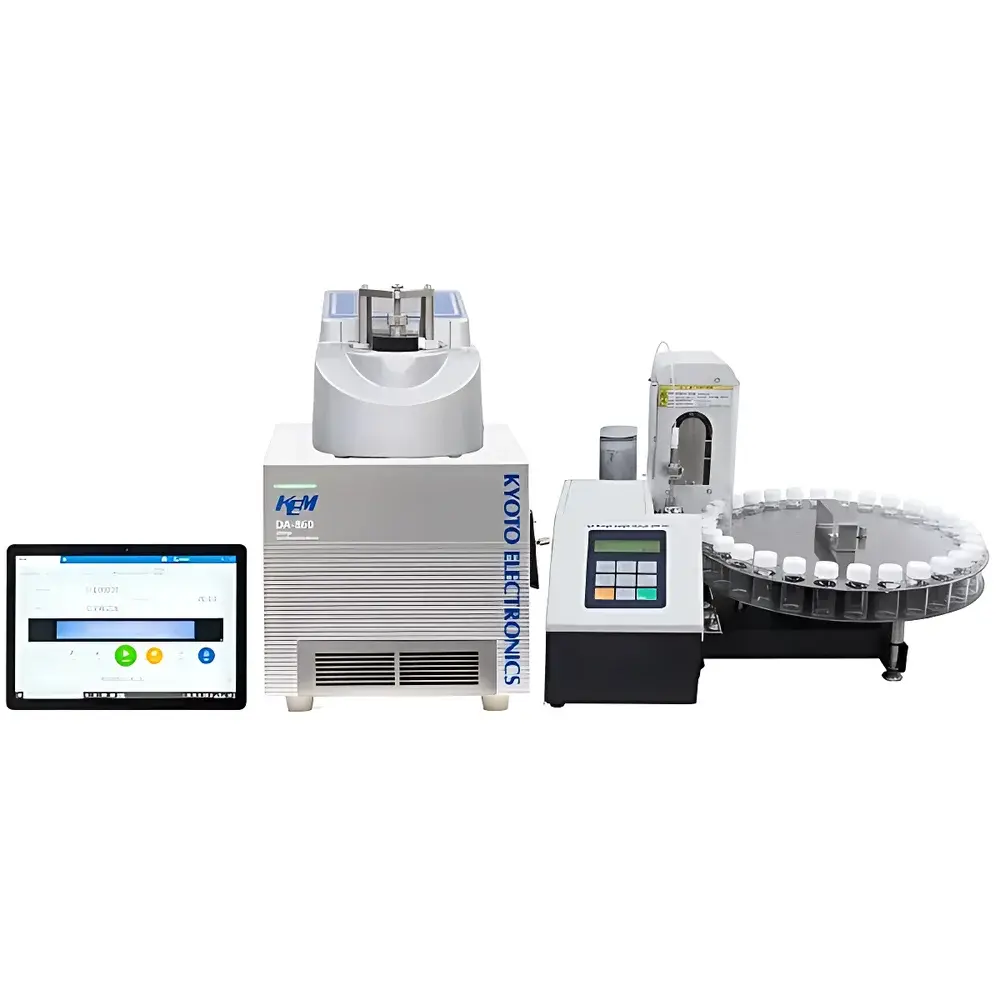
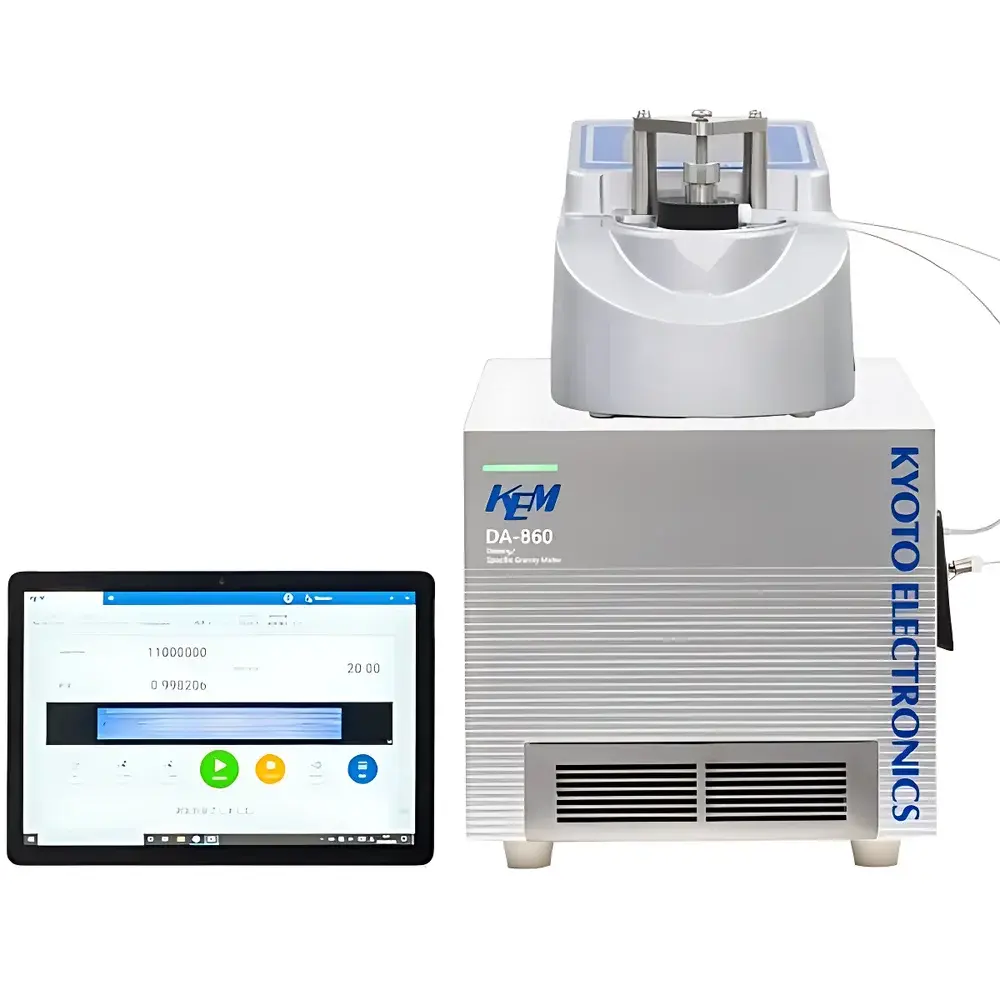
KEM DA-850+RA-600 Automated Density and Refractometer System
| Brand | KEM (Kyoto Electronics Manufacturing) |
|---|---|
| Origin | Japan |
| Manufacturer Type | Original Equipment Manufacturer (OEM) |
| Instrument Type | Oscillating U-tube Densimeter & Abbe-type Refractometer |
| Form Factor | Benchtop Laboratory Instrument |
| Sample Type | Liquids Only |
| Density Range | 0 to 3 g/cm³ |
| Density Accuracy | ±1 × 10⁻⁵ g/cm³ |
| Density Repeatability | 5 × 10⁻⁶ g/cm³ |
| Density Resolution | 0.00001 g/cm³ |
| Refractive Index Range | 1.3200–1.7000 nD |
| Refractive Index Accuracy | ±0.0001 nD |
| Refractive Index Resolution | 0.0001 nD |
| Temperature Control Range (Density) | 0–100 °C |
| Temperature Control Range (Refractometry) | 5–75 °C (optional: 5–100 °C) |
| Sample Volume Requirement | 1–2 mL |
| Temperature Regulation | Peltier-controlled |
| Auto-sampling | Integrated |
| Display Interface | Touchscreen tablet or external PC via USB/Ethernet |
| Calibration Standards | Air + distilled water (or certified reference materials) |
| Compliance | ASTM D4052, ASTM D1250, ISO 12185, ISO 2859, USP <841>, Ph. Eur. 2.2.39, JIS K 0061 |
Overview
The KEM DA-850+RA-600 Automated Density and Refractometer System is a dual-function benchtop analytical instrument engineered for simultaneous, high-precision measurement of density (absolute and relative) and refractive index (nD) of liquid samples. It integrates two independently validated physical measurement principles into a single platform: oscillating U-tube densimetry (per ISO 12185 and ASTM D4052) and critical-angle refractometry at the sodium D-line (589.3 nm), compliant with ISO 2859 and USP . The system employs a thermally stabilized U-tube sensor with real-time viscosity compensation—enabling accurate density determination across low- to high-viscosity liquids without manual correction. Simultaneously, the RA-600 module utilizes a temperature-regulated prism and monochromatic LED source aligned to the D-line spectral band, ensuring traceable nD values under strictly controlled thermal conditions. Designed for routine QC, R&D, and regulatory-compliant testing, the DA-850+RA-600 eliminates inter-instrument variability by co-locating both measurements on a shared sample aliquot—reducing operator error, sample consumption, and analysis time.
Key Features
- Simultaneous dual-parameter acquisition: density (ρt, dt/t) and refractive index (nD) from a single 1–2 mL sample injection.
- Peltier-based temperature control for both modules, enabling precise setpoint regulation from 0–100 °C (densimeter) and 5–75 °C (refractometer; optional extension to 100 °C).
- Viscosity-compensated oscillating U-tube measurement—automatically corrects for damping effects in viscous fluids (e.g., glycerol, syrups, resins), maintaining ±1 × 10⁻⁵ g/cm³ accuracy across the full 0–3 g/cm³ range.
- Integrated auto-sampler with programmable sequence execution, supporting unattended batch analysis of up to 30 samples per run.
- Calibration traceability to SI units via air and certified water standards; optional support for NIST-traceable secondary standards (e.g., hydrocarbon mixtures, sucrose solutions).
- Modular architecture allows independent operation of DA-850 or RA-600 modules when required for method-specific validation or maintenance.
Sample Compatibility & Compliance
The DA-850+RA-600 is validated for use with homogeneous, non-particulate, non-volatile, and non-corrosive liquids—including aqueous solutions, organic solvents, oils, pharmaceutical formulations, food extracts, and cosmetic emulsions. It conforms to global pharmacopoeial methods: USP (Refractive Index), USP (Specific Gravity), Ph. Eur. 2.2.39 (Density of Liquids), and JP 2.05 (Relative Density). In industrial applications, it supports ASTM D1250 (Petroleum Measurement Tables), ASTM D4052 (Laboratory Determination of Density of Crude Oil), and ISO 12185 (Crude Oil and Liquid Petroleum Products). For food and beverage testing, the system meets AOAC Official Method 932.12 (Brix via nD) and ISO 2173 (Soluble Solids in Fruit Juices). All measurements are fully auditable under GLP/GMP environments, with electronic records compliant with FDA 21 CFR Part 11 requirements when paired with KEM’s optional LIMS-integrated software suite.
Software & Data Management
Operation is managed through KEM’s proprietary WinCT-Density/Refracto software, running on Windows OS (64-bit). The interface provides real-time graphical monitoring of oscillation decay curves and refractometric light intensity profiles, enabling immediate detection of bubble formation, contamination, or incomplete filling. Data export supports CSV, PDF, and XML formats—with embedded metadata including timestamp, operator ID, calibration history, temperature logs, and uncertainty estimates per GUM (JCGM 100:2008). Audit trails record all user actions, parameter changes, and result modifications with time-stamped digital signatures. Optional 21 CFR Part 11 compliance package includes role-based access control, electronic signatures, and immutable archive storage. Raw data files are stored in vendor-neutral HDF5 format for third-party reprocessing.
Applications
This system serves as a primary metrology tool across regulated and industrial laboratories. In pharmaceutical development, it verifies excipient density for formulation consistency and measures nD of active pharmaceutical ingredients (APIs) per ICH Q5C stability protocols. In petrochemical QA, it determines API gravity and distillation cut verification per ASTM D1298. In food science, it quantifies Brix (°Bx) in fruit juices and soft drinks using nD-to-Brix correlation models, and validates ethanol concentration in alcoholic beverages via density interpolation. Flavor & fragrance labs rely on its precision for relative density (d20/20) and nD reporting required by ISO 855 and IFRA standards. Cosmetic manufacturers apply it for raw material identity testing and batch release per ISO 16128 and CPNP guidelines.
FAQ
What is the minimum sample volume required for a valid measurement?
A single analysis requires only 1–2 mL of homogeneous liquid—sufficient to fill both the U-tube sensor and refractometer prism chamber without overfilling or air entrapment.
Can the system measure highly viscous samples such as molasses or polymer solutions?
Yes—the DA-850 module applies real-time viscosity compensation based on oscillation damping characteristics, preserving accuracy up to ~2000 mPa·s without dilution or pre-heating.
Is temperature equilibration between the two modules synchronized?
The system maintains independent but coordinated thermal control: the DA-850 and RA-600 modules reach and hold their respective setpoints within ±0.02 °C, with inter-module thermal crosstalk minimized by physical isolation and adaptive PID algorithms.
How is calibration traceability documented for audit purposes?
Each calibration event generates a timestamped report listing standard identities, certified values, measured deviations, expanded uncertainty (k=2), and technician signature—exportable as PDF/A-1b for regulatory submission.
Does the software support automated pass/fail evaluation against specification limits?
Yes—users define upper/lower specification limits per parameter; the software flags out-of-spec results in real time and logs deviation magnitude with color-coded status indicators in the results table.



