
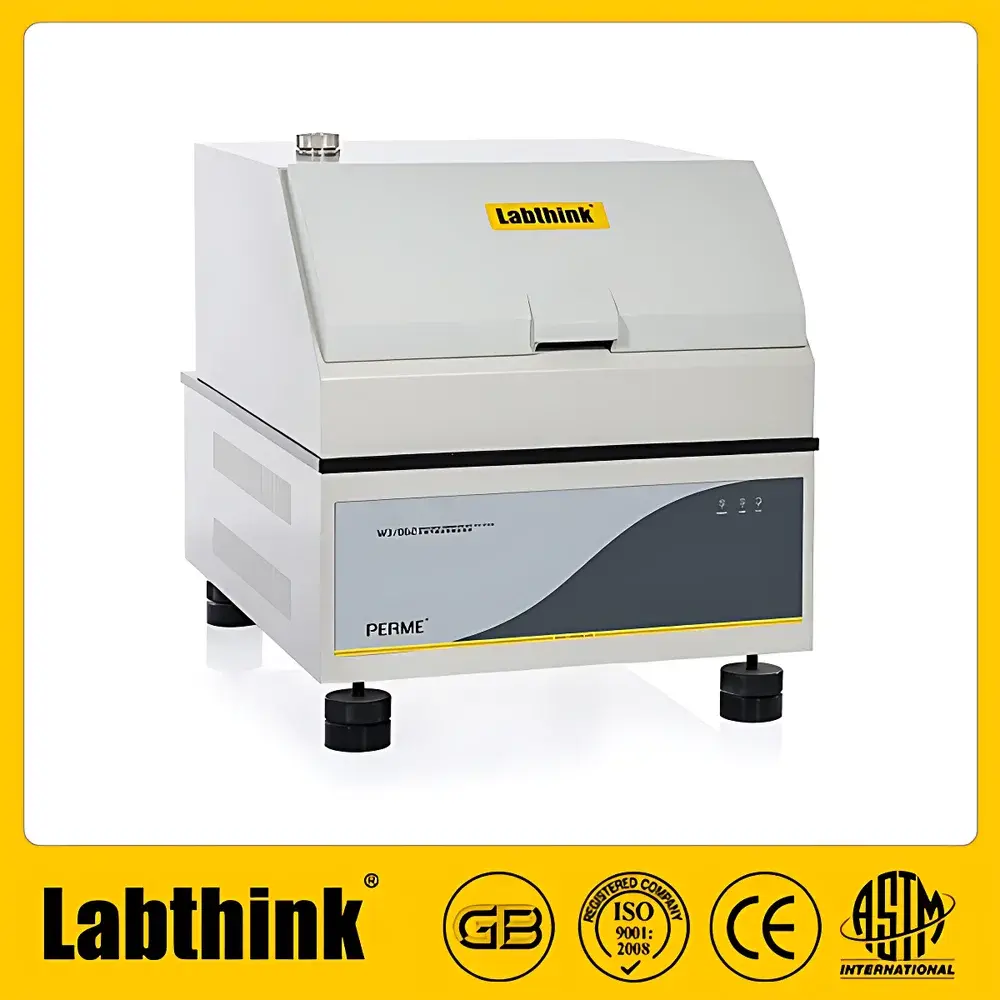
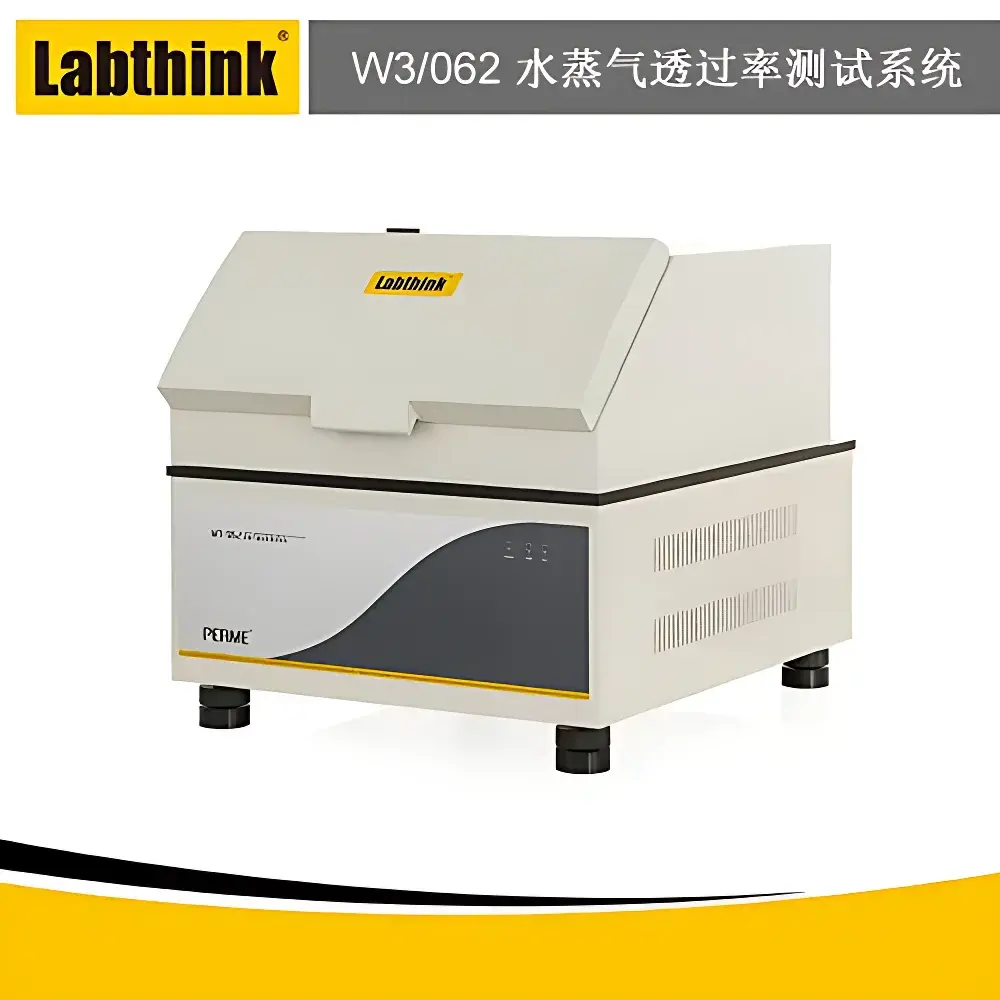
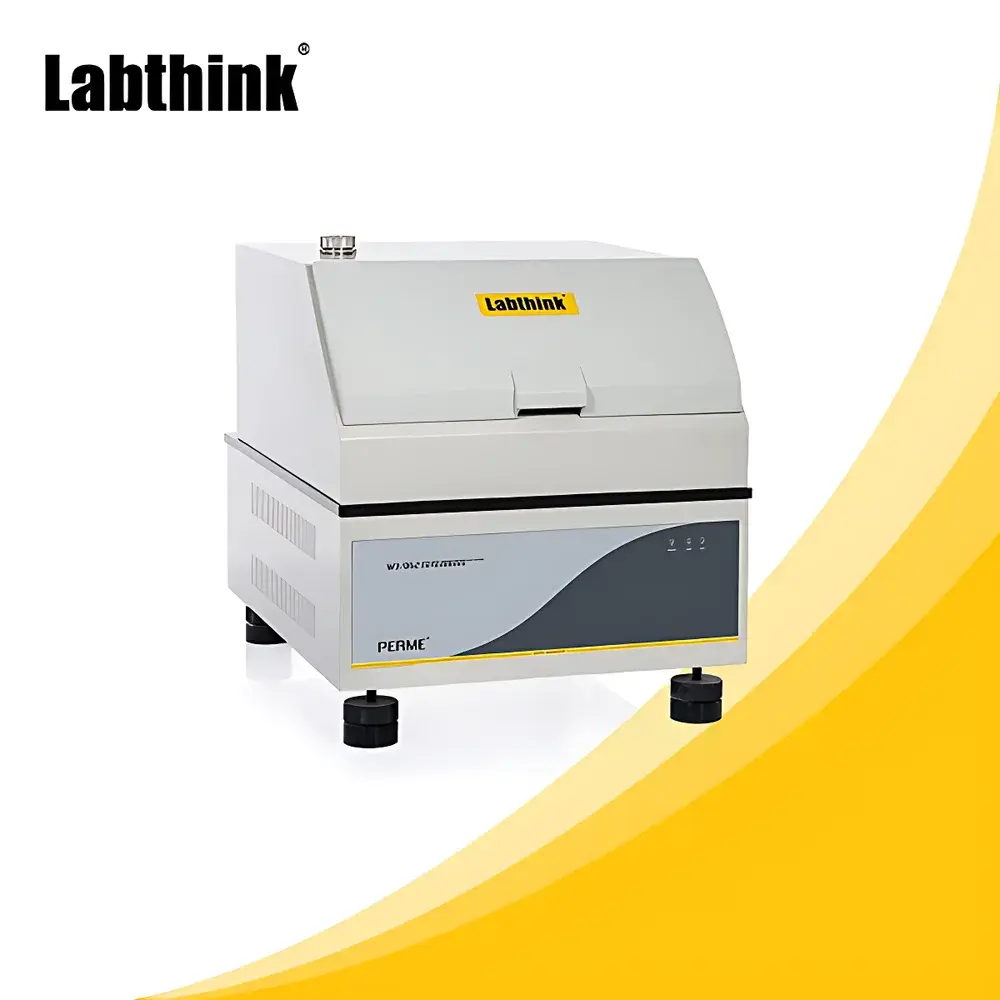
Labthink W3/062 Gravimetric Water Vapor Transmission Rate (WVTR) Tester
| Brand | Labthink |
|---|---|
| Model | W3/062 |
| Principle | Gravimetric Cup Method (Weight Gain/Loss) |
| Test Range | 0.1–10,000 g/m²·24h (loss mode) |
| Sample Capacity | 1–6 specimens simultaneously |
| Temperature Control | 15–55 °C (±0.1 °C) |
| Humidity Control | 10–98 %RH (±1 %RH) |
| Test Area | 33 cm² |
| Specimen Thickness | ≤3 mm |
| Chamber Volume | 45 L |
| Power Supply | 220 VAC 50 Hz / 120 VAC 60 Hz |
| Net Weight | 80 kg |
| Compliance | ASTM E96, ASTM D1653, ISO 2528, GB/T 1037, GB/T 16928, TAPPI T464, DIN 53122-1, JIS Z0208, YBB00092003 |
Overview
The Labthink W3/062 Gravimetric Water Vapor Transmission Rate (WVTR) Tester is a precision-engineered instrument designed for quantitative determination of water vapor permeation through flexible barrier materials using the standardized cup-based gravimetric method. It operates on the fundamental principle of establishing a controlled humidity gradient across a planar specimen sealed over a test cup—either containing desiccant (weight loss mode) or saturated salt solution/water (weight gain mode)—and measuring mass change over time under stabilized thermal and hygric conditions. This method directly yields WVTR in g/m²·24h, a critical parameter for evaluating moisture barrier performance in packaging films, medical device pouches, pharmaceutical blister lidding, architectural membranes, and functional textiles. The system conforms to internationally recognized standards including ASTM E96 (Procedure A & B), ISO 2528, GB/T 1037, and YBB00092003, ensuring data integrity for regulatory submissions, QC release testing, and R&D material screening.
Key Features
- High-resolution gravimetric measurement: Equipped with a calibrated high-sensitivity weighing sensor (resolution: 0.001 g), enabling detection of ultra-low transmission rates down to 0.1 g/m²·24h with repeatability compliant with ISO 5725-2 and ASTM D6988.
- Parallel multi-specimen testing: Six independently controlled test cups mounted on a precision-machined circular tray allow concurrent evaluation of up to six distinct samples—each with independent data acquisition and real-time mass tracking.
- Scalable architecture: Modular design supports connection of up to nine satellite units per host controller, expanding capacity to 60 simultaneous tests—ideal for high-throughput quality assurance laboratories operating under ISO/IEC 17025 or GMP environments.
- Stable environmental control: Dual-zone temperature and humidity regulation (15–55 °C ±0.1 °C; 10–98 %RH ±1 %RH) ensures thermodynamic equilibrium across all test positions, minimizing edge effects and inter-cup variability.
- Configurable test modes: Supports both weight gain (humid side upstream) and weight loss (dry side upstream) configurations per ASTM E96 procedures, accommodating diverse material hydrophilicity and application requirements.
Sample Compatibility & Compliance
The W3/062 accommodates flat, non-porous, and semi-crystalline polymeric films up to 3 mm thick—including PE, PP, PET, PA, EVOH, aluminum-laminated composites, coated papers, and sterile medical packaging substrates. Specimens are cut to Ø74 mm (33 cm² exposed area) using the included precision punch. All hardware components contacting test environments—cup bodies, sealing gaskets, and humidity generation modules—are constructed from corrosion-resistant stainless steel and borosilicate glass to prevent contamination and ensure long-term calibration stability. The instrument meets mechanical and electrical safety requirements per IEC 61010-1 and is validated for use in GLP-compliant laboratories. Data output includes full audit trails, user access logs, and timestamped raw mass/time series—supporting compliance with FDA 21 CFR Part 11 when integrated with Labthink’s Lystem™ Laboratory Data Management System (LDMS).
Software & Data Management
Controlled via Labthink’s proprietary Windows-based software, the W3/062 provides intuitive workflow navigation, automated test setup, real-time curve visualization (mass vs. time), and automatic slope-based WVTR calculation per ISO 2528 Annex A. Software features include configurable pass/fail criteria, statistical summary reports (mean, SD, CV%), export to CSV/PDF/XLSX, and digital signature support. When deployed within a local area network, the system integrates seamlessly with Lystem™ LDMS—a secure, role-based platform that centralizes instrument metadata, calibration records, sample IDs, operator credentials, and electronic signatures. Lystem™ supports version-controlled SOPs, deviation tracking, and electronic archiving aligned with ALCOA+ principles (Attributable, Legible, Contemporaneous, Original, Accurate, Complete, Consistent, Enduring, Available).
Applications
- Quality control of food-grade PE cling films and vacuum-sealed packaging laminates
- Barrier validation of sterile barrier systems (SBS) per ISO 11607-1 for Class II/III medical devices
- Accelerated aging studies correlating WVTR with shelf-life predictions for hygroscopic pharmaceuticals
- Development and specification of high-barrier coatings for flexible OLED encapsulation
- Comparative analysis of biodegradable films (PLA, PHA, starch blends) under varying RH conditions
- Regulatory documentation for packaging submissions to USP , EP 3.2.1, and China NMPA technical guidelines
FAQ
What standards does the W3/062 comply with?
The instrument fully implements test protocols defined in ASTM E96 (Methods A, B, C, D), ISO 2528, GB/T 1037, GB/T 16928, TAPPI T464, DIN 53122-1, JIS Z0208, and YBB00092003.
Can the system operate in both gain and loss modes without hardware modification?
Yes—mode selection is software-configured; only the internal cup environment (desiccant vs. water reservoir) and chamber humidity setpoint require adjustment.
Is calibration traceable to national metrology institutes?
All standard weights supplied (e.g., 10 g, 20 g certified masses) are NIST-traceable; optional annual calibration services include uncertainty budgets per ISO/IEC 17025.
What is the recommended maintenance schedule?
Daily: Visual inspection of seals and cup cleanliness; Weekly: Desiccant replacement and humidity generator cleaning; Annually: Sensor linearity verification and temperature/humidity sensor recalibration.
Does the system support 21 CFR Part 11 compliance out of the box?
Full Part 11 functionality—including electronic signatures, audit trail review, and permission-based access—is enabled when used with Lystem™ LDMS and configured with appropriate IT infrastructure controls.







