
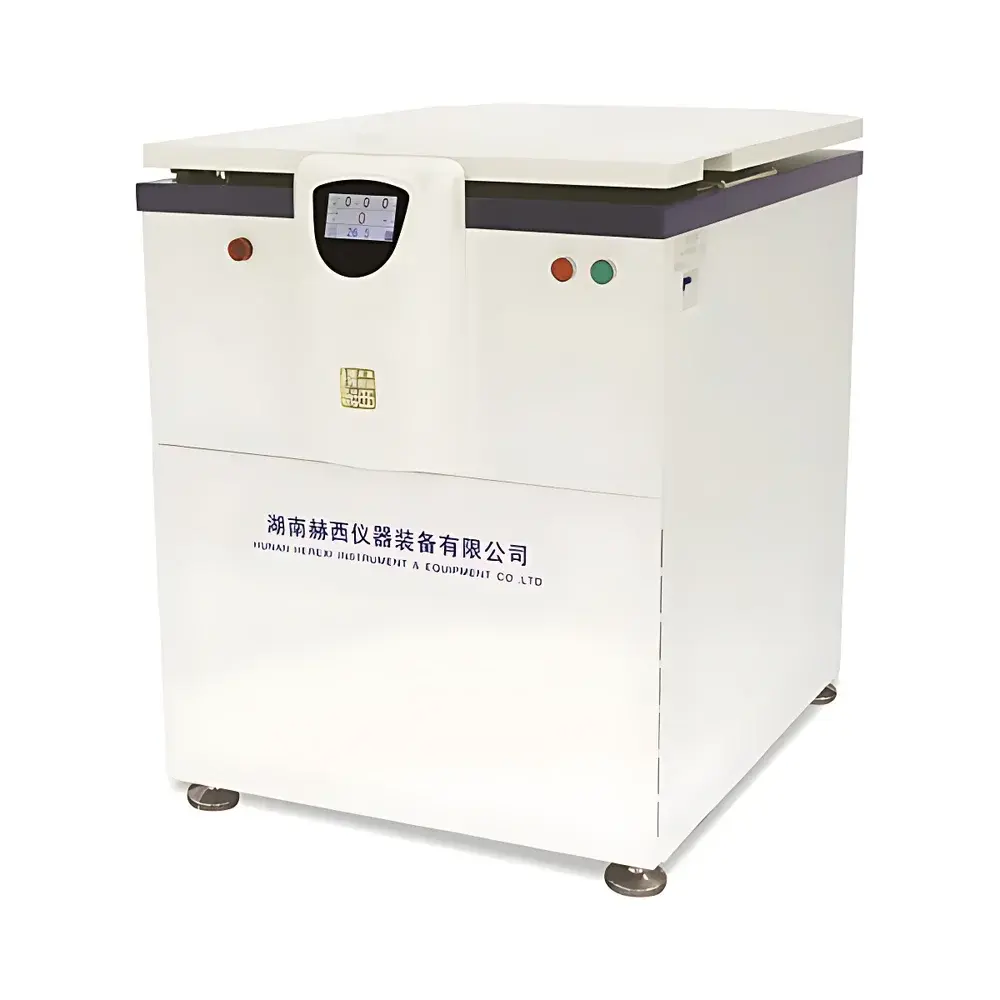
Hettich LR6M Vertical Low-Speed High-Capacity Refrigerated Centrifuge
| Brand | Hettich |
|---|---|
| Origin | Hunan, China |
| Manufacturer Type | Authorized Distributor |
| Country of Origin | China |
| Model | LR6M |
| Instrument Type | Floor-Standing Centrifuge |
| Speed Category | Low-Speed Centrifuge (≤6,000 rpm) |
| Function | Refrigerated Centrifuge |
| Configuration | Horizontal Rotor |
| Separation Class | Cell & Bacterial Pelletization |
| Max Capacity | 6 × 1000 mL |
| Max Speed | 4200 rpm |
| Max RCF | 5167 × g |
| Dimensions | 840 × 730 × 950 mm |
| Weight | 270 kg |
| Power Supply | AC 220 V / 50 Hz |
| Total Power | 4.0 kW |
| Noise Level | <65 dB(A) |
| Temperature Range | −20 °C to +40 °C |
| Temp. Accuracy | ±1 °C |
| Acceleration/Deceleration | 10-step programmable |
| Timer Range | 1 min – 99 h 59 min |
| Speed Accuracy | ±50 rpm |
| Refrigerant | R404a (non-CFC, ozone-friendly) |
| Compliance | ISO 9001:2015, ISO 13485:2016, CFDA Registered & Certified |
| Control System | Mitsubishi PLC (IEC 61131-2:2007, EU EMC Directive 2014/30/EU), Weintek HMI (NEMA 4, CE certified) |
| Rotor Material | Austenitic 304 Stainless Steel Chamber |
| Safety | Mechanical door lock, triple-layer steel protection housing, imbalance detection, over-speed/over-temp/under-voltage/over-pressure alarms, auto-balance compensation, active vibration damping |
Overview
The Hettich LR6M is a vertically oriented, floor-standing low-speed refrigerated centrifuge engineered for high-volume, temperature-sensitive separation tasks in regulated life science and industrial laboratories. Designed around the principles of sedimentation kinetics under controlled thermal conditions, the LR6M leverages horizontal rotor geometry to maximize gravitational force distribution across large-volume samples while maintaining precise thermal stability throughout extended runs. Its operational envelope—spanning −20 °C to +40 °C with ±1 °C accuracy—is optimized for applications requiring cold preservation of labile biological matrices (e.g., whole blood, cell suspensions, bacterial cultures, plant extracts) without compromising structural integrity or enzymatic activity. Unlike high-speed ultracentrifuges, the LR6M operates within the low-speed domain (up to 4200 rpm, 5167 × g), prioritizing sample yield, reproducibility, and operator safety over ultra-high g-forces—making it ideal for preparative centrifugation where pellet compactness and supernatant clarity are critical, rather than subcellular fractionation.
Key Features
- High-capacity horizontal rotor configuration supporting up to six 1000 mL bottles (6 × 1000 mL), enabling batch processing of clinical or production-scale volumes in a single run.
- Intelligent refrigeration system utilizing R404a—a non-ozone-depleting, low-GWP refrigerant—paired with a high-efficiency compressor; features pre-cooling, standby cooling, and automatic defrost functions for uninterrupted workflow continuity.
- Dual-control architecture integrating Mitsubishi PLC (compliant with IEC 61131-2:2007 and EU EMC Directive 2014/30/EU) and Weintek touchscreen HMI (NEMA 4-rated, CE-certified), ensuring electromagnetic robustness and intuitive multilingual operation (English, Chinese).
- Advanced mechanical safety suite: three-layer steel-reinforced housing, 304 stainless steel centrifuge chamber, fail-safe mechanical door lock with tactile engagement feedback, and real-time imbalance detection with automatic deceleration.
- Programmable acceleration/deceleration profiles (10 steps each), 16 user-defined protocol storage slots, and dynamic curve visualization (speed ramp, RCF integral, temperature trace) via 7-inch TFT-LCD display.
- Active vibration suppression system with custom-tuned elastomeric mounts and asymmetric mass compensation, reducing operational noise to <65 dB(A) and minimizing sample resuspension risk during deceleration.
Sample Compatibility & Compliance
The LR6M accommodates standard ISO-compliant centrifuge bottles (e.g., 500 mL and 1000 mL polypropylene or glass containers) and is validated for use with viscous, heterogeneous, or density-gradient media common in blood banking, dairy processing, and botanical extraction. Its design meets essential regulatory prerequisites for quality-controlled environments: registered and licensed under China’s CFDA (now NMPA) framework; certified to ISO 9001:2015 (Quality Management) and ISO 13485:2016 (Medical Device Quality Systems); and constructed to support GLP/GMP-aligned documentation practices—including audit-ready parameter logging, user-access controls, and timestamped event records. While not FDA 21 CFR Part 11–validated out-of-the-box, its data export capability (via USB) and deterministic control logic facilitate integration into validated laboratory information management systems (LIMS).
Software & Data Management
Operation is managed through an embedded microprocessor-based interface with no external PC dependency. All runtime parameters—including setpoints, actual values, alarm logs, and curve traces—are stored internally with time/date stamps. The system supports CSV export of session data via USB port for offline analysis in Excel or statistical software. Protocol editing allows fine-tuning of speed, time, temperature, and ramp profiles per rotor type; rotor recognition is manual (user-selected from on-screen menu), ensuring configurability across mixed-use labs. Language localization includes English and Simplified Chinese UI layers, with future firmware updates potentially extending support to additional languages per regional demand.
Applications
- Clinical diagnostics: plasma/serum separation from whole blood (e.g., hospital core labs, blood banks, CDC reference labs).
- Biopharmaceutical manufacturing: harvest of mammalian or microbial cells prior to lysis or filtration; clarification of fermentation broths.
- Food & beverage QA/QC: fat separation in milk/cream analysis (AOAC 989.10), juice clarification, starch recovery from root crops.
- Agricultural & environmental research: soil suspension fractionation, algal biomass concentration, wastewater solids settling studies.
- Academic teaching labs: safe, scalable demonstration of sedimentation theory, density gradient preparation, and cold-chain sample handling protocols.
FAQ
What is the maximum relative centrifugal force (RCF) achievable with the LR6M using the 6×1000 mL horizontal rotor?
The maximum RCF is 5167 × g at 4200 rpm with the full 6×1000 mL load.
Does the LR6M support rotor auto-identification or require manual selection?
Rotor selection is manual via the touchscreen interface; users must confirm rotor type before initiating a run to ensure correct RCF calculation and safety interlocks.
Can the temperature be adjusted during an active run?
Yes—the system permits real-time temperature setpoint modification without interrupting centrifugation, provided the new target remains within the −20 °C to +40 °C range.
Is the LR6M compliant with international electrical safety standards for export use?
It carries CE marking per EU directives (EMC 2014/30/EU, LVD 2014/35/EU) and conforms to IEC 61010-1 for laboratory equipment; voltage/frequency variants (e.g., 110 V/60 Hz) are available upon request.
How is data integrity ensured during power interruption?
Critical runtime parameters and alarm events are written to non-volatile memory; the system resumes operation post-reboot with last-known safe state, and all logged data remains intact.



