
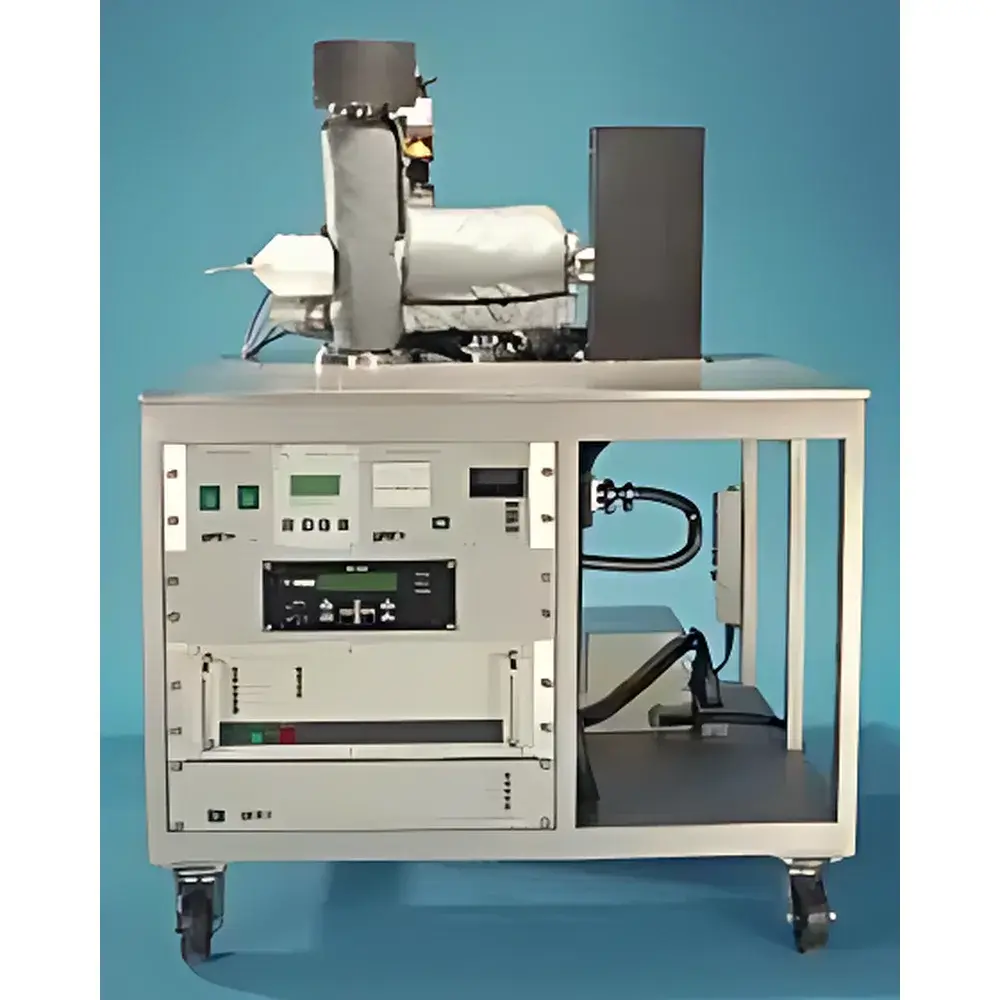
Hiden HPR-80 Quantitative Reactive and Corrosive Gas Analyser
| Brand | Hiden |
|---|---|
| Origin | United Kingdom |
| Model | HPR-80 |
| Mass Range | up to 2500 amu |
| Detection Limit | 5 ppb |
| Inlet Pressure Range | 1 mtorr to atmospheric pressure |
| Ion Source Temperature | Heated, electropolished stainless steel |
| Stability | < ±0.5% peak height over 24 h |
| Calibration | Viscous-flow QIC-corrected inlet with purge capability |
| Control Software | MASsoft |
| Compliance | Designed for UHV/HP vacuum interfaces, compatible with ASTM E1943 (standard guide for mass spectrometry in process analysis), supports GLP/GMP data integrity requirements via audit trail and user access control |
Overview
The Hiden HPR-80 Quantitative Reactive and Corrosive Gas Analyser is a purpose-engineered quadrupole mass spectrometer system optimized for real-time, quantitative monitoring of highly reactive, corrosive, and condensable gas species in demanding industrial and research environments. Unlike conventional mass spectrometers with stainless-steel or nickel ion sources vulnerable to etching and surface passivation, the HPR-80 integrates a fully heated, electropolished 316L stainless-steel ion source and inlet manifold—designed to maintain stable ionization efficiency during continuous exposure to hydrogen fluoride (HF), hydrogen chloride (HCl), hydrogen bromide (HBr), chlorine trifluoride (ClF₃), silane (SiH₄), phosphine (PH₃), arsine (AsH₃), and chlorofluorocarbons (CFCs). Its operational principle relies on electron impact (EI) ionization at controlled filament emission current and electron energy (typically 70 eV), followed by mass-resolved detection using a high-transmission quadrupole mass filter and Faraday cup/ion counter hybrid detector. The system operates across an extended dynamic pressure range—from ultra-high vacuum (1 mtorr) through viscous flow regimes up to ambient pressure—enabling direct coupling to plasma reactors, CVD/PVD chambers, MOCVD tools, and exhaust scrubber lines without intermediate dilution or cryogenic trapping.
Key Features
- Heated, electropolished stainless-steel inlet and ion source assembly—resistant to halogen-induced corrosion and metal halide deposition
- Viscous-flow calibrated quadrupole inlet system (QIC) with integrated purge capability for trace-level quantification and matrix effect correction
- Detection limit of 5 parts-per-trillion (ppt) for select species under optimized conditions; typical quantitative LOD of 5 ppb for reactive gases such as HF and HCl
- Mass range extended to 2500 atomic mass units (amu), supporting analysis of heavy metal organometallic precursors (e.g., TDMAT, TEMAHf) and polymer fragments
- Capacitance manometer-based pressure measurement—decoupled from gas composition to ensure accurate total pressure reporting independent of analyte partial pressures
- Long-term signal stability: ≤ ±0.5% peak height drift over 24-hour continuous operation, validated per ISO 17025-compliant calibration protocols
- Modular hardware architecture enabling integration with load-lock systems, differential pumping stages, and RF-shielded enclosures
Sample Compatibility & Compliance
The HPR-80 is engineered for compatibility with aggressive chemistries encountered in semiconductor fabrication, thin-film deposition, and plasma etch processes. It meets material compatibility requirements outlined in SEMI F20 (Specification for Materials Used in Semiconductor Manufacturing Equipment) for wetted components exposed to Class 3 (corrosive) process gases. All internal surfaces contacting sample gas are electropolished to Ra < 0.4 µm and passivated per ASTM A967. The system supports compliance with FDA 21 CFR Part 11 when configured with MASsoft Enterprise Edition—including electronic signatures, role-based access control, and immutable audit trails for all acquisition, calibration, and report-generation events. Data output conforms to ASTM E2657 (Standard Practice for Reporting Mass Spectral Data) and ISO/IEC 17025:2017 Annex A3 for analytical instrument validation.
Software & Data Management
MASsoft v6.x provides full instrument control, spectral acquisition, and advanced data processing. Key capabilities include real-time matrix inversion for multi-component quantification in overlapping mass spectra (e.g., distinguishing 28Si16O+ from 12C16O+), single-peak referencing for drift compensation, and normalization against internal reference gases (e.g., Ar or N₂). Raw data is stored in vendor-neutral HDF5 format with embedded metadata (timestamp, pressure, filament current, lens voltages). Batch processing workflows support automated peak integration, calibration curve fitting (linear, quadratic, or multi-point non-linear), and export to CSV, Excel, or LIMS-compatible XML. Optional MASsoft Connect enables OPC UA integration for Industry 4.0 process control systems.
Applications
- Plasma diagnostics and reactive ion etch (RIE) endpoint detection in Si, SiO₂, and low-k dielectric patterning
- In-situ monitoring of precursor decomposition pathways and byproduct formation during MOCVD growth of GaN, AlN, and III-V heterostructures
- Quantitative analysis of etchant gas consumption and reaction stoichiometry in fluorine- and chlorine-based plasma chemistries
- Exhaust gas composition profiling for abatement system optimization and regulatory reporting (e.g., EPA Method 25A, ISO 14644-8)
- Real-time tracking of residual moisture, oxygen, and hydrocarbon contaminants in high-vacuum deposition chambers
- Corrosion mechanism studies involving mixed acid vapors (HF/HCl/HNO₃) in nuclear fuel reprocessing and spent fuel storage simulations
FAQ
Can the HPR-80 analyze gases at atmospheric pressure without dilution?
Yes—the heated QIC inlet enables direct sampling from 1 mtorr to 760 torr, eliminating the need for pressure-reducing orifices that compromise sensitivity and introduce memory effects.
How is quantification accuracy maintained for reactive species like HF?
Through viscous-flow calibration using certified gas standards, combined with real-time ion source temperature stabilization and periodic single-peak reference correction to compensate for surface adsorption/desorption dynamics.
Is the system compliant with pharmaceutical process analytical technology (PAT) guidelines?
When deployed with MASsoft Enterprise and validated per ICH Q2(R2), it satisfies PAT requirements for multivariate real-time monitoring and supports Stage 3 (continuous manufacturing) verification under FDA guidance.
What maintenance intervals are recommended for long-term operation in corrosive environments?
Ion source cleaning is recommended every 200–500 operating hours depending on gas aggressiveness; full system bake-out and filament replacement intervals are documented in the HPR-80 Preventive Maintenance Manual (Rev. 4.2).
Related Products





