
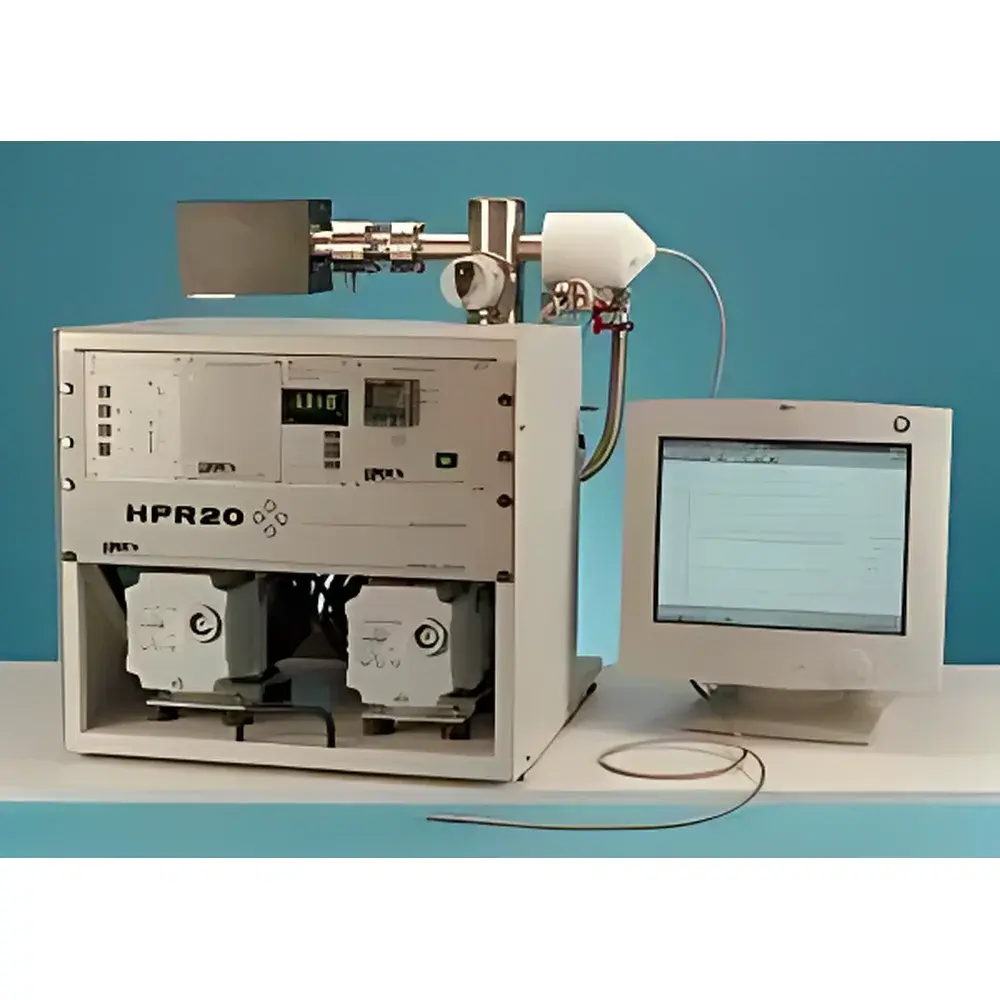
Hiden HPR20 Research-Grade Online Quadrupole Mass Spectrometer
| Brand | Hiden |
|---|---|
| Origin | United Kingdom |
| Model | HPR20 |
| Mass Range | up to 510 amu |
| Detection Limit | down to 5 ppb |
| Response Time | < 500 ms |
| Sample Flow Rate | 1–20 cm³/min |
| Sampling Pressure Range | 10 mbar to 2 bar (optional high-pressure inlet up to 30 bar) |
| Capillary Temperature | up to 200 °C |
| Ion Source Pressure Control | Automatic via integrated mass flow controller |
| Cryogenic Trap | Liquid nitrogen-cooled cold finger for condensable species |
| Ionization | Soft electron ionization (EI) with adjustable electron energy |
| Long-Term Stability | ±0.5% peak height drift over 24 h |
| Communication Interfaces | RS232, RS485, Ethernet |
| Software | MASsoft Professional v6.x with GLP-compliant audit trail and calibration management |
Overview
The Hiden HPR20 is a research-grade quadrupole mass spectrometer engineered for real-time, quantitative analysis of gas-phase species in dynamic process environments. Based on robust single-focusing quadrupole mass filtering technology, the HPR20 delivers high mass resolution (unit mass resolution at 10% valley definition), precise mass calibration stability, and low-noise detection across its full mass range of 1–510 amu. Its core architecture integrates a heated quartz inert capillary (QIC) inlet system, enabling direct, contamination-free sampling from reactors, exhaust streams, vacuum chambers, or ambient atmospheres without intermediate gas conditioning. Unlike benchtop GC-MS systems requiring discrete injection, the HPR20 operates continuously—making it ideal for kinetic studies, transient reaction monitoring, and closed-loop process control where sub-second temporal resolution is critical.
Key Features
- Heated quartz inert capillary (QIC) inlet, temperature-controlled up to 200 °C, minimizing surface adsorption and condensation of reactive or polar vapors
- Sub-500 ms system response time from sample entry to spectral acquisition, achieved through optimized ion optics and fast-scanning quadrupole electronics
- Integrated automatic mass flow controller ensuring stable ion source pressure across variable upstream sampling conditions (10 mbar – 2 bar standard; optional 30 bar high-pressure interface)
- Liquid nitrogen-cooled cryogenic trap positioned upstream of the ion source, selectively removing water, solvents, and other condensables to extend filament life and improve signal-to-noise ratio for trace analytes
- Soft electron ionization (EI) with tunable electron energy (1–100 eV), supporting both structural identification and gentle fragmentation for labile organics, including metal-organic precursors used in CVD/MOCVD
- Long-term intensity stability (< ±0.5% peak height drift over 24 hours) validated under continuous operation, essential for unattended multi-day experiments and regulatory-compliant data logging
- Fully programmable scanning modes: peak jump, step-scan, full-spectrum sweep, and triggered acquisition synchronized with external process events (e.g., reactor temperature ramps or valve actuations)
Sample Compatibility & Compliance
The HPR20 accommodates a broad spectrum of gas and vapor matrices—including corrosive etchants (e.g., Cl₂, NF₃), reactive metal-organic compounds (e.g., TMAl, DEZ), catalytic effluents, fermentation off-gases, and environmental air samples—without degradation of sensitivity or calibration integrity. All wetted surfaces are constructed from electropolished stainless steel and fused quartz, ensuring chemical inertness and ultra-low memory effects. The system complies with ISO/IEC 17025 requirements for analytical instrument validation and supports IQ/OQ/PQ documentation packages. When operated with MASsoft Professional software, it meets FDA 21 CFR Part 11 criteria for electronic records and signatures, including role-based access control, full audit trail, electronic signature workflows, and secure calibration history archiving.
Software & Data Management
MASsoft Professional v6.x serves as the native control, acquisition, and quantification platform for the HPR20. It provides real-time spectral visualization, multi-component peak integration, internal standard normalization, and stoichiometric ratio tracking across time-series datasets. The software supports automated calibration routines using certified gas standards, dynamic background subtraction, and library-assisted peak identification (NIST/EPA/NIOSH spectral databases). Raw data files (.mas) are stored in a structured binary format with embedded metadata (timestamp, instrument configuration, operator ID, calibration status), ensuring traceability and interoperability with LIMS and MES platforms via OPC UA or CSV export. Batch processing scripts enable post-acquisition recalibration, isotope ratio correction, and reaction rate derivation using built-in kinetic modeling tools.
Applications
- Chemical vapor deposition (CVD) and metal-organic CVD process optimization, including precursor decomposition kinetics and byproduct evolution profiling
- Catalytic reaction monitoring in fixed-bed or fluidized-bed reactors, with simultaneous detection of reactants, intermediates, and products at ppm–ppb levels
- Thermal desorption and evolved gas analysis (EGA) coupled to TGA or DSC instruments for mechanistic decomposition pathway elucidation
- Environmental emission monitoring—real-time tracking of VOCs, NOₓ, SO₂, and halogenated compounds in stack gases or ambient air
- Hydrogen safety analytics in fuel cell and electrolyzer R&D, including trace O₂, CO, and hydrocarbon impurity detection
- Plasma process diagnostics, measuring radical densities (e.g., O, H, N), excited species, and stable end-products in low-temperature plasma reactors
FAQ
What is the maximum operating pressure for the standard HPR20 sampling interface?
The standard QIC inlet supports continuous sampling from 10 mbar up to 2 bar absolute pressure. A high-pressure option extends this range to 30 bar with reinforced sealing and pressure-regulated differential pumping.
Can the HPR20 quantify isotopic ratios, such as ¹²CO₂ vs. ¹³CO₂, with sufficient precision?
Yes—the HPR20 achieves mass-resolved detection at unit mass resolution with <0.1% mass scale drift over 8 hours, enabling reproducible isotopic ratio measurements when combined with internal standard referencing and detector linearity correction.
Is MASsoft compatible with Windows 11 and 64-bit enterprise IT environments?
MASsoft Professional v6.4+ is fully certified for Windows 10/11 (64-bit), supports domain authentication, TLS 1.2+ encrypted communications, and integrates with Active Directory for centralized user management.
How is calibration maintained during extended unattended operation?
The system supports scheduled auto-calibration using integrated reference gas pulses; calibration validity is continuously verified via internal diagnostic peaks and logged with timestamped uncertainty estimates per ASTM E1947.
Does the HPR20 meet explosion-proof requirements for installation in hazardous areas?
The base HPR20 is rated for laboratory use (IEC 61010-1). For Zone 1/2 installations, Hiden offers ATEX-certified variants with intrinsically safe sampling interfaces and purged enclosures—consult factory for model-specific certification documentation.





