
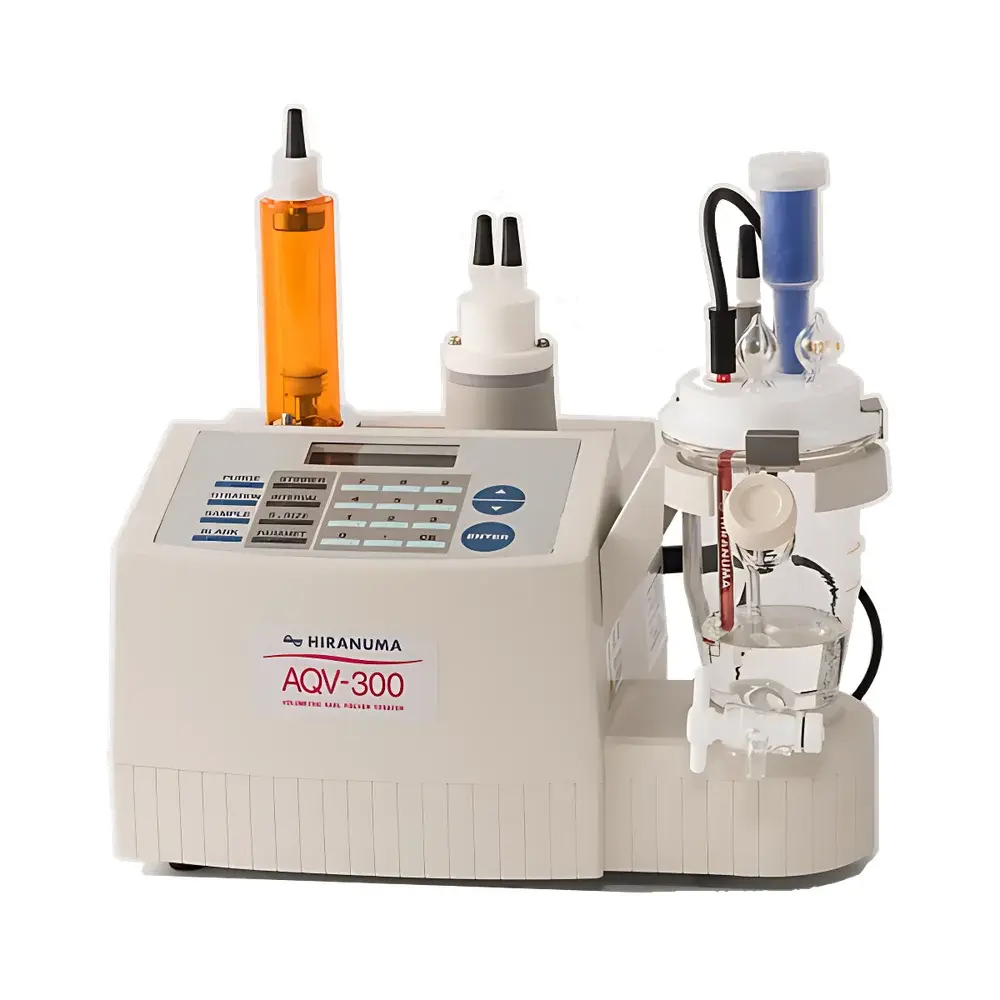
Hiranuma AQV-300 Karl Fischer Volumetric Moisture Titrator
| Brand | Hiranuma |
|---|---|
| Origin | Japan |
| Model | AQV-300 |
| Titration Method | Fully Automatic Volumetric Karl Fischer Titration |
| Instrument Type | Volumetric Karl Fischer Moisture Analyzer |
| Dimensions (W × D) | 310 mm × 270 mm |
| Interface | Dual RS-232C ports |
| Compliance | Designed for GLP-compliant environments |
| Software Integration | Compatible with standard PC-based data acquisition and balance synchronization |
Overview
The Hiranuma AQV-300 is a compact, fully automatic volumetric Karl Fischer titrator engineered for precise and reproducible moisture determination in solid, liquid, and gaseous samples across pharmaceutical, chemical, polymer, and food quality control laboratories. It operates on the fundamental electrochemical principle of volumetric Karl Fischer titration—where iodine generated in situ via coulometric or generator-cell-assisted reaction quantitatively oxidizes water in the sample matrix. In the AQV-300, iodine is delivered via a precisely metered reagent burette, enabling stoichiometric quantification of water content based on the I₂ + SO₂ + H₂O → 2HI + SO₃ reaction equilibrium. The instrument’s design prioritizes operational reliability under routine QC workflows, with built-in endpoint detection via dual-platinum electrode polarization monitoring and adaptive drift compensation algorithms to ensure accuracy even with low-moisture or high-drift samples.
Key Features
- Compact footprint (310 mm W × 270 mm D), optimized for benchtop integration in space-constrained analytical labs or production QC stations.
- Intuitive membrane keypad interface with dedicated execution, setup, and numeric keys—minimizing operator training time and reducing input error risk.
- Predefined measurement condition files allow rapid method recall and parameter switching (e.g., solvent type, titrant concentration, endpoint threshold, stirring speed) without manual reconfiguration.
- Dual RS-232C communication ports support simultaneous connection to an analytical balance (for automatic sample weight import) and a host PC (for real-time data logging, report generation, and remote diagnostics).
- Self-diagnostic routines verify reagent delivery integrity, electrode response stability, and system seal integrity prior to each titration cycle—enhancing assay robustness and traceability.
Sample Compatibility & Compliance
The AQV-300 accommodates a broad range of sample types—including hygroscopic powders, viscous oils, solvents, pharmaceutical actives, excipients, and packaged materials—when used with appropriate sample preparation accessories (e.g., oven samplers, gas extraction kits, or homogenization adapters). Its volumetric methodology complies with ASTM E203, ISO 760, and USP , supporting validated moisture testing protocols required for regulatory submissions. The instrument architecture supports audit-ready operation: all method parameters, raw titration curves, endpoint timestamps, and user IDs are timestamped and stored internally. When integrated with compliant PC software, it meets FDA 21 CFR Part 11 requirements for electronic records and signatures—including role-based access control, electronic audit trails, and non-erasable data archiving.
Software & Data Management
While the AQV-300 operates autonomously via its embedded firmware, its dual RS-232C interface enables seamless interoperability with third-party laboratory data management systems (LIMS) and chromatography data systems (CDS). Raw titration data—including volume consumed, mV response vs. time, calculated water content (ppm or % w/w), and statistical summaries (n=3 RSD)—are transmitted in ASCII format for direct ingestion into Excel, LabWare, or custom QA databases. Optional Hiranuma-provided PC software provides method template libraries, calibration curve management, batch reporting (PDF/CSV), and GLP-compliant electronic signature capture. All data exports include full metadata: instrument ID, operator ID, date/time stamp, environmental temperature/humidity (if logged externally), and reagent lot traceability.
Applications
- Pharmaceutical QC: Water content verification of APIs, lyophilized products, and tablet coatings per ICH Q5C stability guidelines.
- Chemical manufacturing: Moisture control in solvents (e.g., THF, DMF), catalysts, and monomers where residual water impacts polymerization kinetics.
- Electronics materials: Quantification of trace moisture in solder pastes, encapsulants, and dielectric fluids affecting dielectric strength and shelf life.
- Food & feed analysis: Compliance testing for moisture limits in powdered dairy, starches, and pet food per AOAC 992.13 and ISO 15512.
- Research labs: Method development for novel Karl Fischer reagents, solvent compatibility studies, and kinetic endpoint modeling.
FAQ
What is the difference between volumetric and coulometric Karl Fischer titration?
Volumetric KF uses a standardized iodine-containing titrant delivered via burette; it is optimal for samples containing >100 ppm water. Coulometric KF generates iodine electrolytically and is preferred for ultra-trace analysis (<10 ppm). The AQV-300 implements the volumetric approach.
Can the AQV-300 be validated for GMP environments?
Yes—the instrument supports IQ/OQ documentation templates, and its firmware logs all critical events with immutable timestamps. When paired with compliant PC software, it satisfies 21 CFR Part 11 and EU Annex 11 requirements.
Is oven heating integrated into the AQV-300?
No—the base unit does not include a built-in oven; however, it is compatible with external Karl Fischer oven samplers (e.g., Hiranuma KF-210) via RS-232 handshake for automated moisture release from thermally labile solids.
What reagents are compatible with the AQV-300?
Standard one-component and two-component volumetric KF reagents (e.g., Hydranal–Composite 5, Aquastar–R, or Metrohm KF Reagent Hydranal) may be used, provided they meet the manufacturer’s viscosity and conductivity specifications for stable burette delivery.
Does the AQV-300 support multi-sample sequential analysis?
It operates in single-sample mode per run; however, when connected to an autosampler (e.g., Hiranuma AS-300, sold separately), up to 30 samples can be processed unattended with full weight synchronization and result auto-export.
Related Products






