
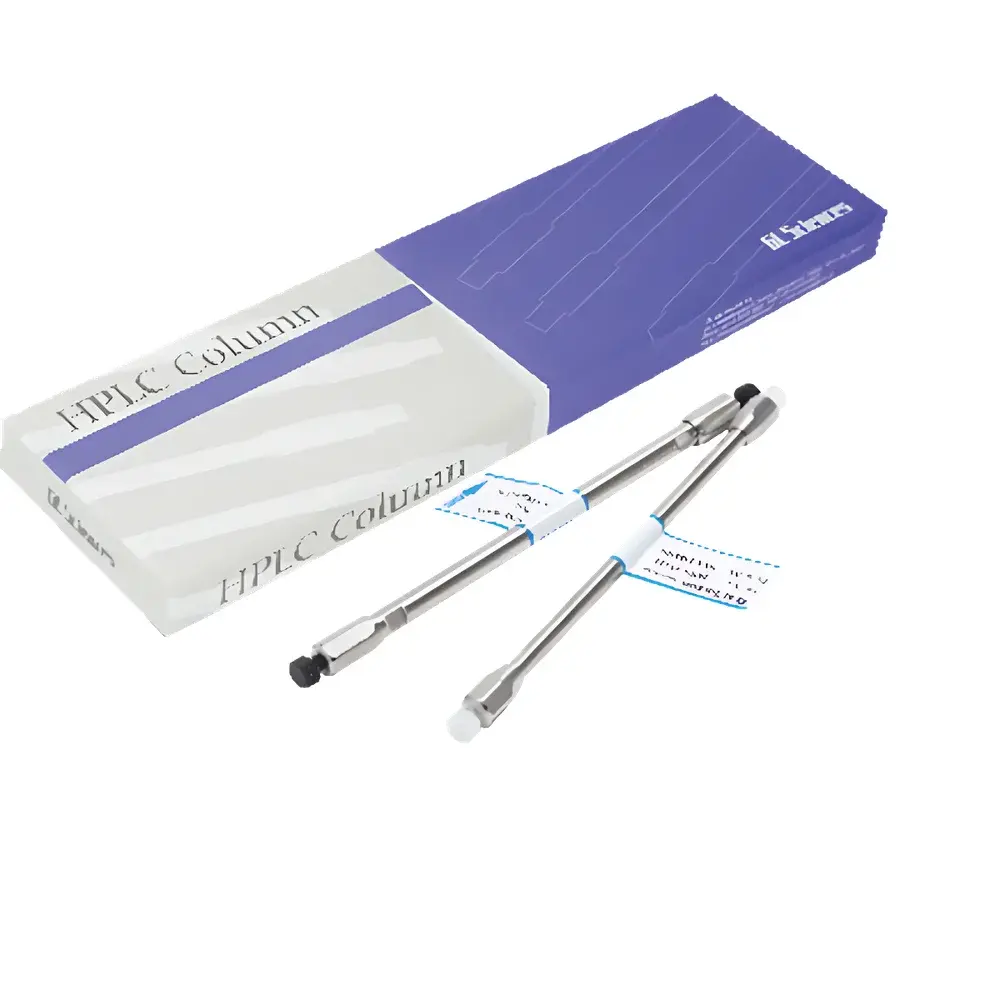
Hitachi LaChrom II and GL Sciences C18 Reversed-Phase HPLC Columns
| Brand | Hitachi |
|---|---|
| Origin | Japan |
| Manufacturer | GL Sciences Inc. & Hitachi High-Tech Corporation |
| Column Type | Reversed-Phase C18, C8, NH₂ |
| Packing Material | Fully Porous Silica-Based Particles (1.9–5 µm) |
| Endcapped | Yes |
| Pore Size | 100 Å (standard), 120 Å (wide-pore variants available) |
| Surface Area | ~300 m²/g |
| Carbon Load | 12–18% (C18), 8–12% (C8), 4–6% (NH₂) |
| pH Stability | 1.5–10.0 (C18/C8), 2.0–8.5 (NH₂) |
| Max. Pressure | 600 bar |
| Temperature Range | 5–60 °C |
| Dimensions | 50–250 mm × 2.1–4.6 mm ID |
| Particle Size Options | 1.9, 3, and 5 µm |
Overview
Hitachi LaChrom II and GL Sciences C18 reversed-phase high-performance liquid chromatography (HPLC) columns represent a collaborative engineering effort between Hitachi High-Tech Corporation and GL Sciences Inc., combining Japanese precision manufacturing with decades of stationary phase development expertise. These columns operate on the principle of partition chromatography, where analyte separation is governed by differential hydrophobic interactions between solutes and the chemically bonded alkyl (C18, C8) or amino (NH₂) functional groups grafted onto high-purity, spherical silica particles. Engineered for reproducible retention time stability and high peak symmetry across diverse mobile phase compositions—including aqueous/organic gradients, low-pH acidic buffers, and basic modifiers—the LaChrom II series delivers consistent theoretical plate counts exceeding 120,000 plates/m under standard test conditions (e.g., uracil, caffeine, benzoic acid). Each column batch undergoes rigorous QC testing per ISO/IEC 17025-accredited protocols, including backpressure verification, asymmetry factor (As) measurement at 10% peak height, and resolution testing against certified reference mixtures.
Key Features
- High-density, sterically protected C18 bonding (12–18% carbon load) ensures robust retention and reduced silanol activity—critical for basic compound analysis without ion-pairing reagents.
- Advanced endcapping technology minimizes residual silanol exposure, delivering symmetrical peak shapes (As = 0.9–1.2) for both acidic and basic pharmaceuticals, peptides, and small-molecule metabolites.
- Multiple particle size options (1.9 µm for UHPLC, 3 µm for high-resolution HPLC, 5 µm for routine QC applications) enable method scalability across instrument platforms—from conventional HPLC to sub-2-µm-capable systems.
- Batch-certified lot documentation includes full chromatographic performance data (efficiency, selectivity α, resolution Rs), pore size distribution (N₂ adsorption BET), and metal impurity profiling (ICP-MS verified <10 ppm Fe, Al, Ni).
- Extended pH stability range (1.5–10.0 for C18/C8; 2.0–8.5 for NH₂) supports method development flexibility in method transfer and forced degradation studies per ICH Q1/Q2 guidelines.
Sample Compatibility & Compliance
These columns are validated for use with common HPLC and UHPLC systems from Agilent, Waters, Shimadzu, Thermo Fisher, and Hitachi Prima series. They accommodate a broad spectrum of sample matrices: biological fluids (plasma, urine), environmental extracts (PAHs, pesticides), food additives (sugars, preservatives), and synthetic intermediates. All LaChrom II and GL Sciences C18 columns comply with United States Pharmacopeia (USP) classification standards L1 (octadecylsilane), L7 (octylsilane), L8 (aminopropylsilane), L10 (cyano), and L31 (polymeric C18). Lot-specific certificates confirm adherence to ISO/IEC 17025 calibration traceability, supporting GLP and GMP-regulated environments. Column lifetime validation data (≥2,000 injections under typical gradient conditions) is provided with each shipment for audit readiness.
Software & Data Management
Column performance metadata—including lot number, manufacturing date, QC chromatograms, and retention time deviation logs—is digitally archived and accessible via Hitachi’s ColumnTrack™ portal (login required). This system supports 21 CFR Part 11-compliant electronic records: user authentication, audit trails for column usage history, and exportable PDF certificates suitable for regulatory submissions. Integration with Chromatography Data Systems (CDS) such as OpenLab CDS, Empower, and LabSolutions is achieved through standardized .csv and .xml metadata exchange protocols. Batch-level traceability enables retrospective root-cause analysis during OOS investigations, aligning with FDA and EMA expectations for analytical instrument qualification (AIQ) and column management SOPs.
Applications
- Pharmaceutical QC release testing (API purity, related substances, dissolution profiles) per USP and EP 2.2.46.
- Biopharmaceutical characterization: peptide mapping, monoclonal antibody subunit analysis, and glycan profiling using NH₂ columns in HILIC mode.
- Environmental monitoring: multi-residue pesticide screening in soil/water extracts using C18 columns with LC-MS/MS detection.
- Clinical research: quantification of neurotransmitters, steroids, and vitamin D metabolites in serum via isocratic or shallow-gradient methods.
- Food safety: mycotoxin (aflatoxin B1, ochratoxin A) detection and confirmation in cereals and dairy products.
FAQ
Are these columns compatible with 100% aqueous mobile phases?
Yes—LaChrom II C18 columns feature hydrophilic surface modification that prevents phase collapse during prolonged aqueous elution, enabling reliable retention of polar compounds without organic solvent priming.
What is the recommended storage solvent for long-term column preservation?
Store in ≥80% organic solvent (acetonitrile or methanol); avoid pure water or buffer-only storage. For NH₂ columns, use chloroform:methanol (95:5) to prevent amine oxidation.
Do you provide column regeneration protocols for performance recovery?
Yes—validated cleaning procedures for protein fouling, lipid buildup, and salt precipitation are included in the Technical Support Manual (Revision 4.2, 2024), aligned with ASTM D7854-21 guidance.
Is method transfer support available between LaChrom II and legacy LaChrom columns?
Yes—Hitachi provides column equivalency reports and gradient adjustment calculators based on kinetic plot analysis and retention modeling (k vs. log P correlations).
Can these columns be used under GMP-regulated conditions?
Absolutely—each column ships with a Certificate of Analysis (CoA) containing full QC data, manufacturing controls documentation, and ISO/IEC 17025 accreditation statements for full regulatory defensibility.






